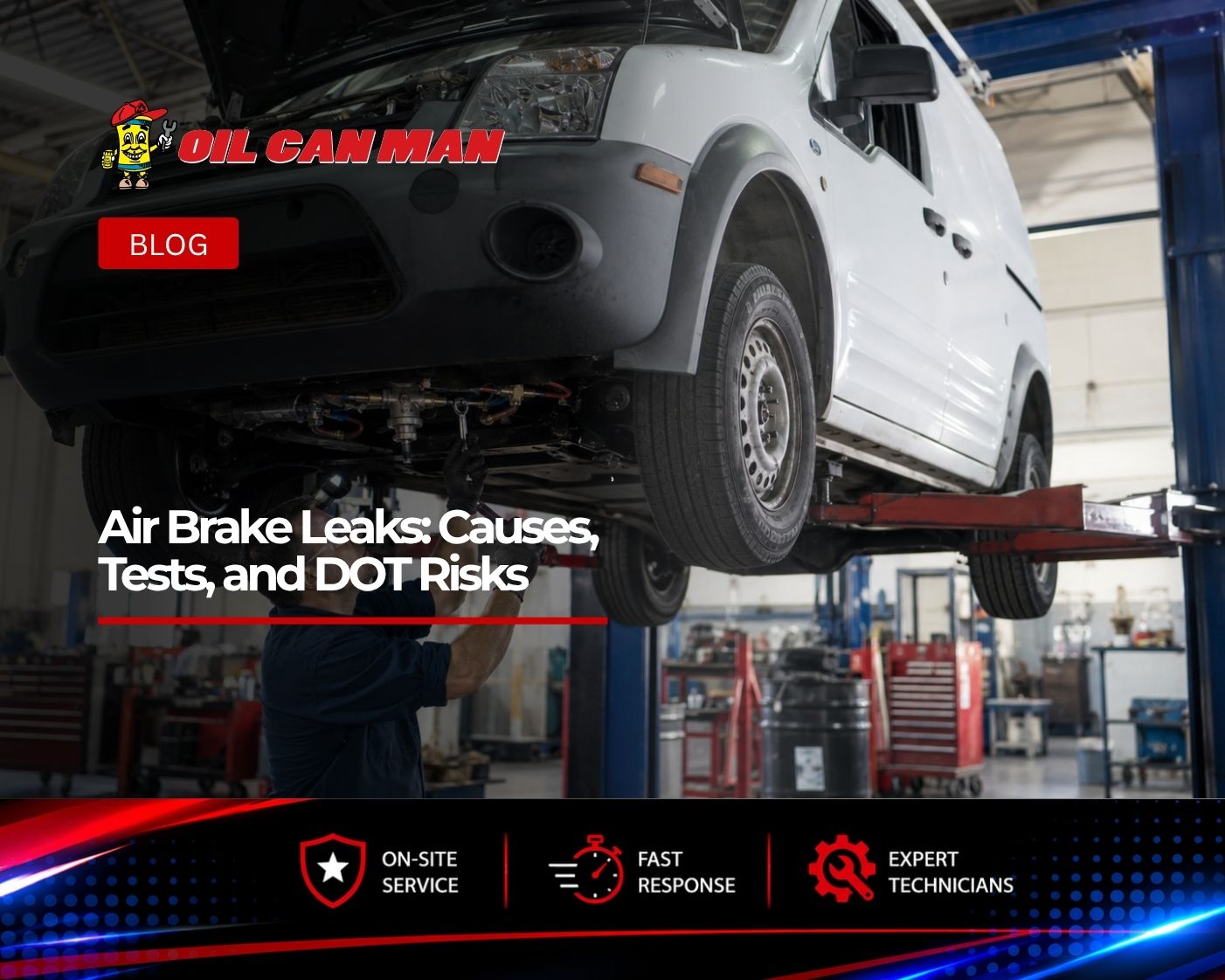
A Hissing Brake System Can Become a Fleet Availability Problem
An air brake leak may begin as an occasional hiss, slower pressure buildup, or unexplained pressure drop. For fleet managers, that warning matters because the air system supports service braking on tractors, straight trucks, and many commercial trailers. A developing fault can turn a scheduled route into an unexpected repair decision.
Oil Can Man provides mobile fleet maintenance and commercial brake repair throughout South Florida, allowing appropriate diagnostic and repair work to be performed closer to where fleet vehicles operate. Oil Can Man’s current production site confirms mobile brake service for trucks and trailers as well as facility-based repair when the job requires it.
What Causes an Air Brake Leak?
A leak can originate in several parts of the system. Finding the source matters because replacing a hose will not solve a leaking valve, and tightening a fitting will not repair a damaged brake chamber.
Damaged Hoses and Air Lines
Commercial trucks expose air lines to heat, movement, vibration, road debris, and contact with surrounding components. Hoses can become abraded, cracked, restricted, poorly supported, or damaged deeply enough to affect their integrity.
Federal requirements state that brake tubing and hose connections must be installed to avoid leaks, constrictions, and other conditions that adversely affect braking performance. CVSA also identifies significant hose damage, swelling, improper joining, and certain audible leaks as inspection concerns.
Drivers should report visible chafing or a new hissing sound rather than attempting roadside air-line repairs.
Loose Fittings and Gladhand Seals
Connections at fittings and tractor-trailer couplers can develop leakage from wear, contamination, damaged seals, improper installation, or movement.
A trailer air leak around the service or emergency connection deserves inspection before the combination returns to normal operation. Oil Can Man currently lists trailer brake and air-system work within its commercial trailer repair services.
CVSA’s April 2026 inspection bulletin clarifies that an audible leak at an air-brake fitting can be a violation, and certain leaks that cannot be corrected by tightening are treated as out-of-service conditions. Regardless of fitting type, CVSA directs inspectors to conduct an air-loss test when an audible brake-system leak is detected.
Leaking Brake Chambers
A brake chamber leak can occur when the chamber, diaphragm, connections, or related components deteriorate. Because the chamber converts air pressure into mechanical braking force, this is not a component drivers should disassemble or attempt to repair without proper qualifications.
A brake chamber leak also needs to be evaluated in the context of the complete braking system. CVSA provides specific inspector guidance for chamber leaks and applies its brake-related out-of-service criteria according to the condition found and the vehicle’s overall brake status.
Faulty Valves, Reservoirs, and Related Components
Relay valves, protection valves, drain valves, reservoirs, and other pneumatic components can also leak. A fault in one section may make the sound difficult to locate because air travels through interconnected circuits.
Moisture and contamination can interfere with pneumatic components. Freezing becomes a greater concern for South Florida fleets when vehicles travel into cold climates. These conditions make proper air brake system troubleshooting more useful than assuming every pressure problem is caused by a hose.
Compressor or Air-Supply Problems
A compressor problem is not necessarily a leak, but inadequate air-pressure recovery can produce similar operational symptoms or make an existing leak more serious.
Federal in-use inspection standards address compressor buildup as well as overall system integrity. This is why technicians consider pressure buildup, governor operation, leakage, warning devices, and individual components together during diagnosis.
If repeated pressure loss is affecting vehicle availability, Oil Can Man’s mobile fleet brake service can evaluate the concern and determine whether appropriate work can be completed at the fleet location or requires facility-based repair.
Warning Signs Drivers Should Report
Drivers do not need to disassemble brake components to provide useful diagnostic information.
Report symptoms such as:
- A new or persistent hissing sound
- Air pressure dropping faster than normal
- Unusually slow air-pressure buildup
- A low-air warning during operation
- Frequent compressor cycling
- A noticeable leak near trailer connections
- Visible air-line abrasion or damage
- Brake-system behavior that changes after coupling a trailer
Federal rules require covered air-braked commercial vehicles to have a pressure gauge and low-pressure warning system. A low-air warning therefore should not be treated as a nuisance indicator that can simply be ignored.
A suspected semi truck air brake leak should be documented with the vehicle number, trailer number if applicable, when the symptom occurs, dashboard pressure readings, weather conditions, and whether the leak changes when the service brakes are applied.
What Does an Air Pressure Loss Test Check?
A pressure-loss test measures how quickly stored air pressure falls under controlled conditions. It helps distinguish minor system loss from leakage that exceeds the applicable inspection standard.
Under the federal in-use inspection standard in 49 CFR 570.57, with the engine stopped and service brakes released, pressure loss must not exceed 2 psi per minute for a single vehicle or 3 psi per minute for a combination vehicle. With the service brakes fully applied, the limits are 3 psi per minute for a single vehicle and 4 psi per minute for a combination, with an additional allowance for additional towed vehicles.
Fleet operators sometimes call this a DOT air leak test, but it is important not to treat every inspection procedure as interchangeable. Roadside inspectors apply the current federal regulations together with CVSA’s North American Standard Out-of-Service Criteria. CVSA’s current Operation Airbrake procedure specifically includes low-air warning checks and an air-loss-rate test when a leak is detected.
Testing should be performed using the correct procedure for the vehicle and inspection context rather than improvised roadside methods.
When Should the Vehicle Stay Out of Service?
Drivers and fleet managers should not make continued-operation decisions based only on how loud a leak sounds.
Stop and obtain qualified assistance when the vehicle cannot maintain adequate air pressure, the low-air warning activates unexpectedly, braking behavior changes, a hose or component is visibly compromised, or there is uncertainty about whether adequate braking capability remains.
CVSA’s 2026 guidance makes an important distinction: not every audible fitting leak automatically creates the same out-of-service condition, but an audible air leak requires an air-loss test during a North American Standard Inspection. If the vehicle fails that test, it is placed out of service. Certain hose, tubing, and non-tightenable leak conditions can independently meet out-of-service criteria.
That distinction is important when discussing DOT air leak test concerns. An inspection violation and an out-of-service condition are related concepts, but they are not always identical.
Oil Can Man also provides on-site DOT inspection services for commercial vehicles in South Florida. These services can support inspection readiness, but the fleet operator remains responsible for applicable regulatory requirements.
Mobile Brake Service or Repair Facility?
A semi truck air brake leak does not automatically mean the vehicle must be towed to a repair facility.
Mobile service may be appropriate when the vehicle is safely parked and the fault involves accessible hoses, connections, trailer air-system components, chambers, or other repairs that can be diagnosed and serviced safely at the location. Oil Can Man’s production site currently confirms mobile brake repair and trailer service across its South Florida service area.
Facility service may make more sense when diagnosis requires extensive disassembly, specialized equipment, multiple interacting brake faults, or work that cannot be completed safely in the field.
The goal is not to force every repair into a mobile model. It is to choose the service environment that fits the actual condition.
The Leak Appears Only With a Trailer
Consider a South Florida logistics fleet where a tractor maintains normal air pressure when operating alone but develops an audible hiss and faster pressure loss after a particular trailer is connected.
That pattern gives the maintenance team an important diagnostic clue. The tractor’s compressor should not immediately be blamed. The technician can instead investigate the trailer air leak, gladhands, seals, hoses, chambers, valves, and related trailer circuits.
If the trailer is safely parked at the fleet yard, mobile diagnosis may avoid unnecessary towing. If testing reveals extensive brake-system damage, facility-based work may be the better option.
This type of symptom-based air brake system troubleshooting helps fleets address the actual defect rather than repeatedly replacing unrelated components.
Build Air-System Checks Into Preventive Maintenance
Preventive inspections should include air hoses, tubing, connections, visible chamber condition, trailer couplers, pressure behavior, warning devices, and driver-reported symptoms.
Mobile fleet maintenance can also help businesses coordinate brake inspections with other scheduled fleet work instead of waiting for an air brake leak to appear during a route or roadside inspection.
Drivers should be encouraged to report changes early. A new hiss, slower buildup, or recurring low-air warning gives the maintenance team more time to diagnose the system before the issue becomes an unplanned vehicle-down event.
Address Air Leaks Before the Next Route
An air-system problem affects more than one brake component. It can affect whether a tractor, straight truck, or trailer is suitable for its next assignment.
Oil Can Man provides commercial brake repair, trailer service, preventive fleet maintenance, and mobile service throughout its verified South Florida service area. The current production website lists (954) 764-8117 as its primary service number and confirms 24/7 mobile service availability without specifying a guaranteed response time.
Call Oil Can Man at (954) 764-8117 to describe the air-pressure symptoms, vehicle or trailer involved, and where the equipment is located so the team can discuss the appropriate mobile or facility-based repair option.
FAQs
Is it safe to drive a truck with an air brake leak?
It depends on the condition, but unexplained air loss should never be ignored. If pressure cannot be maintained, a low-air warning activates unexpectedly, braking performance changes, or significant hose or component damage is visible, the vehicle should be professionally evaluated before continued operation.
What commonly causes a semi truck air brake leak?
Possible sources include air hoses, fittings, gladhands, seals, brake chambers, valves, reservoirs, and related pneumatic components. Pressure-recovery problems can also involve the compressor or governor, which is why diagnosis should evaluate the complete air system rather than one symptom.
Can a mobile mechanic repair a trailer air leak?
Some accessible trailer air-system faults may be suitable for mobile service when the trailer is safely parked and the repair can be completed correctly in the field. Oil Can Man currently lists mobile trailer repairs involving brakes and air systems among its services.
Can an audible air leak cause a DOT violation?
Yes. Current CVSA guidance states that an audible air-brake-system leak can be documented as a violation and requires an air-loss test during a North American Standard Inspection. Depending on the leak location, component condition, and test result, the vehicle may also meet out-of-service criteria.