Why a Stuck Roll-Up Door Becomes a Fleet Problem
When a box truck roll-up door won’t open, the engine may run perfectly, and the vehicle may still be unable to complete its assigned work. Delivery crews cannot reach cargo, technicians may lose access to equipment, and route schedules can be interrupted until the door can be opened, closed, and secured correctly.
For South Florida businesses operating box trucks, trailers, and commercial vehicles, Oil Can Man provides mobile and facility-based fleet repair from its Fort Lauderdale operation. Its current service offering specifically includes rear roll-up door repair and replacement for commercial fleets.
A stuck, unusually heavy, crooked, or difficult-to-latch door can result from rollers, tracks, cables, counterbalance springs, panels, hinges, latches, corrosion, or impact damage. The symptom provides a starting point, but it does not confirm which component has failed.
1. Worn or Damaged Rollers
Rollers guide the door through the vertical and horizontal tracks. As rollers wear, loosen, bind, or become damaged, the door may:
- Move roughly
- Hesitate at the same point
- Make scraping or grinding sounds
- Shift sideways
- Become harder to raise or lower
TODCO recommends checking door movement and having worn or damaged rollers and hinges replaced when necessary. If the door remains difficult to move, its guidance calls for inspection by a trained service person rather than continued forcing of the door. Review TODCO’s roll-up door owner guidance
Worn rollers are a common reason a fleet may need box truck roll-up door repair, but track condition and door alignment should be considered at the same time.
2. Bent, Damaged, or Obstructed Tracks
A roller cannot travel smoothly if the track is bent, distorted, contaminated, or affected by impact damage.
A roll-up door stuck at approximately the same height each time may indicate a localized track, roller, hinge, or panel problem. Visible signs fleet personnel can report include:
- A dented track
- Scraping marks
- A roller sitting unusually in the track
- A door that shifts to one side
- Debris in an accessible track area
Drivers should not attempt to straighten major track damage while the door is under load. Forcing a damaged door can compound the problem by affecting rollers, panels, hinges, or cables.
Utilimaster’s truck-body service guidance includes checking whether the rear door remains centered in the opening, whether fasteners are loose, and whether the door opens and closes correctly. See Utilimaster roll-up door inspection guidance
3. Frayed, Damaged, or Uneven Cables
Door cables work with the counterbalance assembly to control door movement. A cable problem can cause the door to become crooked, unusually heavy, uneven, or difficult to move.
Safe observations may include:
- Visible fraying
- A cable that appears slack
- Uneven door movement
- One side rising before the other
- A door hanging at an angle
This is not an appropriate DIY repair.
TODCO specifically advises having frayed, damaged, or worn cables replaced by trained service personnel and directs trained personnel to handle cable-drum adjustment.
Professional roll-up door cable repair is important because the cable system works with a spring-loaded counterbalance system.
4. Counterbalance Spring Problems
A counterbalance spring reduces the effort required to move a heavy commercial roll-up door. When spring assistance is lost, the door may suddenly feel much heavier than normal.
A truck door spring failure may present as:
- A significant increase in door weight
- A door that will not stay balanced
- Abrupt changes in opening behavior
- Difficulty raising the door
Spring work is one of the clearest areas where fleet personnel should stop at observation.
TODCO warns that a roll-up door is a heavy moving object assisted by a spring under high tension and states that a door with a broken counterbalance spring should not be operated. Morgan’s truck-body maintenance manual similarly warns that the spring is under extreme tension and says spring repairs should be performed only by qualified service personnel. Read Morgan’s truck-body roll-up door guidance
If truck door spring failure is suspected, do not compensate by having employees muscle the door open.
Repair Priority Guide
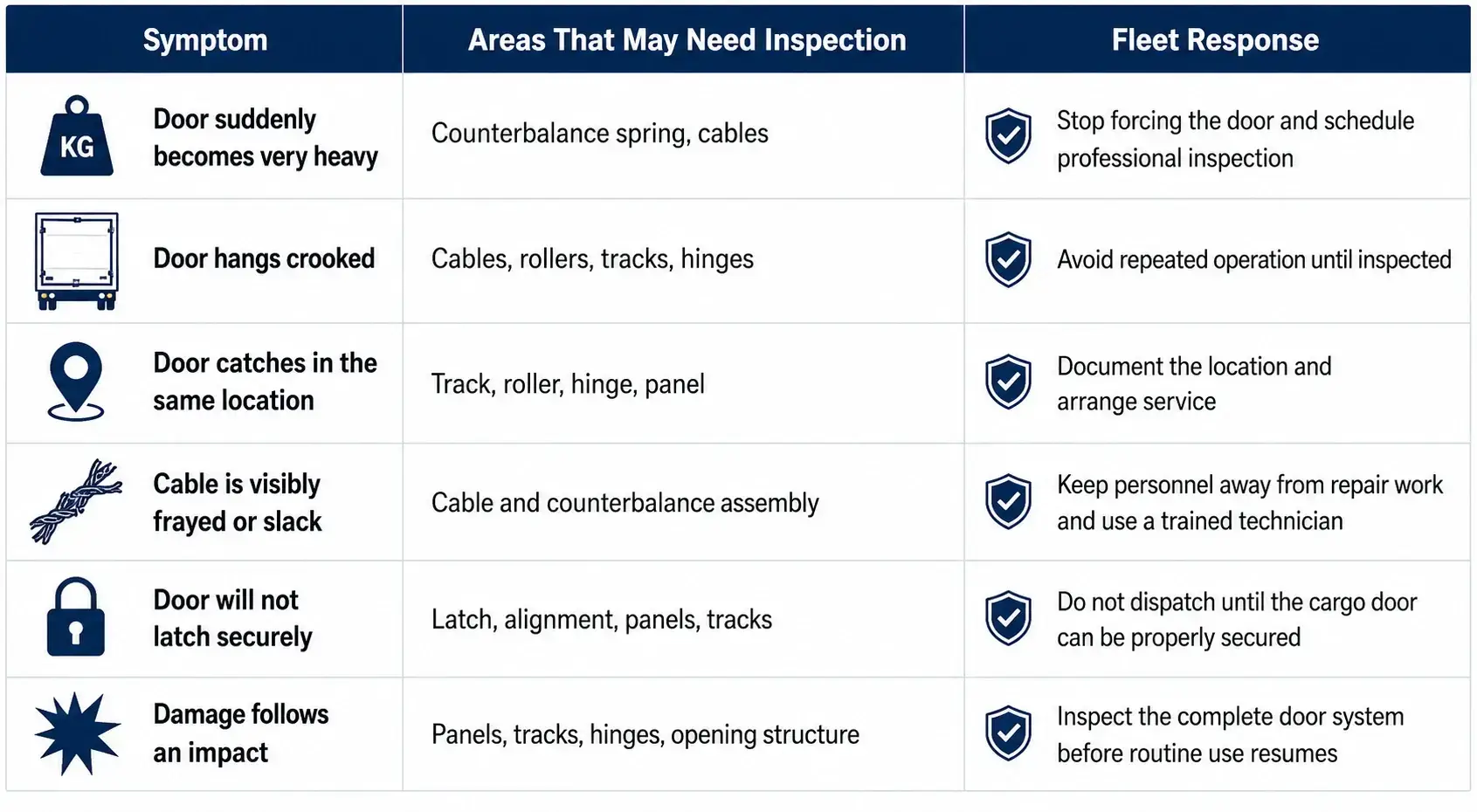
5. Damaged Panels or Hinges
Roll-up doors depend on individual panels and hinges moving together through a curved track.
A bent panel, loose hinge, damaged end hinge, or distorted section can create resistance even when the spring and cables are still functioning.
Watch for:
- Panels no longer lining up
- Gaps between sections
- Visible bows or dents
- Loose hardware
- Scraping between the panel and door opening
Whiting Door cautions that roll-up truck door repair can be dangerous and recommends that people without appropriate experience and training leave repair and installation work to qualified personnel. Review Whiting Door maintenance guidance
Oil Can Man’s current rear roll-up door and floor repair service includes springs, rollers, panels, mobile onsite service, and replacement options for commercial trucks and fleets.
If a box truck door has become heavy, crooked, difficult to move, or unable to latch, Oil Can Man can evaluate the problem and determine whether mobile commercial truck door repair or facility-based service is the better fit.
6. Latch or Lock Problems
Sometimes the door moves normally but will not open because the latch is damaged, binding, misaligned, or no longer releasing correctly.
The opposite problem matters too. A door that opens but cannot be securely latched creates a cargo-security and operating issue.
TODCO advises operators to check lock movement and have worn or damaged locks replaced. It also instructs operators to close and lock the roll-up door before driving the vehicle.
Fleet personnel can safely report whether the handle operates, whether the latch appears aligned, and whether the problem started after impact. Avoid forcing the hardware when the door itself appears crooked or under abnormal load.
7. Impact Damage and Corrosion
Backing into a dock, forklift contact, cargo shifting against the door, or another impact can affect more than the visible panel.
Damage may involve:
- Tracks
- Hinges
- Rollers
- Bottom fixtures
- Latch alignment
- Door panels
- The surrounding opening
Corrosion can also contribute to stiff hardware, deteriorated fasteners, or difficult movement, particularly on commercial vehicles exposed to rain, humidity, outdoor storage, and coastal South Florida conditions.
Oil Can Man already covers corrosion as a broader fleet issue in its existing work-truck corrosion resource, while this article keeps the focus on how corrosion can contribute specifically to roll-up door operation.
Mobile Repair or Shop Repair?
Many accessible roll-up door problems may be suitable for mobile diagnosis and commercial truck door repair, especially when the vehicle is parked at a fleet yard or business location.
Oil Can Man currently advertises mobile on-site roll-up door repairs as well as repair through its Fort Lauderdale facility.
Mobile service may make sense for the following:
- Roller problems
- Door hardware
- Cable or spring service performed by trained personnel
- Panel-related repairs
- Latches
- Inspection and diagnosis
Shop service may make more sense when there is substantial impact damage, structural distortion, extensive panel replacement, or a repair requiring equipment and workspace that are impractical at the vehicle’s location.
Its broader commercial trailer repair service also includes doors, structural and floor work, lights, wiring, brakes, and other commercial trailer repairs.
Hypothetical Fleet Example
Consider a moving company with eight box trucks.
One driver reports that the rear door became unusually heavy near the end of a route. Another employee notices that the door is slightly crooked and one cable appears different from the opposite side.
Rather than forcing the door open for the next morning’s loading schedule, the fleet manager removes that truck from cargo-loading duty, records the symptoms, takes identifying information for the truck and door, and arranges inspection.
If the problem is an accessible door component, mobile repair may be practical. If impact damage has distorted the opening or extensive repair is required, facility service may be more appropriate.
The scenario is hypothetical, but it illustrates the operational decision behind box truck roll-up door repair: protect employees, secure the cargo area, and choose a repair setting based on what actually failed.
Prevent Roll-Up Door Problems From Becoming Route Problems
A preventive door check does not require employees to disassemble the system.
Fleet personnel can regularly report:
- Changes in door weight
- Rough or uneven movement
- Visible cable wear
- Damaged rollers
- Bent tracks
- Loose or damaged hinges
- Panel damage
- Latch problems
- Corrosion
- Damage after loading or dock contact
Morgan recommends daily inspection of pull straps and cables for wear and fraying, while TODCO calls for checks of fasteners, straps, door movement, cable condition, locks, tracks, rollers, and hinges.
Oil Can Man’s updated mobile trailer repair guide can also help fleet managers organize door, electrical, brake, floor, tire, and other trailer-related maintenance around actual fleet operations.
Get a Stuck Box Truck Door Inspected
When a box truck roll-up door won’t open, repeatedly forcing it can turn a manageable door problem into additional damaged components or expose employees to a spring or cable system that needs professional attention.
Oil Can Man provides mobile roll-up door service across its South Florida fleet market and facility-based repairs when the job is better suited to the shop. Its current primary service number is (954) 764-8117, and its Fort Lauderdale facility is listed at 730 NW 7th Street, Fort Lauderdale, FL 33311.
Call Oil Can Man at (954) 764-8117 and describe whether the door is stuck, heavy, crooked, damaged, or unable to latch so the team can discuss the appropriate mobile or facility-based repair approach.
FAQs
Why is my box truck roll-up door suddenly hard to open?
Possible causes include worn rollers, bent tracks, damaged hinges or panels, cable problems, or loss of assistance from the counterbalance spring. A sudden major increase in door weight is a reason to stop forcing the door and have the system inspected.
What should I do when a box truck roll-up door won’t open?
Drivers can document visible damage, unusual door position, cable condition, latch behavior, and when the problem began. They should not adjust the spring, counterbalance assembly, or cables. Manufacturer guidance identifies these as repairs for trained service personnel.
Can a frayed roll-up door cable still be used temporarily?
A frayed or damaged cable should not be treated as normal operating wear. TODCO recommends having worn or damaged cables replaced by trained service personnel. Professional roll-up door cable repair can also determine whether another component contributed to the cable damage.
Can Oil Can Man repair box truck roll-up doors onsite?
Oil Can Man’s current production site lists mobile onsite roll-up door repair for commercial trucks and fleets, along with a Fort Lauderdale facility for work better suited to a shop environment.