Warm A/C Can Be More Than a Refrigerant Problem
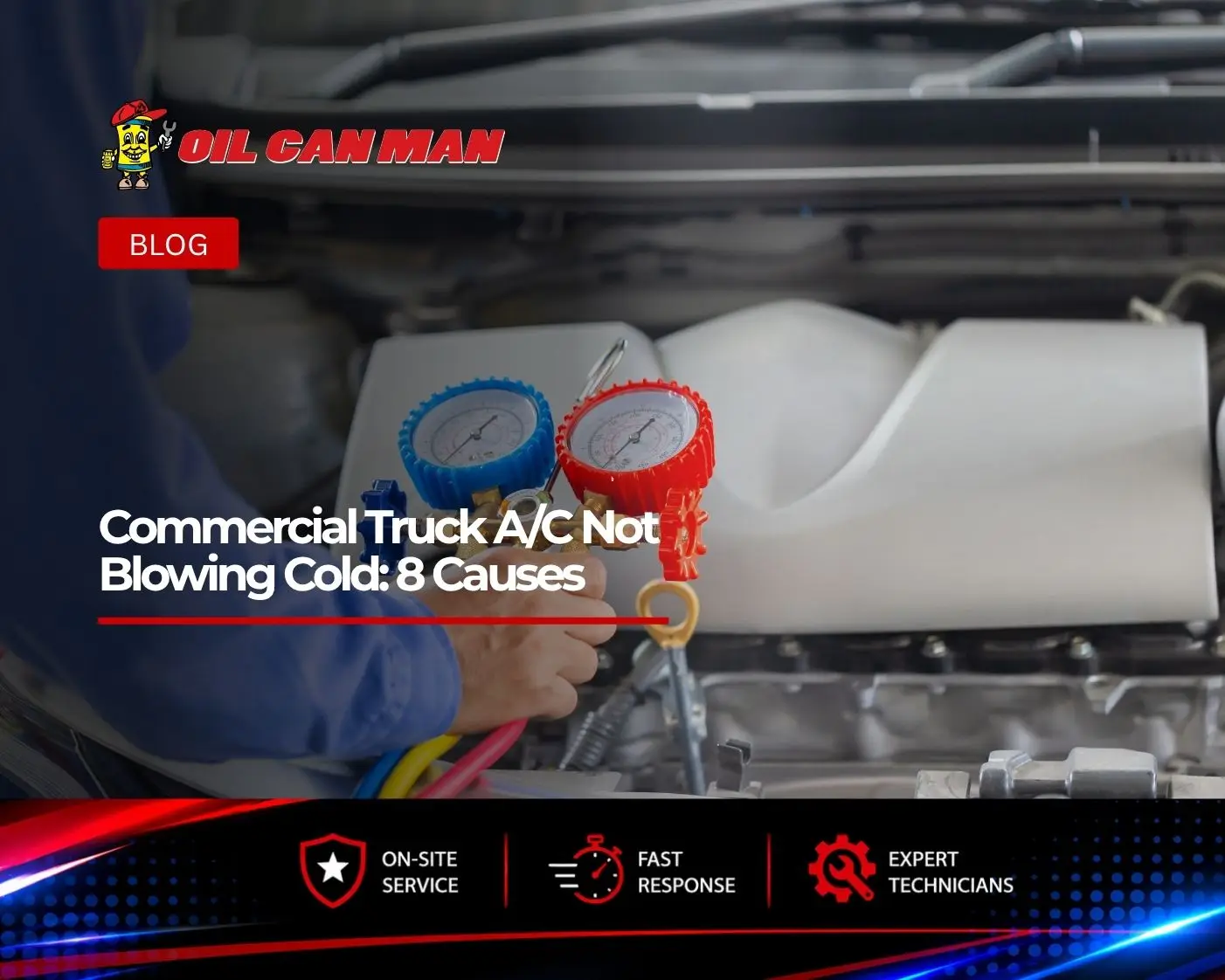
If your commercial truck AC is not blowing cold, the pattern of the failure can tell technicians almost as much as the temperature coming from the vents. Cooling that disappears at idle, becomes weak after several minutes, works only at highway speed, or comes with poor airflow can point toward very different parts of the system.
For South Florida fleets, that matters because drivers and crews spend long periods in heat, traffic, and idle-duty operation. [Oil Can Man] provides mobile and in-shop fleet maintenance, including air-conditioning service for vehicles ranging from commercial vans to over-the-road trucks. Oil Can Man fleet service and repair. Oil Can Man’s current production site also confirms a dedicated commercial A/C service page and its Fort Lauderdale repair facility.
A good fleet AC diagnostics process begins with the symptom rather than automatically assuming the truck needs refrigerant or a compressor.
1. Refrigerant Loss or a System Leak
Low refrigerant can reduce cooling performance, but refrigerant should not simply be treated as something that needs routine topping off.
Possible leak areas can include:
- Hose and line connections
- Compressor shaft seals
- Condenser or evaporator
- Service fittings
- O-rings and seals
- Other vehicle-specific components
Freightliner’s maintenance guidance instructs technicians to inspect refrigerant hoses and fittings and notes that oily areas around lines or connections can indicate leakage. Review Freightliner A/C maintenance guidance
Sanden also lists refrigerant charge and leak diagnosis among the checks used when an automotive or truck A/C system lacks cooling. See Sanden compressor and A/C service manuals
If a truck AC refrigerant leak is suspected, repeatedly adding refrigerant without diagnosing why the charge is low is not a complete repair strategy.
2. Compressor or Clutch Problems
The compressor circulates refrigerant through the system. Depending on the vehicle design, the problem may involve the compressor itself, its clutch, belt drive, electrical controls, or another component preventing compressor operation.
Possible symptoms include:
- Intermittent cooling
- Unusual compressor noise
- Cooling that stops unexpectedly
- Compressor that does not engage where a clutch-type design is used
- Repeated cycling
- Poor cooling despite normal cabin airflow
Sanden’s diagnostic material lists clutch coils, electrical supply, clutch bearings, compressor operation, refrigerant charge, and related components among the areas technicians may need to evaluate.
A Hino technical bulletin published through NHTSA provides a useful fleet lesson: compressors returned for poor cooling or noise had sometimes been replaced unnecessarily, and Hino directed technicians to distinguish low-refrigerant conditions from mechanical compressor problems before replacement. Review the Hino A/C diagnostic bulletin
That is why truck AC compressor problems should be diagnosed rather than assumed from warm vent air alone.
3. Condenser Airflow Problems
When a truck cools reasonably well while moving but becomes warm at idle, condenser airflow deserves attention.
The condenser must reject heat from the refrigerant. Its performance can be affected by:
- Debris blocking fins
- Damaged fins
- Cooling-fan problems
- Fan-control faults
- Vehicle-specific airflow restrictions
Freightliner specifically calls for checking condenser fins for road debris as part of A/C maintenance. Sanden diagnostic material also identifies a blocked condenser or non-functioning fan as possible causes of poor cooling.
For a South Florida truck operating in traffic or spending substantial time idling, the difference between cooling at road speed and cooling while stationary is useful diagnostic information.
4. Cooling-Fan or Fan-Control Failure
A related issue is a fan that is not moving enough air through the condenser when the truck is stopped.
That can produce one of the most recognizable commercial vehicle air conditioning complaints:
Cold while driving, warm at idle.
Depending on the vehicle, technicians may need to evaluate the fan itself, electrical supply, relays, commands, sensors, or other fan-control components.
This does not mean every warm-at-idle complaint is a failed fan. Refrigerant charge, condenser condition, compressor performance, engine-cooling configuration, and ambient conditions can produce overlapping symptoms.
Oil Can Man’s broader Florida fleet A/C maintenance guide is a useful preventive-maintenance companion to this diagnostic article. The existing page focuses on preparing fleet vehicles for Florida operating conditions, while this article addresses an active cooling failure.
5. Pressure Sensors, Switches, Wiring, or Controls
Modern A/C systems depend on electrical information as much as mechanical components.
A pressure sensor or switch may influence whether the compressor is allowed to operate. Wiring faults, connectors, relays, control modules, temperature inputs, and vehicle-specific logic can also create intermittent cooling.
Potential driver complaints include:
- A/C works sometimes and not others
- Compressor operation stops unexpectedly
- Cooling returns after restarting the vehicle
- Warning messages or electrical faults appear
- System cycles unusually
Electrical diagnosis should be based on the correct wiring information and vehicle-specific procedures, not on bypassing pressure or protection devices.
This is particularly important when a commercial truck AC not blowing cold complaint occurs alongside other electrical symptoms.
6. Restrictions in the Refrigerant Circuit
Refrigerant must move through the complete circuit correctly.
Restrictions can occur in areas such as:
- Expansion device
- Receiver-drier or accumulator
- Refrigerant lines
- Evaporator
- Other vehicle-specific passages
Sanden lists restrictions in the liquid line, expansion valve, receiver-drier, or evaporator among possible causes of poor system performance.
The symptom may be intermittent rather than constant, which is why pressure, temperature, refrigerant charge, and operating conditions need to be evaluated together.
If one truck is cooling poorly, cycling intermittently, or losing A/C at idle, Oil Can Man can evaluate the complaint and determine whether mobile diagnosis or facility-based commercial truck A/C repair makes more sense for the vehicle and repair scope.
7. Weak Cabin Airflow
Sometimes the refrigerant system is producing cooling, but the driver is not getting enough conditioned air through the vents.
Possible causes can include:
- Restricted cabin filter
- Blower-motor problem
- Blocked air intake
- Duct problem
- Evaporator airflow restriction
- Door or actuator problem within the HVAC housing
Freightliner’s A/C maintenance guidance specifically instructs technicians to check the air intake and blower motor when vent airflow is insufficient.
This is why “not cold” and “not enough air” should be documented as separate complaints.
Fleet managers can also incorporate A/C checks into broader commercial vehicle preventive maintenance planning rather than waiting for peak heat to expose every weak system at once.
8. Vehicle-Specific HVAC Controls or Mechanical Problems
Not every truck uses the same HVAC architecture.
Depending on the vehicle, poor cooling may involve:
- Blend or temperature doors
- HVAC actuators
- Cab temperature sensors
- Control heads
- Auxiliary cab or sleeper systems
- Compressor-control strategy
- Vehicle communication faults
That is why the same symptom across three different trucks may produce three different repair orders.
The vehicle identification, model, engine, HVAC configuration, fault history, and previous repair records all help determine the correct diagnostic procedure.
What Drivers Should Report to the Fleet Manager
When commercial truck AC is not blowing cold, ask the driver for more than “the A/C doesn’t work.”
Useful questions include:
- Is the air warm all the time or only at idle?
- Does cooling improve with vehicle speed?
- Is the airflow strong but warm, or weak overall?
- Does the A/C cool initially and then become warm?
- Are there unusual noises when the A/C operates?
- Has refrigerant been added previously?
- Has the compressor, condenser, fan, or electrical system been repaired recently?
- Is the problem intermittent?
- Are there any dashboard or electrical warnings?
These details give technicians a better starting point for fleet AC diagnostics.
Why Repeated Refrigerant Top-Offs Are Not a Repair Plan
EPA regulates servicing of motor vehicle air-conditioning systems under Section 609 of the Clean Air Act.
Technicians performing MVAC service for compensation must be properly trained and certified, and approved refrigerant-handling equipment must be used. EPA also prohibits intentional venting and requires proper refrigerant recovery and handling. Review EPA motor vehicle A/C servicing requirements
For fleets, the practical takeaway is simple: refrigerant-system work should be treated as professional service, not repeated topping off whenever vent temperature increases.
A truck AC refrigerant leak should be diagnosed along with the rest of the system before a long-term repair decision is made.
Same Complaint, Different Diagnosis
Consider a South Florida service fleet with three work trucks reporting weak A/C.
Truck A cools normally at highway speed but becomes warm in traffic.
Truck B blows strong air but never becomes cold.
Truck C produces cold air, but vent airflow is extremely weak.
The fleet manager should not request the same repair for all three.
Truck A’s diagnosis may emphasize condenser airflow and fan operation. Truck B may require refrigerant, compressor, control, or restriction diagnosis. Truck C’s path may begin with the blower, cabin airflow, filter, ducting, or HVAC doors.
The phrase commercial truck AC not blowing cold describes the driver’s complaint. It does not identify the failed component.
Mobile A/C Diagnosis vs. Shop Service
Oil Can Man currently offers both mobile fleet service and a Fort Lauderdale repair facility. Explore Oil Can Man mobile fleet service
Mobile service may be practical for:
- Initial diagnostics
- Electrical checks
- Accessible component inspection
- Preventive A/C service
- Repairs suitable for field conditions
Facility service may make more sense when the vehicle requires extensive disassembly, difficult leak detection, component replacement, or work requiring specialized shop equipment.
The correct choice depends on the truck and diagnosis, not simply on convenience.
Restore Cooling Without Guessing at the Cause
When commercial truck AC is not blowing cold, replacing the compressor or adding refrigerant before completing a proper diagnosis can miss the actual problem.
Oil Can Man provides heavy-duty truck AC repair, commercial vehicle A/C diagnostics, preventive fleet maintenance, and mobile or facility-based service throughout its South Florida service area. Its current website lists (954) 764-8117 as the primary service number and confirms its Fort Lauderdale facility at 730 NW 7th Street, Fort Lauderdale, FL 33311.
Call Oil Can Man at (954) 764-8117 and describe whether the truck blows warm air, loses cooling at idle, has weak airflow, cycles intermittently, or has received previous A/C repairs so the team can discuss the appropriate diagnostic and service approach.
FAQs
Why is my commercial truck A/C cold while driving but warm at idle?
Condenser airflow is one possible area to inspect. Cooling-fan operation, condenser blockage, refrigerant charge, compressor performance, and vehicle-specific controls can all affect low-speed cooling, so the symptom should be diagnosed rather than attributed to one component automatically.
Does warm A/C always mean the truck needs refrigerant?
No. Low refrigerant is one possible cause, but compressor faults, condenser airflow, fans, electrical controls, sensors, restrictions, or cabin-airflow problems can produce similar symptoms.
Can Oil Can Man provide heavy duty truck AC repair?
Yes. Oil Can Man’s current production site lists A/C service for vehicles ranging from passenger vehicles to over-the-road trucks and provides both mobile and facility-based fleet service.
Can commercial truck A/C service be performed onsite?
Some diagnostics and repairs may be suitable for mobile service. Other work may require Oil Can Man’s Fort Lauderdale facility, depending on the refrigerant system, accessibility, component failure, diagnostic requirements, and repair scope.