When Several Diesel Trucks Need DPF Service
Three trucks have recurring DPF warnings, another is approaching a manufacturer-recommended service milestone, and tomorrow’s deliveries are already scheduled. For fleet managers, the challenge is not simply finding a cleaning provider. It is deciding which vehicles need attention, what service each requires, and how to schedule the work without unnecessarily disrupting operations.
Searching for DPF filter cleaning near you is a starting point. Oil Can Man provides DPF cleaning and service for South Florida commercial fleets, with mobile and facility-based options depending on the work required. A coordinated service plan begins with individual vehicle assessments.
Why Multi-Truck Fleets Need Individual DPF Evaluations
Not every diesel truck needs DPF cleaning at the same mileage or engine-hour reading.
Differences in routes, loads, engine configuration, idle time, and maintenance history influence aftertreatment service requirements.
For effective commercial diesel fleet maintenance, evaluate each truck using:
- Manufacturer maintenance requirements
- Mileage and engine hours
- Operating conditions and duty cycle
- DPF warning messages and diagnostic findings
- Previous regeneration, cleaning, or replacement history
Cummins’ X15 maintenance guidance illustrates how DPF ash-maintenance recommendations vary by operating duty. These recommendations are engine-specific and should not be applied automatically to every fleet vehicle.
The goal is to determine which trucks need evaluation rather than scheduling identical cleaning procedures for the entire fleet.
Review Maintenance History and Diagnostic Information
Accurate records help managers distinguish recurring aftertreatment problems from approaching maintenance requirements.
Before requesting diesel truck aftertreatment service, review each vehicle’s warning history, previous DPF work, mileage, engine hours, and unresolved repairs.
A DPF warning does not automatically confirm that physical cleaning is necessary.
Understand Regeneration Versus Cleaning
Regeneration burns accumulated combustible soot through passive, active, or manufacturer-approved stationary procedures.
Physical DPF cleaning removes noncombustible ash that regeneration cannot eliminate.
The EPA’s DPF operation and maintenance guidance explains this distinction and the importance of investigating unusually frequent cleaning requirements.
Some filters may require inspection, cleaning, or replacement depending on their condition and manufacturer instructions.
For recurring warnings, Oil Can Man’s guide to repeated DPF regeneration explains why further diagnosis may be necessary.
Prioritize Trucks Requiring DPF Service
When multiple trucks have aftertreatment concerns, the correct order depends on vehicle condition and applicable operating restrictions.
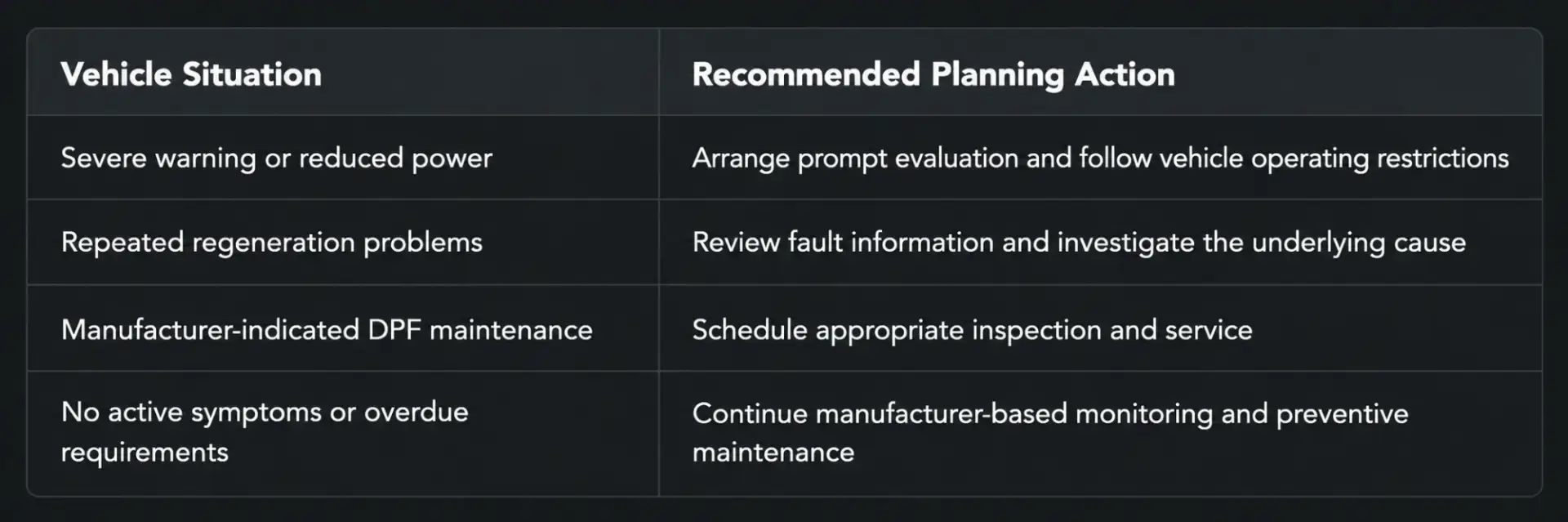
Do not continue operating a vehicle when its condition or manufacturer instructions prohibit it.
A preventive DPF maintenance program should combine manufacturer guidance, maintenance records, diagnostic findings, and operational planning rather than relying on one universal cleaning interval.
Need DPF Service for Several Trucks?
Oil Can Man provides fleet DPF cleaning services in South Florida. Share your fleet size, vehicle details, warning messages, and service history to discuss which units require evaluation and what service options may be appropriate.
Coordinate Multi-Truck DPF Service Scheduling
Fleet managers should organize DPF work around actual maintenance needs and vehicle availability.
For multi-truck DPF service scheduling, identify which units can be made available together, which need additional diagnostics, and whether the required work can be performed on-site.
Mobile service may be appropriate when suitable equipment, access, and manufacturer-approved procedures are available.
Facility-based work may be necessary for specialized cleaning, filter removal, extensive repairs, or equipment unavailable at the fleet location.
For some engine applications, the manufacturer may recommend filter replacement or exchange instead of certain cleaning methods. Cummins’ DPF guidance explains why the service approach and filter condition matter.
Oil Can Man’s fleet maintenance services can also support coordination with other scheduled maintenance needs.
Planning DPF Service for 12 Trucks
Consider a trucking company operating 12 diesel trucks across South Florida.
The maintenance manager identifies:
- 2 trucks with significant aftertreatment warnings or reduced power requiring evaluation.
- 3 trucks experiencing repeated regeneration concerns.
- 2 trucks approaching manufacturer-indicated DPF maintenance.
- 5 trucks with no current aftertreatment complaints or overdue requirements.
Rather than booking 12 identical cleaning appointments, the manager separates the vehicles by diagnostic priority and maintenance requirements.
The trucks with significant warnings receive attention based on their actual operating condition. Recurring regeneration concerns are investigated before choosing a repair procedure.
The remaining vehicles continue their individual maintenance plans.
This approach helps the manager organize service requests without assuming every truck requires immediate cleaning.
Multi-Truck Fleet DPF Maintenance Checklist
Before contacting a service provider, prepare:
- Fleet information: Number of affected trucks, vehicle types, and fleet location.
- Vehicle records: Unit numbers, mileage, engine hours, and engine configurations.
- DPF concerns: Warning lights, fault information, and regeneration history.
- Previous service: Filter cleaning, replacement, and related aftertreatment repairs.
- Service requirements: Manufacturer guidance, operating restrictions, and inspection findings.
- Scheduling details: Available service windows, site access, and operational priorities.
Document completed work and any recommended follow-up. Maintaining individual records makes future service planning more consistent.
Frequently Asked Questions
Should every truck in a fleet receive DPF cleaning at the same interval?
No. Maintenance requirements depend on the engine, duty cycle, operating conditions, diagnostic findings, and manufacturer recommendations.
Can multiple diesel trucks receive DPF service at one location?
Suitable mobile diagnostics and service may be coordinated at a fleet location. Physical cleaning or specialized repairs may require facility-based resources.
Does frequent regeneration mean the DPF needs cleaning?
Not necessarily. Repeated regeneration can be associated with operating conditions, soot accumulation, sensor concerns, engine problems, or ash loading. Diagnosis should establish the cause.
What should a fleet manager prepare before scheduling DPF cleaning?
Provide vehicle identification, mileage or hours, warning information, previous aftertreatment service, fleet location, and the number of affected vehicles.
Build a Better DPF Service Plan for Your Fleet
Managing DPF service across several diesel trucks requires more than booking identical cleaning appointments.
Oil Can Man supports commercial fleets throughout Broward, Miami-Dade, and Palm Beach counties with DPF service and mobile fleet maintenance, backed by its Fort Lauderdale repair facility when needed.
Managing several diesel trucks with DPF concerns? Call (954) 764-8117 or contact Oil Can Man with your fleet size, vehicle conditions, warning history, and scheduling requirements to discuss an appropriate service plan.