The Truck Needed Most Is Not Always the One That Should Leave First
Three trucks are due for maintenance, a driver reports a braking concern, and another unit has returned with the same warning message. Tomorrow’s routes still need coverage. Fixing the easiest item first might close a work order, but it does not necessarily address the most important problem.
Effective fleet maintenance starts by separating vehicles that cannot be dispatched from work that can be scheduled. Then consider inspection findings, maintenance deadlines, recurring problems, and available replacement vehicles. Oil Can Man’s fleet maintenance services support South Florida businesses with mobile maintenance, commercial vehicle repairs, and facility-based work when the job requires it.
1. Separate Safety and Inspection Holds From Ordinary Scheduling
A safety-critical defect is not simply another overdue task.
For vehicles subject to FMCSA rules, 49 CFR Part 396 prohibits operation in a condition likely to cause an accident or breakdown. A vehicle formally declared out of service cannot resume operation until the repairs required by the notice are satisfactorily completed. Route urgency does not override these restrictions.
Have reported braking, steering, tire, wheel, or other safety concerns evaluated before dispatch when safe operation is uncertain. An internal maintenance hold and an official out-of-service order are different, but neither should be treated as permission to finish another route.
Overdue required inspections also need separate handling. Under 49 CFR §396.17, applicable vehicles must meet periodic inspection requirements, including the required passing inspection within the preceding 12 months and onboard documentation. Each vehicle in a combination must be inspected. Scheduling an appointment does not satisfy the inspection requirement.
Oil Can Man offers DOT inspection services for commercial fleets. The carrier remains responsible for meeting applicable operating requirements.
2. Give Every Backlog Item a Clear Next Action
Use this proposed planning framework after reviewing vehicle condition and applicable requirements. These are workflow categories, not official out-of-service classifications.
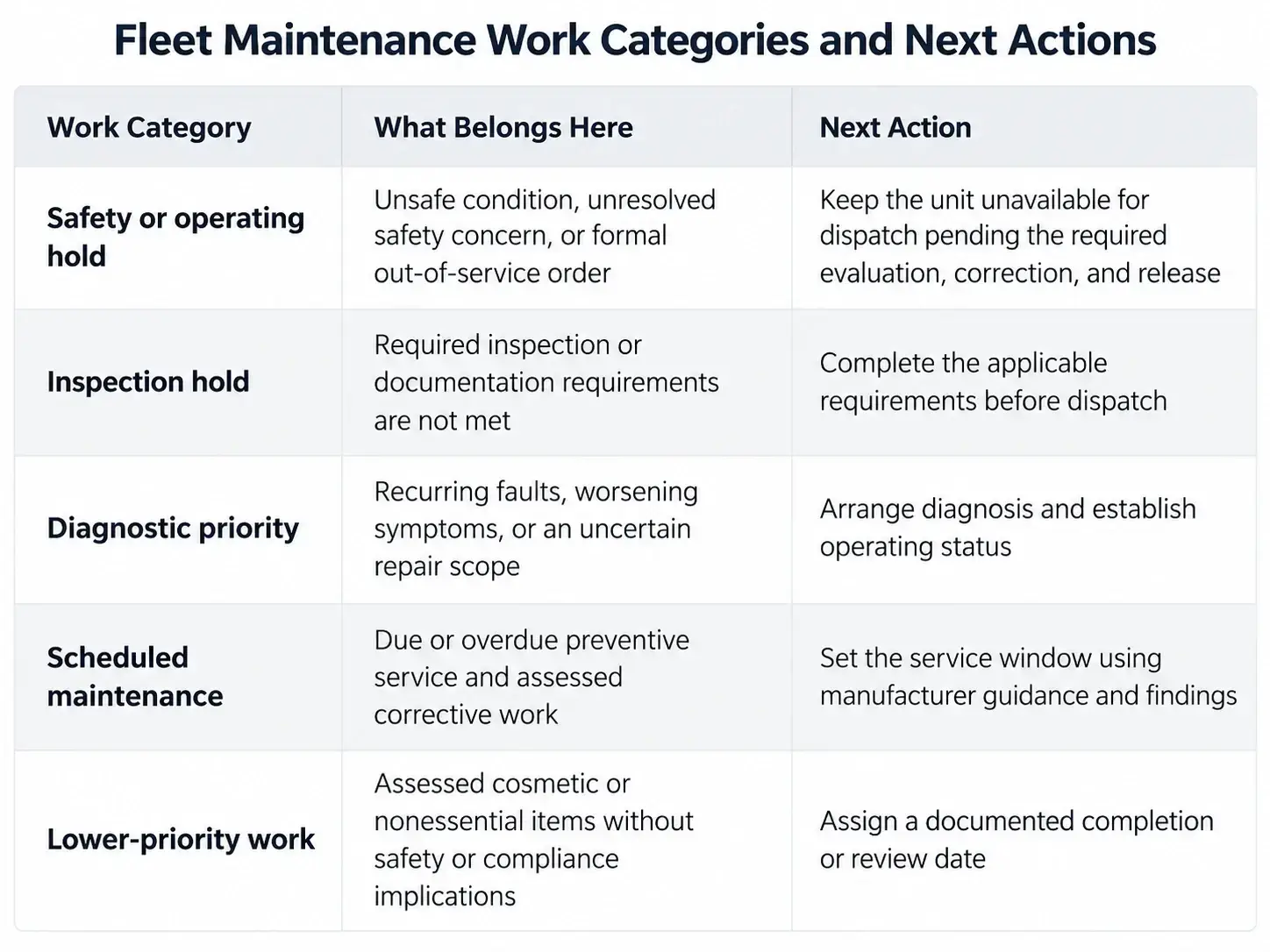
Do not assign every job an arbitrary “repair within 48 hours” deadline. The condition, applicable rules, manufacturer instructions, and assessment should determine the response.
3. Build One Working Backlog, Not Several Separate Lists
Combine driver reports, open estimates, inspection findings, and maintenance reminders into one working register.
For each item, record the unit number, vehicle type, mileage or engine hours, reported symptom, inspection findings, service due date, operating status, and responsible person. Add approval status, parts requirements, location, and the next action.
For covered vehicles, FMCSA’s maintenance-record requirements include vehicle identification, maintenance due information, and the date and nature of inspections, repairs, and maintenance. Your backlog register should connect to those records rather than replace them.
4. Give Recurring Problems a Diagnostic Review
Do not let a repeated complaint disappear into another generic work order.
An entry such as “hydraulic leak again” should identify the location, previous repair, and conditions when the leak appeared. For diesel engine warnings, record the exact message and recent work rather than choosing a replacement component.
Ask the technician what needs inspection or testing before approving another repair. The aim is to investigate the pattern, not assume that the same symptom proves the same part failed.
Several Vehicles Need Attention at Once?
Bring Oil Can Man a unit-by-unit list of overdue service, reported defects, and current operating restrictions. Ask which tasks can be grouped for mobile maintenance and which need additional diagnosis or facility-based work. Its fleet program includes maintenance-history tracking and service reminders.
5. Protect Preventive Maintenance While Clearing Repairs
Emergency work should not leave preventive fleet maintenance permanently unscheduled.
FMCSA’s systematic-maintenance guidance explains that maintenance intervals can be fleet-specific or vehicle-specific. Driver inspection and periodic inspection requirements are additional to that maintenance program.
For your planning process, use manufacturer guidance, current usage, and service history to identify what is due. Give each overdue task an owner and a service window instead of repeatedly moving it to “next week.”
Among jobs that can legitimately be scheduled, consider replacement-vehicle availability, required equipment, and operational impact. Do not use those factors to justify operating an unsafe unit.
6. Match the Work to Mobile or Facility Service
Oil Can Man’s mobile service covers preventive maintenance, diagnostics, and a range of commercial repairs. Its Fort Lauderdale facility supports major repairs and other shop-level work.
For mobile fleet maintenance in South Florida, discuss site access, working space, vehicle availability, and the tasks requested. Grouping suitable work at one yard may be practical, but not every repair belongs there.
Major disassembly, specialized equipment, or unsuitable site conditions may make facility service more appropriate. Confirm the repair scope with the provider rather than assuming a mobile appointment guarantees completion on-site.
Before scheduling, identify who can approve additional work and what parts remain unconfirmed. Oil Can Man’s guide to repair approvals and pre-approved parts explores the approval side of repair delays.
Four Units, Four Different Priorities
Consider a contractor with a box truck showing reduced braking performance, a trailer with an expired required inspection, a work van due for preventive maintenance, and a dump truck with a recurring hydraulic leak.
The braking concern needs evaluation before dispatch. The trailer cannot be treated as inspection-ready because an appointment is booked. The hydraulic complaint needs assessment, not an assumed hose replacement.
The van’s scheduled maintenance may be grouped with other suitable yard work. Repairs requiring specialized shop resources can be planned separately.
The contractor should reorganize assignments around the units available for work, not pressure restricted vehicles back into service.
Keep the Backlog From Rebuilding
During each backlog review, ask which jobs are waiting on diagnosis, approval, parts, or scheduling. Track overdue preventive services, aging work orders, repeat visits, and units unavailable for dispatch.
Close an item only after recording the work completed, any remaining recommendations, and the required return-to-service checks. Update the next maintenance trigger.
A shorter list is useful only when it reflects completed work, not deleted reminders.
Turn Your Fleet Maintenance Backlog Into a Service Plan
Falling behind on fleet maintenance does not mean every vehicle needs the same appointment. Start with operating restrictions, establish the diagnostic needs, and organize the remaining work around actual service requirements.
Call (954) 764-8117 or request fleet service from Oil Can Man. Provide your vehicle types, fleet location, outstanding repairs, upcoming maintenance, and any restricted units. The team can discuss mobile or Fort Lauderdale facility-based support for fleets across Broward, Miami-Dade, and Palm Beach.
Frequently Asked Questions
Which fleet repairs should come first?
Address unsafe conditions and unmet operating requirements before ordinary scheduling decisions. Then use diagnostic findings, maintenance deadlines, repair history, and operational needs to organize the remaining work. A route deadline does not override an out-of-service restriction.
Can overdue preventive maintenance wait until the annual inspection?
Do not use the annual inspection as a substitute for preventive maintenance. FMCSA treats systematic maintenance and periodic inspection requirements separately. Follow the applicable maintenance program and manufacturer guidance.
Can several fleet vehicles be serviced at the same location?
Oil Can Man provides maintenance at fleet locations. Ask which tasks are suitable to group, what access is required, and whether any units need facility-based work.
What should be included in a fleet maintenance backlog?
Include the unit, reported issue, findings, operating status, due date, responsible person, approval and parts status, and next action. Keep these entries connected to the vehicle’s service history.