Why Fleet Wrap Quotes Can Vary So Much
For a fleet manager comparing branding options, fleet vehicle wrap cost is rarely determined by one simple per-vehicle price. A compact company car, high-roof service van, box truck, and commercial trailer require different amounts of material, design work, preparation, and installation labor. The condition of each vehicle and the amount of coverage also matter.
Oil Can Man currently provides vehicle wraps, fleet branding, and signage for cars, vans, trucks, and trailers across its South Florida market. Its production service page includes full and partial wraps, fleet branding, durable signage, and design-to-install service.
The best way to budget a fleet graphics project is therefore to define the vehicles, coverage, condition, branding requirements, and rollout plan before expecting a final quote.
Start With the Type and Size of Vehicle
Vehicle size is one of the most obvious factors behind commercial vehicle wrap cost, but total surface area is only part of the equation.
A passenger car generally has fewer large panels than a high-roof van. A box truck offers substantial flat graphic space, while a cargo van may include curves, recessed areas, handles, hinges, moldings, and body contours that require more installation work.
A fleet may include:
- Sales cars
- Pickup trucks
- Cargo vans
- High-roof service vans
- Box trucks
- Commercial trailers
- Mixed vehicle classes
That is why a fleet manager should provide the year, make, model, body style, and approximate quantity of each vehicle when requesting fleet graphics pricing.
For mixed fleets, the better question is not simply, “What does one wrap cost?” It is, “What branding specification makes sense for each vehicle class?”
Spot Graphics, Lettering, Partial Wraps, or Full Wraps?
Coverage level can substantially change the scope of the project.
Spot Graphics and Lettering
Vehicle lettering or individual decals use selected areas rather than covering large portions of the body.
This approach may work when the fleet mainly needs:
- Company identification
- Logo placement
- Contact information
- Service descriptions
- Unit numbers
- Basic brand consistency
It requires less coverage than a partial or full wrap, but design, production, surface preparation, and installation still affect the quote.
Partial Wraps
A partial wrap integrates the vehicle’s original paint color into the design while applying graphics to selected portions of the body.
When comparing partial vs. full vehicle wrap options, fleet managers should consider whether the factory paint already complements the brand. A white service van, for example, may provide a useful background for a carefully designed partial wrap.
Oil Can Man’s current vehicle wraps and fleet branding service confirms that both full and partial wraps are part of its current offering.
Full Wraps
A full wrap uses significantly more of the vehicle’s exterior as part of the design. It may be useful when the brand requires a strong color transformation or when consistency across different factory paint colors is important.
More coverage generally means additional material and installation requirements, but the actual quote still depends on the specific vehicle.
Vehicle Condition Can Change the Quote
One of the easiest costs to overlook is preparation.
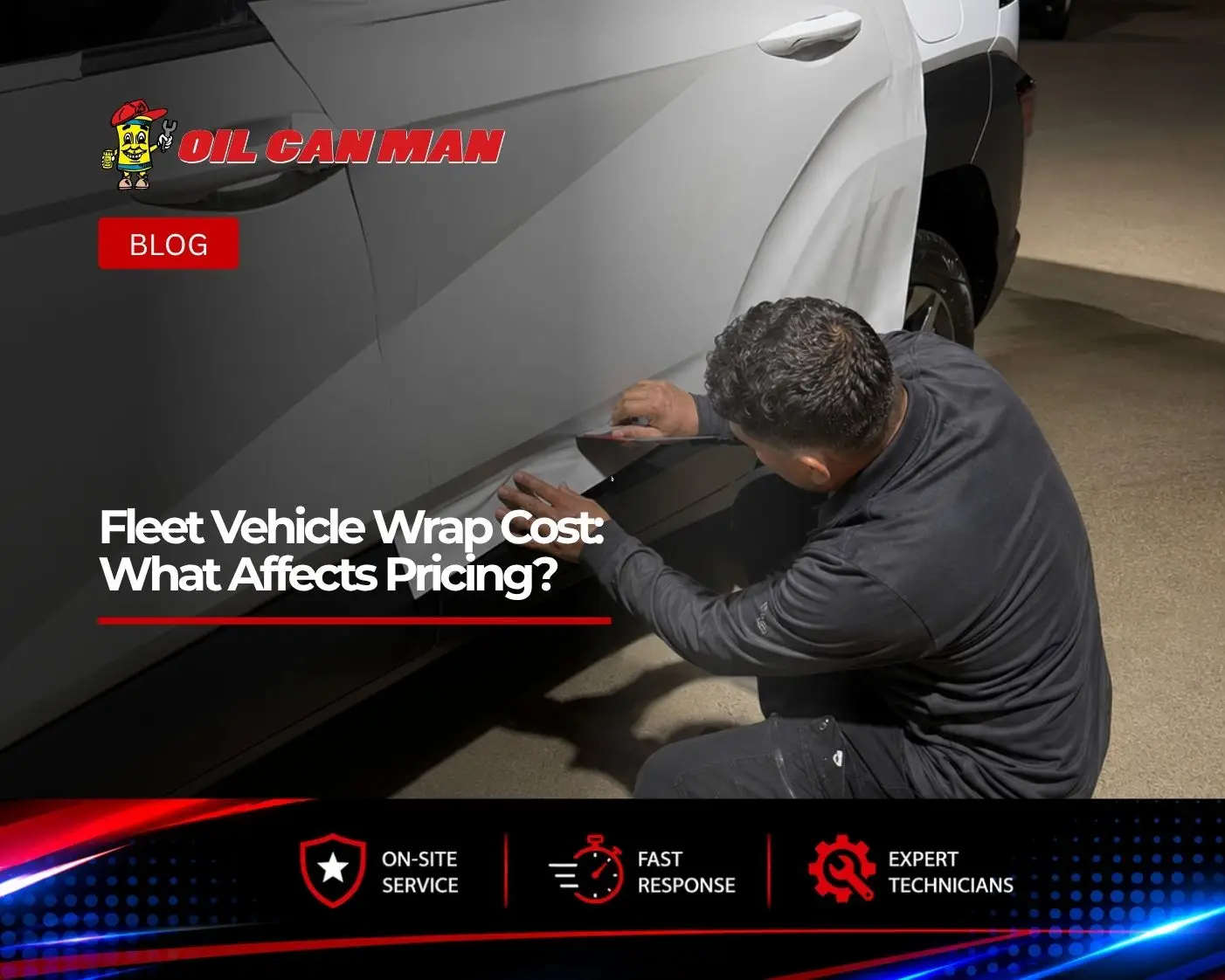
Vinyl should not simply be installed over dirt, wax, damaged paint, corrosion, or an unsuitable surface. 3M’s current vehicle preparation guidance calls for inspecting vehicles for rust, paint-quality problems, scratches, dents, and other conditions that may affect installation, followed by thorough cleaning and surface preparation.
Avery Dennison’s vehicle wrap application guidelines likewise emphasize assessing chipped paint, rust, dents, repainted sections, contamination, and paint adhesion before installation.
As a result, fleet vehicle wrap cost may be affected by:
- Old graphic removal
- Adhesive residue
- Oxidized or damaged surfaces
- Dents or body damage
- Rust or corrosion
- Previously repainted panels
- Additional cleaning and preparation
Oil Can Man also provides commercial vehicle bodywork and collision repair, which can be relevant when a fleet vehicle requires body repairs before a branding project.
Material and Laminate Selection Matter
Not all vehicle films are designed for the same application, exposure, or expected service conditions.
3M’s January 2026 product bulletin for Print Wrap Film IJ280 identifies vehicles, straight trucks, semi-trucks, and semi-trailers among its intended graphic applications. It also notes that graphic performance depends on factors including material combinations, surface condition and preparation, environmental conditions, sun exposure, and cleaning methods.
Laminate and graphic-protection choices can also be part of the production specification. Rather than choosing film solely by the lowest initial material price, fleet managers should ask what film system is being quoted, how it fits the intended vehicle use, and what maintenance guidance applies.
If you are comparing lettering, partial wraps, and full wraps across several vehicle classes, Oil Can Man can review the vehicles, coverage goals, artwork, and operating environment to help define a repeatable fleet-branding specification before the project is scheduled.
Design Complexity Affects Fleet Graphics Pricing
A simple logo-and-lettering package requires a different design process than a full vehicle graphic that must align across doors, handles, windows, body contours, and several vehicle models.
Design considerations may include:
- Number of vehicle templates
- Existing brand standards
- Logo and artwork quality
- Custom illustrations or photography
- Color matching
- Placement of contact information
- Differences between vehicle models
- Proofing and revision requirements
Oil Can Man’s current graphics operation also lists in-house wide-format production of vehicle graphics through its large-format printing capabilities.
A fleet with consistent, approved artwork can also be easier to expand later than one where every new vehicle requires a completely different design.
Box Truck Wrap Cost Has Its Own Variables
A box truck wrap cost evaluation should separate the box from the cab and other exterior surfaces.
Large flat sides may offer straightforward branding space, while rivets, seams, rear doors, hinges, roll-up doors, corner structures, and cab contours can add production or installation complexity.
Fleet managers should clarify:
- Are both sides included?
- Is the rear included?
- Is the cab being wrapped?
- Are doors and hardware part of the design?
- Are existing graphics being removed?
- Does the box need surface or body repair?
- Are replacement panels expected during the vehicle’s service life?
These details make comparisons between quotes more useful than comparing only the final total.
What Affects Van Wrap Cost for a Business?
A van wrap cost for business fleets can differ even between vans that appear similar from a distance.
Wheelbase, roof height, windows, sliding doors, body recesses, handles, trim, existing damage, and factory paint all influence the project.
A service company may also choose different coverage depending on how the vehicle operates. Vans parked at customer locations may benefit from branding on the rear and both sides, while other fleet roles may require a simpler identification package.
The right decision comes from matching the design to the vehicle’s role rather than automatically choosing maximum coverage.
Florida Heat and Sun Should Be Part of the Specification
South Florida fleets operate under significant sun, heat, humidity, rain, and outdoor exposure.
That does not create one universal lifespan for a vehicle wrap. Manufacturer documentation shows that environmental conditions, surface orientation, sun exposure, material selection, installation, and maintenance all affect performance. 3M also distinguishes warranty considerations by graphic system and exposure, including differences between vertical and non-vertical applications.
Fleet managers should therefore ask:
- Which film and laminate system is being proposed?
- What does the manufacturer specify for that application?
- How should the graphics be cleaned?
- Which vehicle surfaces receive the most sun?
- How will vehicles stored outdoors be managed?
- What warranty applies to the exact material system?
That is more useful than assuming every commercial wrap will perform for the same number of years.
Plan Installation Around Fleet Availability
For working vehicles, installation scheduling is part of the business decision.
Removing several vans or trucks from operation simultaneously may affect service capacity. A fleet can instead consider a phased rollout based on route schedules, vehicle availability, replacement cycles, or operational priorities.
A useful installation plan may group vehicles by:
- Vehicle type
- Existing graphic condition
- Bodywork requirements
- Branding priority
- Operational availability
There is no universal installation time because preparation, removal, design, vehicle complexity, and coverage vary. Fleet managers should confirm scheduling requirements before committing vehicles to the project.
Standardizing a Service Fleet
Consider an HVAC company preparing to brand 12 cargo vans and two box trucks.
Some vans are new, while others already have lettering that needs removal. Two vehicles have damaged body panels. The company also wants future replacement vans to match the existing fleet.
Rather than asking for one fleet vehicle wrap cost multiplied by 14, the fleet manager could divide the project by vehicle class and condition.
The company might establish one approved van template, a related box-truck design, documented brand colors, consistent placement rules, and replacement-panel files. The company could address vehicles needing body repairs before installing graphics, while completed vehicles could enter the installation schedule in phases.
This approach gives the fleet a repeatable specification without assuming every vehicle requires identical work.
Questions to Ask Before Approving a Fleet Wrap Quote
Before approving fleet graphics pricing, fleet managers should ask:
- What coverage is included?
- Which film and laminate are specified?
- Is design included?
- Does the quote include old-graphic removal?
- Is surface preparation included?
- Does any vehicle need body repair first?
- How are mixed vehicle types handled?
- How will installation be phased?
- Are artwork and templates retained for future vehicles?
- How are damaged or replaced panels handled later?
- What cleaning and maintenance does the manufacturer recommend?
A detailed specification makes it easier to compare proposals on equivalent terms.
Build a Repeatable Fleet Branding Plan
The best wrap budget is not simply the lowest initial quote. It accounts for the vehicles being branded today and how the fleet will expand, replace vehicles, repair body panels, and maintain visual consistency later.
Oil Can Man currently provides full and partial wraps, fleet branding, signage, design-to-install service, and commercial vehicle bodywork in South Florida. Its current contact information lists 730 NW 7th Street, Fort Lauderdale, FL 33311 and (954) 764-8117.
Call Oil Can Man at (954) 764-8117 to discuss your vehicle types, fleet quantity, branding goals, coverage level, surface condition, and installation requirements, and request a project-specific quote.
FAQs
How much does a fleet vehicle wrap cost?
There is no reliable universal price for every fleet. Vehicle size, coverage, material system, design complexity, surface preparation, old-graphic removal, vehicle condition, quantity, and installation requirements all influence the final quote.
Is a partial wrap cheaper than a full vehicle wrap?
A partial wrap generally uses less graphic material and covers less vehicle surface than a full wrap, but the final difference depends on design complexity, vehicle shape, preparation, and installation requirements. Fleet managers should compare equivalent specifications rather than assuming a fixed percentage difference.
What affects commercial vehicle wrap cost the most?
Vehicle type, coverage, material selection, design, surface condition, existing graphic removal, body repairs, and installation complexity are major variables. Mixed fleets may also require separate templates for cars, vans, trucks, and trailers.
Does Florida weather affect vehicle wraps?
Environmental exposure matters. Manufacturer documentation identifies sun exposure, environmental conditions, surface orientation, preparation, installation, and maintenance among the factors affecting graphic performance. Fleets should select and maintain materials according to the specifications for the actual film system.