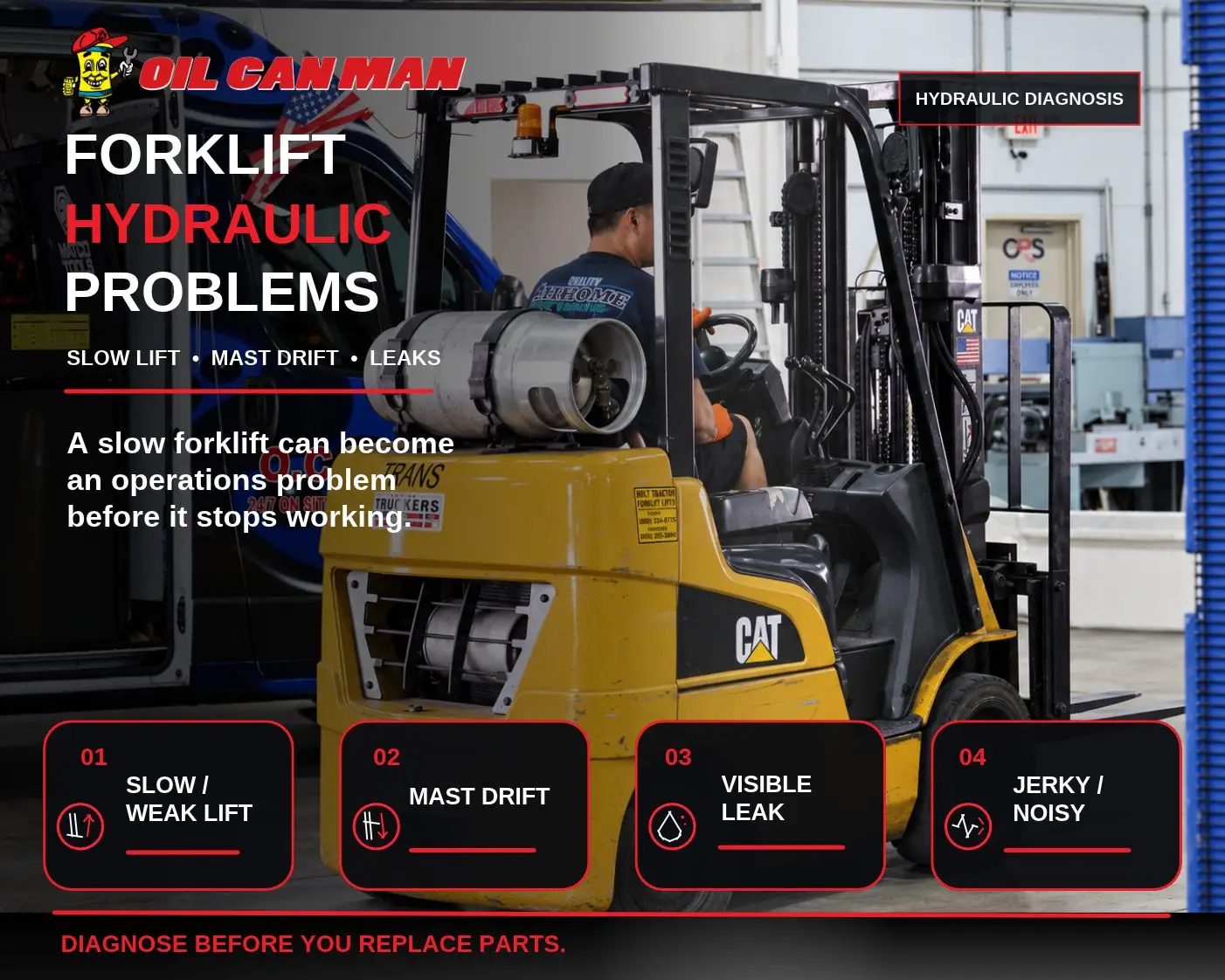
A Slow Forklift Can Become an Operations Problem Before It Stops Working
A forklift that starts lifting more slowly, settling after a load is raised, or leaving hydraulic fluid on the floor may still operate, but the change can quickly interfere with loading, warehouse movement, and job-site schedules. The challenge for a manager is knowing whether the symptom points to a simple service need or a deeper hydraulic problem.
Forklift hydraulic problems can involve fluid condition, hoses, fittings, filters, cylinders, pumps, valves, seals, or other components. The same symptom can have several possible causes, which is why diagnosis should come before parts replacement. Oil Can Man provides mobile hydraulic repair and service for commercial equipment, including forklifts, across its South Florida service area.
What Forklift Hydraulic Symptoms Are Telling You
Operators do not need to diagnose the hydraulic system. They do, however, play an important role in recognizing changes and reporting them accurately.
Common symptoms worth documenting include:

The important word is may. Slow lifting does not automatically mean the pump has failed, and visible oil around the mast does not automatically mean the lift cylinder needs replacement.
1. Forklift Slow Lift or Weak Lifting Power
A forklift slow lift complaint is one of the easiest symptoms to notice, especially when operators use the same equipment every day.
Possible areas technicians may evaluate include:
- Hydraulic fluid level and condition
- Hydraulic filtration
- Pump output
- Restrictions in the system
- Relief or control-valve operation
- Cylinder leakage
- Hoses and fittings
- Mast or carriage condition
- Equipment-specific electronic controls
Toyota notes that inadequate hydraulic-fluid levels can reduce lifting and steering capability, while the correct fluid and maintenance requirements depend on the specific forklift and manufacturer. Toyota hydraulic fluid guidance for forklifts
Avoid assuming a slow mast means “replace the pump.” A complete diagnosis can help prevent parts from being replaced while the original problem remains.
2. Mast Drift or a Load That Does Not Hold Position
Forklift mast drifting describes unwanted movement after the operator has stopped commanding lift or tilt.
Depending on the forklift design and symptom, technicians may need to evaluate:
- Lift-cylinder seals
- Tilt cylinders
- Control valves
- Load-holding components
- Fluid condition
- Hydraulic connections
- Other internal leakage paths
A hydraulic cylinder may appear to be the problem when a valve, hose restriction, pump issue, pressure problem, or another component is contributing to the symptom.
Oil Can Man’s hydraulic cylinder repair or replacement guide explains why drift, slow movement, and visible fluid loss should be diagnosed across the broader hydraulic circuit before deciding which component needs repair.
If mast or load movement creates a condition that adversely affects safe operation, the equipment should not simply remain in service while the problem is monitored.
3. Visible Forklift Hydraulic Leaks
A forklift hydraulic leak may appear as:
- Fluid beneath the machine
- Wet hose connections
- Oil around a cylinder rod or gland
- Fluid around a valve or fitting
- Damp or deteriorated hose surfaces
- Repeated reservoir fluid loss
The leak location matters.
A wet cylinder does not prove the entire cylinder must be replaced. A hose connection can leak near a cylinder, and damaged fittings or external lines can make the source difficult to identify without proper inspection.
Forklift operators should not use their hands to search for leaks in a pressurized hydraulic system. Diagnosis and repair involving hydraulic pressure should be left to qualified personnel.
4. Jerky, Hesitant or Uneven Mast Movement
Smooth hydraulic operation becoming jerky or inconsistent is another symptom worth recording.
Possible contributors can include:
- Low fluid
- Air entering the system
- Contaminated hydraulic fluid
- Restricted flow
- Pump problems
- Valve problems
- Cylinder condition
- Mechanical binding in the mast or carriage
The operator’s description is useful here.
Does the problem occur during lifting, lowering, or tilting? Does it happen only with a load? Does the forklift behave normally when cold and differently after extended operation?
Those details can narrow the diagnostic path without asking operators to perform hydraulic testing themselves.
5. Noisy Hydraulic Operation
A forklift that develops a new whine, chatter, vibration, or other unusual sound during hydraulic operation deserves attention.
Noise may be associated with several conditions, including fluid-supply problems, restrictions, aeration, pump condition, or another hydraulic-system issue.
Toyota also recommends that changes in a forklift’s normal sound prompt maintenance evaluation. Toyota forklift service warning signs
Record when the noise happens:
- During initial lifting
- Under load
- At full lift
- During tilt
- After the forklift warms up
- During attachment operation
That information can be more useful to a technician than simply reporting “hydraulics are noisy.”
When a Forklift Hydraulic Problem Starts Affecting the Shift
If one forklift has a leak, another is lifting slowly, and a third has a recurring cylinder or hose problem, treating each service event separately can make maintenance harder to coordinate.
Oil Can Man can evaluate appropriate forklift hydraulic work at warehouses, fleet yards, industrial properties, and job sites in South Florida when mobile service is practical. Broader pump, valve, hose, and cylinder concerns can also be evaluated as part of a complete hydraulic system troubleshooting approach rather than replacing a component based on one symptom.
6. Weak Tilt or Hydraulic Attachments
Sometimes the mast lifts but another hydraulic function loses strength or responds inconsistently.
That pattern can help technicians determine whether the concern is limited to a particular circuit or affects the system more broadly.
Useful information includes:
- Which hydraulic function is affected
- Whether one or several functions are slow
- Whether the symptom changes under load
- Whether the problem is constant or intermittent
- Recent attachment or hydraulic repairs
- Warning indicators or unusual sounds
Do not assume an attachment problem automatically means the attachment itself has failed.
7. Recurring Hose or Cylinder Problems
Repeated failures deserve a different approach from a one-time repair.
If a forklift repeatedly develops a leak or hose problem in the same area, technicians may need to look beyond the failed component at factors such as:
- Hose routing
- Abrasion
- Excessive movement
- Heat exposure
- Fitting condition
- Contamination
- Pressure behavior
- Cylinder-rod condition
- Alignment
- Previous repair history
Replacing the same component repeatedly without examining the pattern can leave the underlying condition unchanged.
What Forklift Operators Should Record
Good forklift hydraulic system troubleshooting begins with useful observations.
Fleet or warehouse managers can ask operators to record:
- Forklift unit number
- Date and time of the problem
- Current hour-meter reading
- Whether the forklift was loaded
- Approximate load or type of work
- Which hydraulic function was affected
- Slow, jerky, weak or drifting movement
- Visible leak location
- New noises or vibration
- Whether the problem appears after warm-up
- Warning lights or codes
- Previous hydraulic repairs
This creates a usable service history without asking operators to diagnose or repair the equipment.
When Should a Forklift Be Taken Out of Service?
OSHA requires powered industrial trucks to be examined before being placed into service, with examinations performed at least daily. If a forklift needs repair, is defective, or is otherwise unsafe, remove it from service until it is restored to safe operating condition.
OSHA’s pre-operation guidance specifically includes checking hydraulic-fluid levels, visible leaks, hydraulic hoses, mast chains, lift controls, tilt controls, unusual noise, and vibration. Review OSHA’s forklift pre-operation inspection guidance
The underlying OSHA standard also requires repairs to be performed by authorized personnel. Review 29 CFR 1910.178
Managers should follow the applicable regulation, manufacturer requirements, and workplace procedures when deciding whether equipment can remain in operation.
Preventive Hydraulic Inspection Points
Operators and maintenance teams can watch for developing problems during routine inspections without attempting pressurized hydraulic repairs.
Useful inspection points include:
- Visible hydraulic leaks
- Damaged or abraded hoses
- Wet fittings
- Cylinder leakage
- Fluid level
- Changes in hydraulic response
- Mast movement
- Tilt operation
- Attachment operation
- New noise or vibration
- Recurring repair areas
Crown’s maintenance guidance also includes inspecting hydraulic systems for leaks, worn hoses, and damaged lines, reinforcing the value of routine visual inspection.
Preventive maintenance intervals should follow the forklift manufacturer’s recommendations and account for model, fuel type, operating hours, environment, workload, and service history rather than relying on one universal interval.
A Warehouse Forklift That Keeps Slowing Down
Consider a warehouse operating several forklifts.
One unit begins raising pallets more slowly late in each shift. The operator also notices a new hydraulic noise. No major external leak is visible.
Replacing the pump immediately would be premature.
A useful service record would note the hour reading, whether the problem appears only after warm-up, load conditions, fluid observations, previous service, and whether tilt or other hydraulic functions are also affected.
A technician could then evaluate whether the issue involves fluid condition, filtration, pump performance, valves, cylinders, restrictions, or another component.
If the required diagnosis and accessible repair can be performed safely at the warehouse, mobile service may be practical. Work requiring extensive disassembly, machining, or specialized shop equipment may be better suited to a repair facility.
Get the Forklift Diagnosed Before the Problem Becomes Guesswork
A forklift hydraulic problem should not become a cycle of replacing hoses, seals, pumps, or cylinders based only on symptoms.
Oil Can Man provides hydraulic service for forklifts and other commercial equipment across Broward, Miami-Dade, and Palm Beach, with mobile service for appropriate work and its Fort Lauderdale facility available when a repair requires a shop environment. See Oil Can Man’s mobile forklift repair information
Call (954) 764-8117 and provide the forklift type, fleet or warehouse location, current hydraulic symptoms, visible leak information, hour reading, and any recent repairs. The team can discuss whether mobile hydraulic diagnosis or facility-based service is the appropriate next step.
Frequently Asked Questions
Why is my forklift lifting slowly?
Slow lifting may be associated with low or degraded hydraulic fluid, filtration restrictions, pump performance, valve problems, internal cylinder leakage, hoses, system-pressure concerns, or mechanical issues. Diagnosis should identify the cause before parts are replaced.
What causes forklift mast drift?
Mast drift can involve internal leakage through cylinder seals, control valves, load-holding components, or another part of the hydraulic circuit. The symptom alone does not identify which component has failed.
Should a forklift with a hydraulic leak stay in service?
If a leak or other defect adversely affects safe operation, the forklift should be removed from service until the condition has been corrected. Follow OSHA requirements, manufacturer instructions, and your workplace procedures.
Can forklift hydraulic repair be performed at a warehouse?
Some accessible hose, fitting, cylinder, pump, diagnostic, and other hydraulic work may be suitable for mobile service when site conditions and the repair allow it. Major disassembly or specialized shop procedures may require facility-based service.