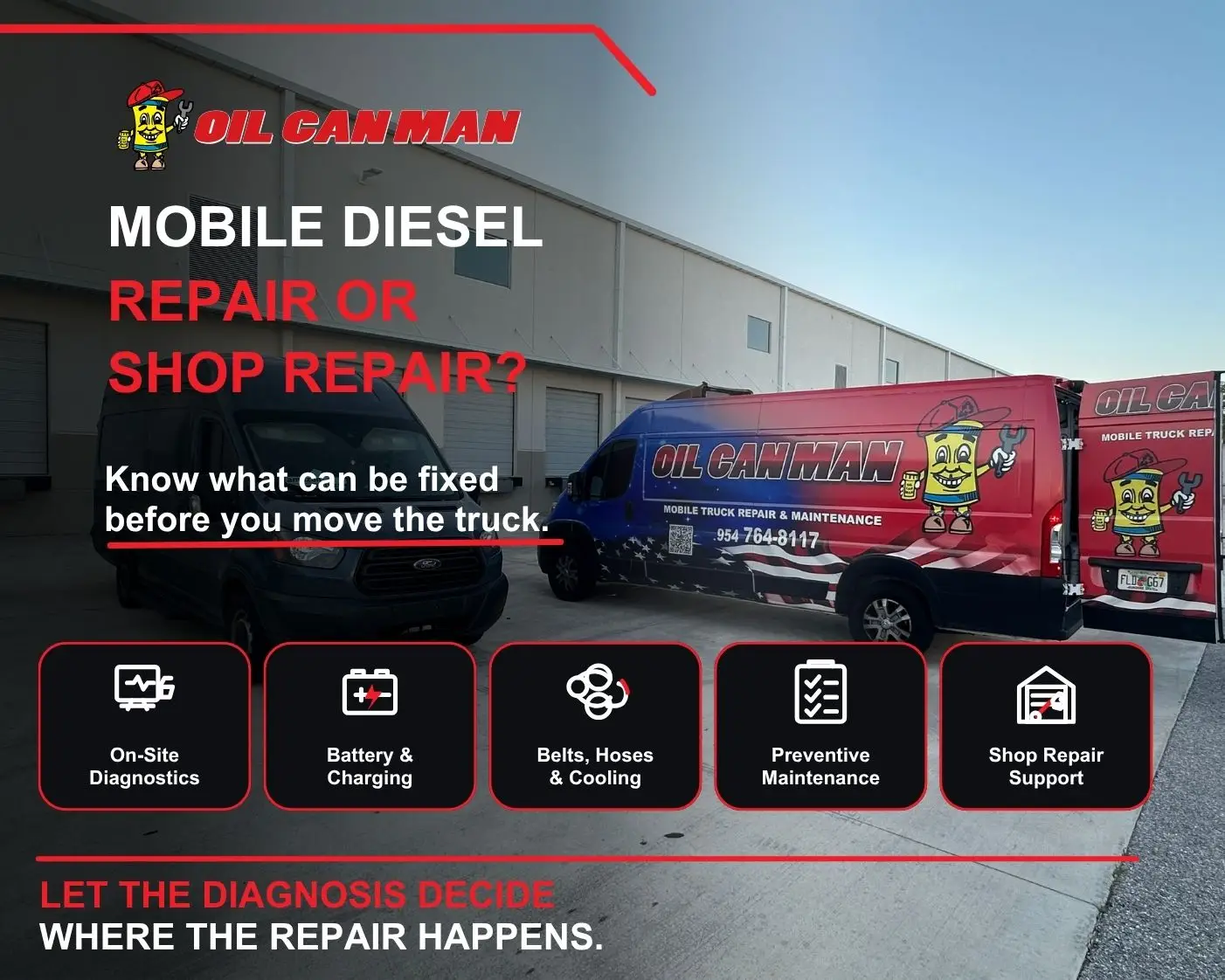
Know What Can Be Fixed Before You Move the Truck
A diesel truck develops a no-start, coolant leak, charging problem, warning light, or loss of power while it is sitting in your yard or at your job site. The immediate question for a fleet manager is often not just, “What’s wrong?” It is, “Can this be handled here, or does the truck need to go to a repair facility?”
The answer depends on the diagnosis, truck configuration, accessibility, repair complexity, site conditions, tooling, and parts required. Oil Can Man provides mobile fleet maintenance and repair services across Broward, Miami-Dade, and Palm Beach, with a Fort Lauderdale facility available for work that is better suited to a shop environment.
For fleet managers, understanding the difference can help avoid automatically towing a truck that may be serviceable on-site while also avoiding attempts to force major repair work into a mobile setting.
What Mobile Diesel Truck Repair Can Often Address On-Site
Mobile diesel service is particularly useful when a technician can safely access the affected system, perform proper diagnostics, and complete the required work without major disassembly or specialized shop equipment.
Computer Diagnostics and Fault Evaluation
Many modern diesel problems begin with electronic diagnosis.
A qualified technician may be able to connect diagnostic equipment, retrieve fault information, review relevant operating data, inspect related wiring or sensors, and determine what additional testing is needed.
Cummins explains that diesel engine electronic control modules can record fault codes that technicians use when troubleshooting engine problems. Fault information is useful for diagnosis, but a code should not automatically be treated as proof that a particular component has failed. Cummins Inc.
This makes mobile truck diagnostics useful for questions such as:
- Why will the truck not start?
- Why is a warning light active?
- Is the problem electrical or mechanical?
- Does the fault require additional testing?
- Can the repair reasonably be completed at the truck’s location?
Batteries, Starting and Charging Systems
Battery and charging problems are often practical candidates for on-site evaluation.
Depending on the diagnosis and access, mobile service may address:
- Weak or failed batteries
- Battery connections
- Charging-system concerns
- Starting-system problems
- Accessible wiring faults
- Certain external electrical components
A no-start condition does not automatically mean the battery is the cause. Starting, charging, fuel, electrical, control-system, and mechanical problems can create overlapping symptoms, so diagnosis should come first.
Cooling-System Leaks, Belts and Hoses
Visible cooling-system concerns and accessible engine-support components may also be suitable for mobile repair.
Examples may include:
- Coolant leaks
- Accessible hoses
- Worn belts
- Clamps and connections
- Certain external cooling components
- Fluid checks and service
Oil Can Man’s existing guidance on commercial fleet belt and hose failures discusses how heat, contamination, routing, wear, and installation can contribute to failures.
An overheating complaint should still be diagnosed instead of assuming a hose or coolant level is the only issue.
Preventive Diesel Fleet Service
Not every mobile diesel call begins with a breakdown.
Routine maintenance can be a strong fit for fleet-yard service because several trucks may be serviced while they are already parked.
Depending on vehicle requirements, preventive service may include:
- Oil and filter service
- Fluid checks
- Belt and hose inspections
- Battery checks
- Visual leak inspections
- Routine service inspections
- Manufacturer-required maintenance items appropriate for mobile service
Oil Can Man currently offers mobile oil change and preventive maintenance service as part of its South Florida fleet support. FMCSA also requires covered motor carriers to systematically inspect, repair, and maintain vehicles under their control, while leaving maintenance intervals fleet-specific or vehicle-specific rather than prescribing one universal PM interval.
Selected Fuel and Air-System Work
Some accessible external fuel and air-system components may be diagnosed or serviced on-site.
Whether the work belongs in the field depends on factors such as:
- Component location
- Fuel-system design
- Required pressure testing
- Contamination concerns
- Manufacturer procedures
- Required tooling
- Amount of disassembly
High-pressure fuel-system work and complex internal failures require proper equipment and qualified procedures. A fleet manager should describe the symptoms and let the technician determine the appropriate repair environment.
Not Sure Whether to Request Mobile Service or Arrange Shop Repair?
If a diesel truck is down at your yard, job site, or operating location, the first useful step is to describe the truck, symptoms, warning lights, whether it starts, visible leaks, and any recent repairs.
Oil Can Man can use that information to determine whether onsite diesel repair is a reasonable starting point or whether the truck is more likely to need facility-based diagnosis and repair. The company’s current service model specifically combines on-site fleet work with a 30,000-square-foot Fort Lauderdale shop.
When a Diesel Truck Is Better Suited to a Repair Facility
Mobile service has limits.
A facility is generally the more practical environment when the repair requires:
- Major engine disassembly
- Internal engine work
- Cylinder-head or bottom-end repairs
- Extensive transmission or driveline work
- Heavy lifting equipment
- Specialized machining
- Controlled cleaning or contamination procedures
- Extended disassembly
- Specialized testing unavailable in the field
Freightliner’s Cascadia service documentation illustrates this distinction. Its maintenance publications cover routine maintenance, while workshop manuals contain detailed removal, disassembly, assembly, installation, and repair procedures.
That is why “Can a mobile mechanic fix it?” cannot be answered solely from a warning light or driver complaint.
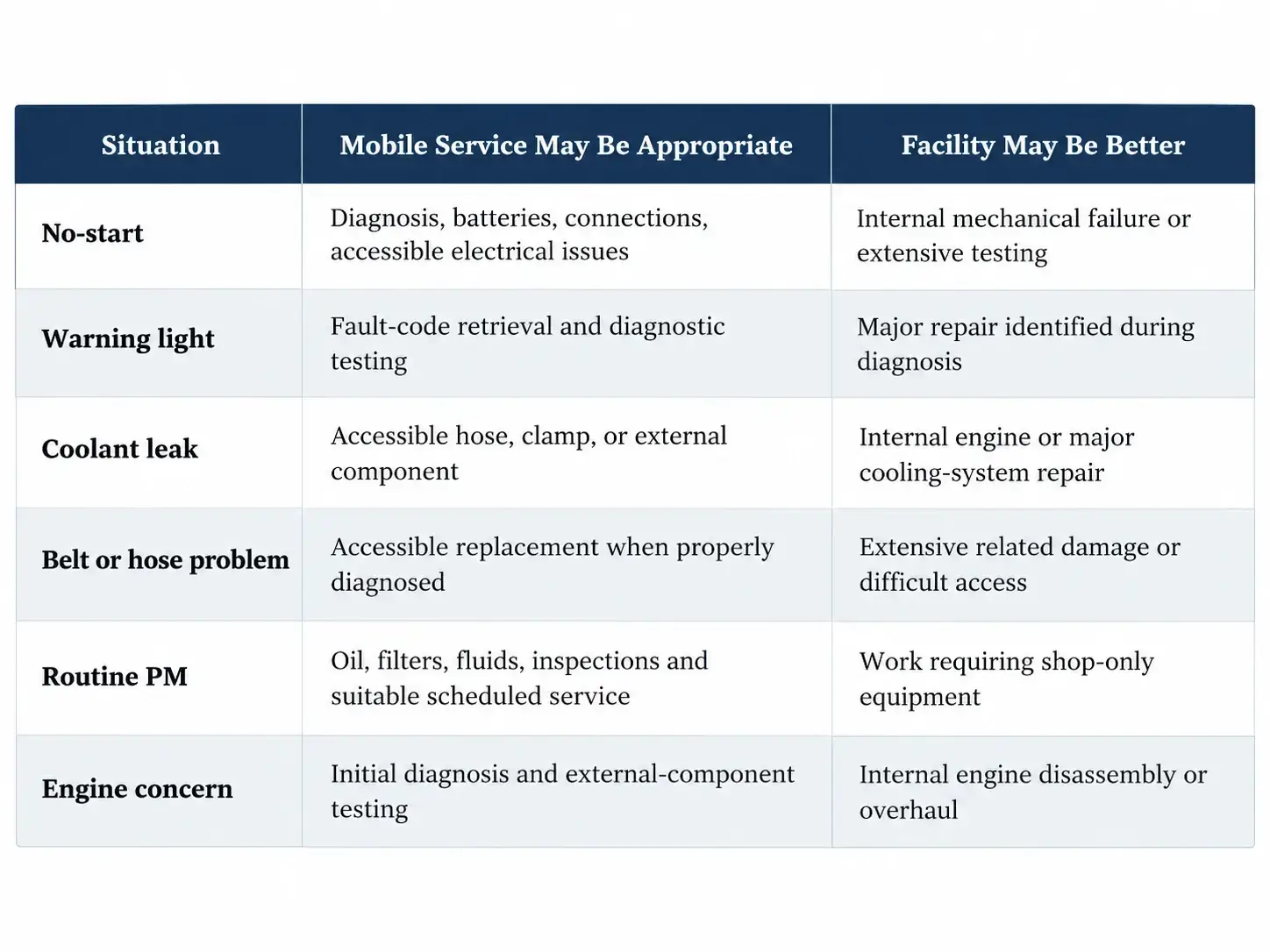
Diagnosis Should Decide Where the Repair Happens
One of the biggest advantages of mobile diesel repair is that diagnosis can sometimes happen before a towing or shop decision is made.
For example, a truck with an electrical no-start may be repairable where it sits. A truck showing similar no-start symptoms because of a deeper engine problem may require facility-based work.
The symptom alone does not determine the repair.
A useful service request should include:
- Truck make, model and vehicle type
- Diesel engine information when known
- Fleet location
- Whether the engine starts
- Active warning lights
- Driver-reported symptoms
- Visible leaks
- Recent repairs
- Whether the truck can move safely
- Number of affected vehicles
Providing this information helps the service provider prepare for the first diagnostic step without pretending the problem has already been identified.
Two Trucks With Very Different Outcomes
Consider a hypothetical South Florida delivery fleet with two diesel box trucks unavailable at the yard.
Truck A will not start. The driver reports that the engine cranks slowly and that electrical behavior changed before the truck was parked.
Truck B is losing coolant and has shown repeated overheating warnings.
Both problems could begin with mobile diesel truck repair and diagnosis.
Truck A might ultimately have an accessible starting or charging-system issue that can be addressed at the yard.
Truck B might reveal an external cooling-system problem suitable for mobile repair, or diagnosis may identify a condition requiring extensive engine work at a facility.
The important point is that the fleet manager does not need to guess which outcome applies before requesting diagnosis.
Use Mobile Repair Where It Fits and Shop Capability Where It Does Not
The best service model is not “everything mobile” or “everything goes to the shop.”
It is matching each repair to the environment where it can be diagnosed and completed properly.
Oil Can Man currently provides on-site fleet maintenance and repair across Broward, Miami-Dade, and Palm Beach, backed by its Fort Lauderdale repair facility for larger jobs. Its website also confirms that phones are answered 24/7 for fleet support.
Call (954) 764-8117 and describe the vehicle type, fleet location, current symptoms, warning lights, and whether the truck can move safely. Oil Can Man can discuss whether mobile diagnosis and repair or facility-based service is the more appropriate next step.
You can also use the Oil Can Man contact page to describe the diesel repair need.
Frequently Asked Questions
What can a mobile diesel truck mechanic repair on-site?
Depending on the diagnosis and truck configuration, mobile service may address batteries, charging and starting concerns, electrical faults, cooling-system issues, accessible belts and hoses, preventive maintenance, diagnostics, and selected external fuel or air-system components.
Can a mobile diesel mechanic diagnose a check-engine light?
Yes, electronic diagnostic tools may be used on-site to retrieve fault information and operating data. Fault codes are diagnostic clues, not automatic proof that the component named in a code has failed. Additional testing may still be required.
When should a diesel truck go directly to a repair facility?
Facility service is generally more appropriate when the job requires major disassembly, internal engine repair, heavy tooling, specialized equipment, machining, or another procedure that cannot reasonably or safely be performed in the field.
Can multiple diesel fleet trucks be serviced at the same location?
Scheduled preventive maintenance and suitable repairs may be grouped at a fleet yard when the work is appropriate for mobile service. More extensive jobs can be routed to a facility based on diagnosis and repair requirements. Oil Can Man currently supports both service models.