A Truck That Will Not Shift Can Quickly Become a Vehicle-Down Problem
When a semi truck transmission not shifting, the problem may appear as a truck that will not go into gear, remains stuck in one range, shifts harshly, misses shifts, delays engagement, grinds, or displays a transmission warning. For fleet managers, those symptoms affect more than drivability. They can interrupt routes, strand equipment, and make it difficult to know whether the truck needs a relatively focused repair or more extensive transmission work.
Oil Can Man provides mobile fleet maintenance and transmission, clutch, and rear-end service for commercial fleets throughout South Florida. Its current production site confirms diagnostic, repair, and rebuilding capabilities for manual and automatic transmissions, with mobile service when appropriate and a Fort Lauderdale facility for larger repairs.
The first diagnostic question should be simple: what type of transmission is in the truck? A manual transmission, automated manual transmission, and fully automatic transmission can produce similar driver complaints for very different reasons.
Start by Identifying the Transmission Type
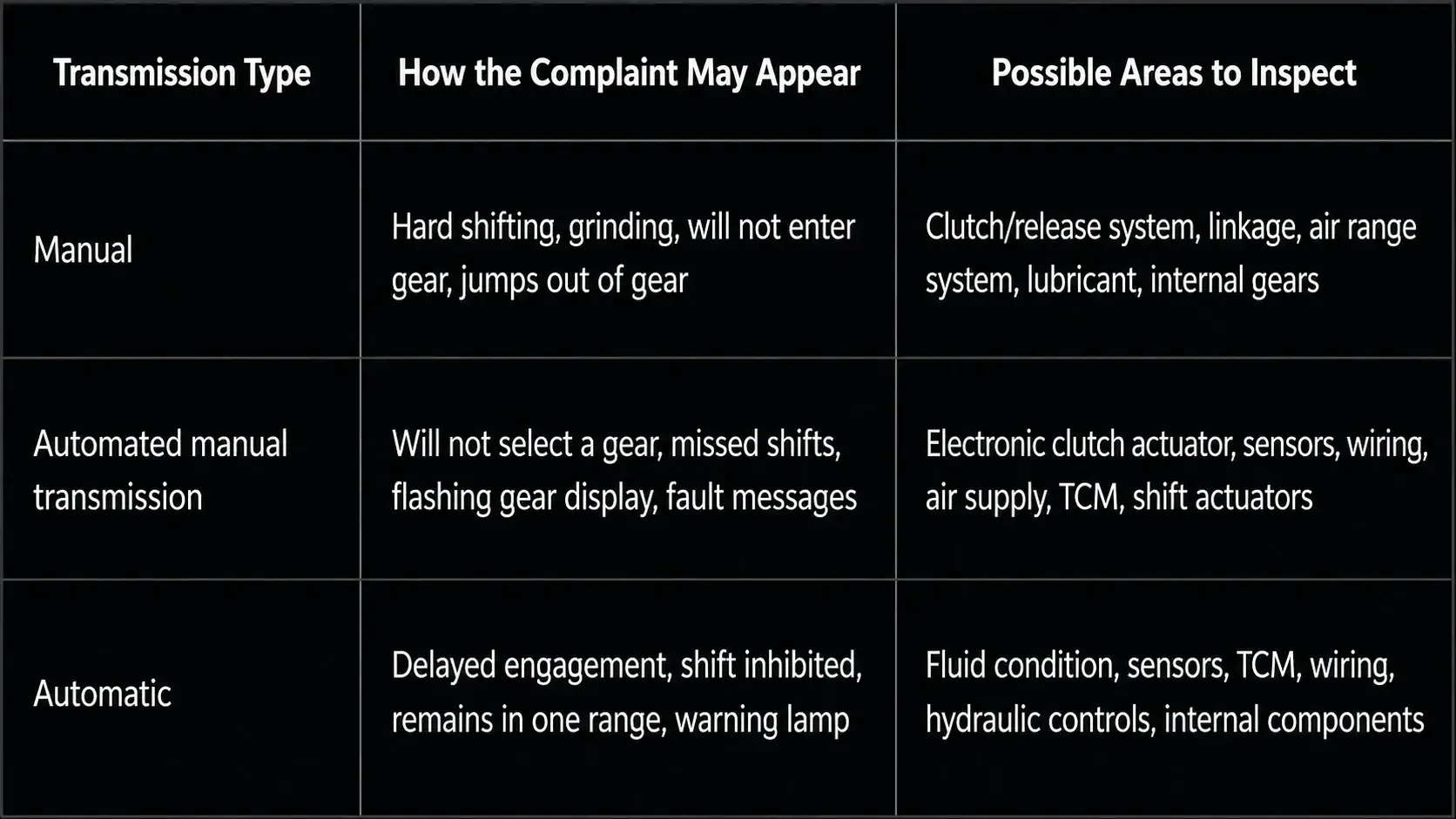
This distinction prevents a fleet from treating every truck that won’t go into gear complaint as the same transmission failure.
Manual Transmission: Clutch and Release Problems
On a manual transmission, difficult gear engagement can begin outside the transmission itself.
Possible causes include:
- Clutch drag
- Clutch-release problems
- Worn or binding shift linkage
- Clutch-brake problems
- Air-system faults on transmissions using air-operated range sections
- Internal transmission wear
Oil Can Man’s existing semi-truck clutch slipping article explains an important distinction: clutch slip occurs when engine torque is not transferred effectively, while clutch drag can make the transmission difficult to put into gear.
Eaton’s heavy-duty transmission troubleshooting guidance also identifies linkage problems, worn bushings, binding, improper adjustment, and internal shift-component problems as possible causes of hard shifting.
Review Eaton Fuller heavy-duty transmission troubleshooting guidance
A hard-shifting semi truck therefore needs diagnosis of the clutch, linkage, air controls where applicable, and transmission rather than an immediate assumption that the gearbox requires replacement.
Air-System Problems Can Affect Some Manual Transmissions
Many heavy-duty multi-range manual transmissions use compressed air to operate range-shift components.
Problems involving the air supply, control valves, lines, range cylinder, or related components can prevent the transmission from completing a range change.
Eaton documentation notes that range-shift complaints can involve air-system components and that insufficient air pressure can contribute to shifting problems.
That does not mean fleet personnel should begin disassembling pneumatic transmission controls. Air and transmission diagnosis should be performed using the correct service procedure for the specific transmission.
Automated Manual Transmission Problems Require a Different Approach
An automated manual transmission, or AMT, still contains mechanical gearing and a clutch, but electronic controls operate the clutch and shifting functions.
That means automated manual transmission problems may involve mechanical, electrical, pneumatic, or software-controlled components.
Possible areas include:
- Electronic clutch actuator
- Shift actuators
- Transmission control module
- Input and output speed sensors
- Wiring or connectors
- Vehicle communication network
- Brake-switch inputs
- Air pressure
- Clutch calibration
- Internal mechanical damage
Eaton’s Endurant diagnostic information shows why AMT diagnosis is different from a traditional manual transmission. Proper troubleshooting can involve fault-code retrieval, service software, electrical testing, air-pressure evaluation, and transmission-specific diagnostic tools.
See Eaton Endurant diagnostic and troubleshooting resources
A truck that refuses to engage a requested gear may therefore have a control or sensor problem rather than damaged internal gears.
Oil Can Man’s commercial truck electrical problems guide is also useful when transmission faults appear alongside intermittent wiring, connector, voltage, or communication problems.
If a transmission is missing shifts, refusing to engage, displaying faults, or repeatedly returning with the same complaint, Oil Can Man can evaluate the truck and determine whether mobile diagnostics or facility-based commercial truck transmission repair is the appropriate next step.
Automatic Transmissions Can Intentionally Inhibit a Shift
A fully automatic transmission can produce a different version of the “won’t shift” complaint.
Potential causes include:
- Transmission-control faults
- Sensor inputs
- Wiring or communication problems
- Fluid level or condition
- Temperature-related protection
- Hydraulic-control problems
- Internal clutch or gear damage
Some automatic transmissions can intentionally inhibit certain shifts when operating conditions or active faults do not allow the requested range.
Allison’s 3000 and 4000 Series operator guidance, for example, describes situations where the control system may inhibit transmission operation or a requested range, with diagnostic codes or selector indications providing additional information.
Access current Allison transmission operator and diagnostic publications
This is another reason a transmission warning message should be recorded rather than cleared or ignored before diagnosis.
Lubrication Problems Can Affect Shift Quality and Component Life
Correct transmission lubricant is not interchangeable across every truck or transmission.
Low lubricant, incorrect lubricant, contamination, or leakage can contribute to poor operation and internal wear.
Eaton’s current Roadranger lubricant manual specifies approved lubricants and model-dependent requirements for its commercial transmissions.
Review Eaton’s Roadranger transmission lubricant manual
Fleet personnel should document visible leakage and service history, but fluid type, level-check procedure, and service intervals should follow the applicable manufacturer documentation.
Transmission Warning Signs That Deserve Higher Priority
Not every shifting complaint carries the same operational risk.
Prioritize professional assessment when the truck:
- Will not engage forward or reverse
- Becomes stuck in gear
- Repeatedly jumps out of gear
- Produces significant grinding
- Develops strong vibration with shifting
- Displays persistent transmission fault warnings
- Leaks transmission fluid
- Produces a burning odor
- Loses propulsion
- Shows a rapidly worsening shift problem
Continuing to force shifts when the truck is grinding or refusing engagement can make diagnosis more difficult and may contribute to additional damage.
A Practical Diagnostic Decision Tree for Fleet Managers
Fleet managers do not need to diagnose the internal transmission. They can improve the repair request by collecting the right information.
Step 1: Identify the transmission
Manual, AMT, or automatic?
Step 2: Describe the exact complaint
Does the truck refuse all gears, only one range, or certain shifts?
Step 3: Record operating conditions
Note whether the problem appears:
- Cold or hot
- Under load
- During acceleration
- After stopping
- During range changes
- Intermittently or continuously
Step 4: Record related symptoms
Capture dashboard messages, warning lamps, air-pressure concerns, unusual noises, leaks, burning smells, or electrical problems.
Step 5: Review recent repair history
Was the clutch, transmission, wiring, actuator, sensor, driveshaft, or related system recently serviced?
That information can shorten the path from “transmission problem” to a useful diagnostic plan.
Why Repeated Failures After Repair Need More Investigation
A transmission that develops the same complaint again should not automatically receive the same repair again.
Repeat failures can indicate:
- An unresolved clutch problem
- Incorrect adjustment or calibration
- Electrical or wiring faults
- Low air supply where applicable
- Lubrication problems
- Driveline alignment or related component issues
- Internal wear that was not previously identified
Maintenance records matter here. Oil Can Man’s commercial vehicle maintenance guide can help fleet managers incorporate transmission complaints and repair history into a broader preventive-maintenance process.
Similar Complaints, Different Repairs
Consider a hypothetical South Florida fleet operating three tractors.
Truck A has a manual transmission and suddenly becomes difficult to put into gear while stopped.
Truck B has an AMT that intermittently remains in neutral and displays a transmission fault.
Truck C has an automatic transmission that delays engagement and shows an active warning.
Calling all three “transmission failures” would hide useful information.
Truck A may require inspection of the clutch release system, linkage, air controls, and gearbox. Truck B may need fault-code, actuator, sensor, wiring, air, or clutch-system diagnosis. Truck C may require evaluation of fluid condition, electronic controls, sensor information, or internal automatic-transmission operation.
The same driver complaint can therefore produce three different diagnostic paths.
Mobile Diagnostics or Facility-Based Transmission Repair?
Mobile service can make sense for appropriate diagnostics, inspections, electronic testing, accessible external components, and certain repairs at the fleet location.
Facility service is more appropriate when the transmission requires:
- Major disassembly
- Internal gear repair
- Extensive clutch or transmission removal
- Precision rebuilding
- Specialized shop equipment
- More involved testing
Oil Can Man currently provides both mobile driveline service and facility-based transmission repair in Fort Lauderdale, allowing the service approach to follow the actual repair scope.
Get the Shift Problem Diagnosed Before Replacing Major Components
When a semi truck transmission is not shifting, the answer is not automatically a replacement transmission. Manual systems can involve clutch, linkage, air, lubricant, or internal problems. AMTs add sensors, actuators, wiring, electronic controls, and calibration. Automatic transmissions introduce their own hydraulic and electronic diagnostic paths.
Oil Can Man provides transmission, clutch, rear-end, and fleet repair throughout its South Florida service area, with mobile service when appropriate and a Fort Lauderdale facility for larger driveline repairs. The current production site lists (954) 764-8117 and the facility at 730 NW 7th Street, Fort Lauderdale, FL 33311.
Call Oil Can Man at (954) 764-8117 and describe the transmission type, symptoms, dashboard messages, operating conditions, and recent repair history to discuss the appropriate diagnostic and repair approach.
FAQs
Why won’t my semi-truck go into gear?
A truck won’t go into gear for several possible reasons, including clutch-release problems, shift linkage faults, air-system problems, electronic controls, actuators, sensors, wiring, lubricant issues, or internal transmission damage. The likely causes depend heavily on the transmission type.
What causes hard shifting in a manual semi-truck?
A hard-shifting semi truck may have clutch drag, linkage problems, range-shift air-system faults, lubricant problems, worn shift components, or internal transmission wear. Eaton specifically identifies linkage and internal shift-system conditions among potential hard-shifting causes.
Can electrical problems cause an automated transmission not to shift?
Yes. AMTs rely on electronic controls, sensors, actuators, connectors, vehicle-network communication, and other inputs. Electrical diagnosis and fault-code information can therefore be an important part of troubleshooting automated manual transmission problems.
Can mobile service diagnose a commercial truck transmission problem?
Some diagnostic, electrical, external component, and drivability work may be suitable for mobile service. Internal disassembly, major transmission removal, rebuilding, or repairs requiring specialized equipment may be better handled at Oil Can Man’s Fort Lauderdale facility.