Why Trailer Floor Pricing Varies So Much
When a trailer floor develops soft spots, broken boards, punctures, loose sections, or damage around a loading area, fleet managers usually want to know one thing first: what will it cost to repair? The trailer floor replacement cost cannot be answered responsibly with one universal number because the scope can range from a localized repair to removal of the entire floor and repair of damaged support structure underneath.
For South Florida fleets operating box trucks, dry vans, trailers, and other commercial equipment, Oil Can Man provides mobile fleet repair and facility-based service. Its current production site specifically lists heavy-duty floor repair and replacement for trucks, trailers, and box vans, along with mobile onsite service when the repair is suitable for field work.
A useful estimate starts by identifying the vehicle, floor construction, damaged area, underlying structure, and how the equipment is used.
What Affects Trailer Floor Replacement Cost?
Several variables determine whether a job remains a straightforward box truck floor repair or becomes a larger structural and flooring project.
1. Trailer Type and Floor Dimensions
A short box truck, dry van, refrigerated trailer, flatbed, and utility trailer can use very different floor systems.
Larger floors generally require more material and removal work, but dimensions alone do not determine the quote. Construction matters too.
Hyundai Translead’s operator guidance, for example, distinguishes laminated wood flooring in dry vans from aluminum floor systems used in refrigerated trailers. It also calls for inspection of boards, fasteners, subfloors, cracks, deformation, and other floor-system components.
Review Hyundai Translead trailer floor inspection guidance
Before requesting an estimate, fleet managers should provide the trailer or truck type, make, model, year when available, body dimensions, and intended cargo use.
2. Flooring Material
Material choice can significantly affect commercial trailer floor repair cost because different vehicles may use hardwood, aluminum, composite systems, or other manufacturer-specific flooring.
Great Dane’s current maintenance manual describes the floor as a system rather than an isolated surface. Its guidance calls for checking floorboards, fasteners, crossmembers, forklift impact areas, welds, and other structural connections.
That distinction matters. Replacing a damaged wooden section is a different project from repairing an aluminum reefer floor or matching a specialized commercial flooring system.
Fleet managers should avoid selecting replacement material solely because it is cheaper. Floor thickness, construction, load requirements, fastener pattern, and compatibility with the existing body should follow the applicable manufacturer specification.
3. How Much of the Floor Is Actually Damaged?
A complete trailer decking replacement is not always necessary.
A professional inspection may identify one of three general scopes:
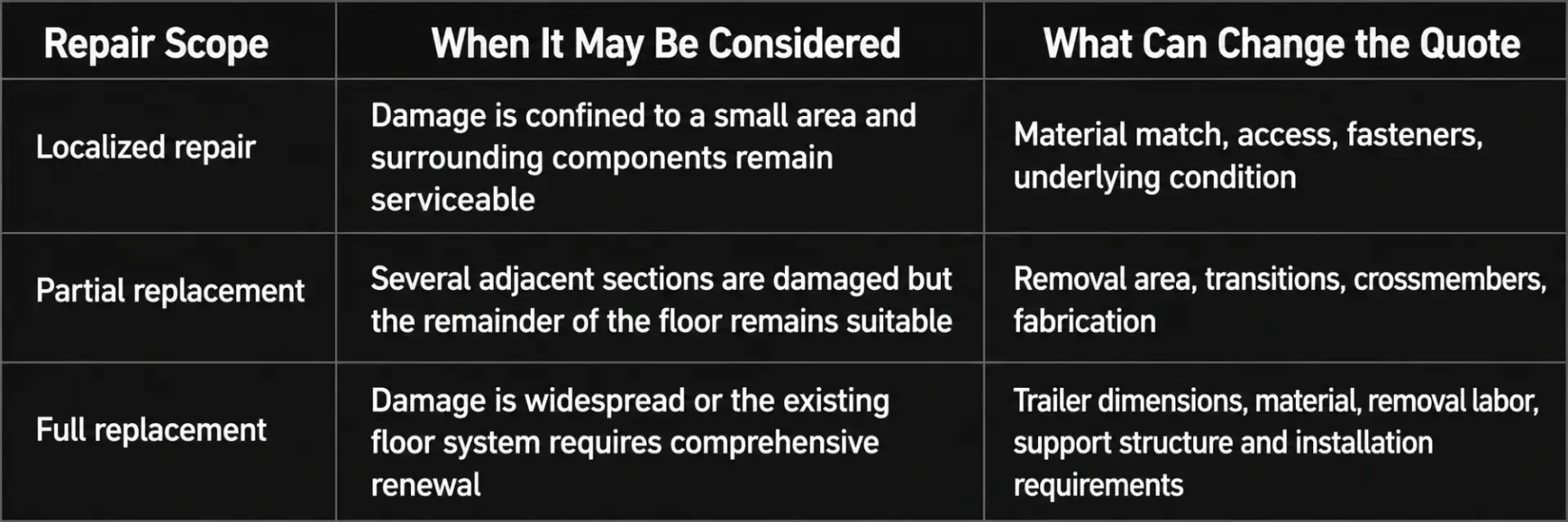
The repair vs replace trailer floor decision should be made after evaluating what exists beneath and around the visible damage, not simply by counting damaged boards.
4. Hidden Damage Beneath the Flooring
One of the biggest variables in a trailer floor replacement cost quote is what becomes visible after damaged flooring is inspected or removed.
Potential concerns include:
- Bent or damaged crossmembers
- Corrosion
- Loose or missing fasteners
- Damaged supports
- Deformation around loading areas
- Previous repairs
- Structural damage from impact
Great Dane specifically recommends inspecting crossmembers and connections along with the top floor. Hyundai Translead similarly treats floorboards, fasteners, sidewall bases, subfloor, and crossmembers as parts of the complete floor system.
This is why photographs of the visible floor can help start the conversation, but they cannot always establish the final repair scope.
If damage extends into the vehicle’s frame or chassis, federal requirements also become relevant. Current 49 CFR 393.201 states that a commercial motor vehicle frame or chassis must not be cracked, loose, sagging, or broken, and welded frame repairs must follow vehicle-manufacturer recommendations.
Review current federal commercial vehicle frame requirements
5. Removal and Preparation Work
The new floor is only part of the job.
The existing decking may need to be removed around:
- Cargo tracks
- Thresholds
- Wear plates
- Fasteners
- Tie-down points
- Interior fixtures
- Damaged structural components
Corroded or damaged fasteners can also make removal more involved.
Preparation should include evaluating the condition underneath before new material is installed. Installing new decking over unresolved structural deterioration can hide the original problem rather than correct it.
If your trailer or box truck has damaged, soft, loose, or deteriorated flooring, Oil Can Man can evaluate the visible damage and determine whether localized repair, partial replacement, or a larger floor-replacement project is appropriate. Explore rear roll-up door and floor repair services.
6. Forklift, Loading, Water, and Impact Damage
How the trailer is used can influence both the damage and the repair scope.
Great Dane’s maintenance guidance specifically calls out rear impact-area damage from forklift traffic as something to inspect. It also recommends checking wooden flooring protection and floor-system connections regularly.
Fleet managers should tell the repair provider whether the unit regularly handles:
- Forklift loading
- Pallet jacks
- Concentrated cargo
- Building materials
- Equipment
- Wet cargo
- Frequent dock loading
- Outdoor storage
Water intrusion or corrosion can also matter because visible surface damage may not show the full condition of the supports below.
A box truck floor repair after localized cargo impact may therefore require a different scope than deterioration spread across an older trailer floor.
7. Fabrication and Parts or Material Availability
Some flooring projects require straightforward replacement material. Others require matching an older body design, special profiles, fabrication, reinforcement, or manufacturer-specific components.
Material dimensions and configuration should be confirmed before the old floor is removed whenever practical.
For trailer decking replacement, the estimate may therefore depend on:
- Correct material availability
- Required lengths and profiles
- Fastener type
- Custom fitting
- Structural fabrication
- Previous modifications
- Trailer configuration
That is another reason generic online prices can be misleading.
Mobile Repair vs. Facility-Based Floor Replacement
Oil Can Man’s production site currently lists mobile onsite roll-up door and floor repair as well as a Fort Lauderdale repair facility. Its broader commercial trailer repair service also includes structural and floor work for commercial trailers, box trucks, flatbeds, and utility trailers.
Mobile service may be practical for an inspection or an appropriate localized repair when access, equipment, and repair scope allow it.
Facility service may make more sense when the job involves:
- Full floor removal
- Extensive structural inspection
- Crossmember repair
- Fabrication
- Large replacement sections
- Specialized equipment
- Significant disassembly
Mobile service should not automatically be assumed to cost less. For a fleet manager, its value may instead come from avoiding unnecessary vehicle movement when the work is suitable for onsite service.
What to Send Before Requesting a Trailer Floor Estimate
A better request for an estimate gives the repair provider enough information to understand the likely scope.
Provide:
- Trailer or box-truck type
- Make and model when available
- Approximate floor dimensions
- Flooring material if known
- Clear photos of the affected area
- Photos from underneath when safely obtainable without entering an unsafe work area
- Location of the damage
- Whether the floor feels soft, loose, cracked, punctured, or deformed
- Recent impact or water exposure
- Type of cargo normally carried
- Whether forklifts regularly enter the vehicle
- Previous floor repairs
- Fleet location and scheduling requirements
This information does not replace an inspection, but it can make the first conversation more useful.
Planning Repairs Without Pulling Every Trailer
Consider a distribution company operating ten dry-van trailers.
Two trailers show localized floor damage near their rear loading areas. A third has a wider section of deteriorated flooring and evidence that the support beneath it may need inspection.
The fleet manager does not assume all three need identical repairs.
Instead, the manager photographs each unit, records the trailer identification, notes where forklift traffic occurs, checks repair history, and identifies the days each trailer can be removed from dispatch.
The first two may be candidates for localized assessment. The third may need facility-based inspection because a larger trailer floor replacement and structural work could be involved.
The benefit of this approach is planning. The fleet can prioritize repair scope and vehicle availability instead of taking several trailers out of service at the same time.
Make Floor Inspection Part of Trailer Maintenance
Floor condition should not be reviewed only when a board breaks.
FMCSA requires motor carriers to systematically inspect, repair, and maintain commercial motor vehicles under their control and to keep applicable maintenance records. The regulation does not prescribe one maintenance interval for every fleet because maintenance programs must account for the equipment and operation.
Review FMCSA systematic maintenance requirements
A fleet trailer inspection can include:
- Floorboards or floor panels
- Fasteners
- Soft or damaged areas
- Crossmembers
- Rear loading zone
- Water intrusion
- Corrosion
- Previous repair areas
Oil Can Man’s existing DOT inspection checklist for commercial trucks and trailers provides additional guidance for organizing inspection readiness without treating a routine maintenance check as the same thing as a federal periodic or roadside inspection.
Plan the Repair Around Your Fleet Schedule
For trailer floor replacement cost planning, the repair invoice is only one part of the decision. Fleet managers should also consider when the trailer is available, whether another unit can cover its work, whether the repair can be grouped with other scheduled service, and whether the damage is expanding.
Oil Can Man provides mobile and facility-based trailer and floor repair for commercial fleets across its South Florida service area. The company’s current production website lists (954) 764-8117 as its primary service number and confirms onsite service across Broward, Miami-Dade, and Palm Beach.
Call Oil Can Man at (954) 764-8117 to discuss your trailer type, floor damage, operating schedule, and whether mobile assessment or facility-based repair is appropriate.
FAQs
How much does trailer floor replacement cost?
There is no single universal price for trailer floor replacement. Trailer size, flooring material, damaged area, removal requirements, substructure condition, fabrication, accessibility, and material availability can all change the estimate. A physical inspection may be necessary before the full scope is known.
Can only part of a commercial trailer floor be repaired?
Sometimes. Localized or partial repair may be appropriate when the damage is confined, and the surrounding flooring and support structure remain serviceable. Wider deterioration, structural damage, or multiple failing areas may justify a larger replacement.
What increases commercial trailer floor repair cost?
A commercial trailer floor repair cost can increase when damage extends beneath the visible surface, specialized materials are required, existing flooring is difficult to remove, structural components require attention, or extensive fabrication is needed.
Can trailer floor replacement be performed onsite?
Oil Can Man currently advertises mobile onsite floor repairs, but not every project is suitable for field service. Full trailer decking replacement, structural repair, or extensive disassembly may be more appropriate at the Fort Lauderdale facility.