Electrical Faults Can Take a Working Truck Off the Schedule
Commercial truck electrical problems can affect starting, lighting, trailer circuits, accessories, and electronic controls. For fleet managers, the concern is not simply whether a switch or light works. It is whether the truck can complete its route safely and whether an intermittent fault will return without warning.
South Florida heat, humidity, heavy rain, vibration, and coastal exposure can make electrical faults harder to reproduce, especially when corrosion develops at terminals, grounds, and connectors. Oil Can Man provides mobile fleet maintenance and commercial vehicle repair for businesses that need service coordinated around vehicle availability.
A useful diagnostic process starts by confirming the symptom, checking power and grounds, inspecting the affected circuit, and reviewing fault information before replacing parts. The same diagnostic discipline applies to semi truck electrical problems as well as box trucks, service vehicles, delivery trucks, and other commercial fleet units.
Common Causes of Commercial Truck Electrical Problems
Weak Batteries and Charging-System Faults
A battery may still power accessories while lacking enough capacity for reliable cranking. Alternator output, cable condition, terminal corrosion, grounds, and vehicle loads also affect starting and charging performance.
The official Freightliner New Cascadia Maintenance Manual calls for inspection of alternator, starter, battery, ground, and charging-system connections, including checks for corrosion, damaged cables, missing insulation, and heat damage.
Good fleet electrical maintenance therefore looks beyond the battery itself when a truck repeatedly cranks slowly or needs a jump-start.
Corroded Grounds and Damaged Wiring
Ground connections can develop unwanted resistance from corrosion, damage, or looseness. Harnesses can also rub against brackets, body equipment, and moving components until insulation or conductors are damaged.
These diesel truck wiring problems may appear only after vibration, rain, or temperature changes. Oil Can Man’s guide to corrosion affecting work trucks in coastal Florida specifically identifies battery terminals, grounds, and connectors as areas where corrosion can contribute to intermittent electrical problems.
Recurring diesel truck wiring problems deserve diagnosis before a fleet begins replacing batteries, sensors, or modules that may not be responsible for the fault.
Fuses, Relays, and Repeated Circuit Failures
A blown fuse is a symptom, not necessarily the root repair. The Volvo Trucks Driver Guide explains that fuses protect electrical circuits from overload and specifically warns against installing a fuse with an incorrect higher rating.
Faulty relays can also contribute to intermittent no-starts or accessories that work only under certain conditions. Professional truck electrical diagnostics should determine why a protective device or control circuit is failing rather than relying on repeated part replacement.
Parasitic Draws and Batteries That Keep Going Dead
Modern commercial trucks may have multiple systems using electrical power while the engine is off. An unintended draw or equipment remaining active can discharge batteries during storage.
Volvo’s current power-management guidance notes that trucks have numerous systems capable of consuming battery power and uses operating modes designed to limit unnecessary battery drain.
If one truck repeatedly has a dead battery after sitting, record how long it was parked, what accessories or auxiliary equipment remained connected, and whether similar vehicles have the same problem. Fleets storing vehicles outside can also incorporate these checks into an outdoor fleet maintenance program.
Starter, Trailer, and Auxiliary Electrical Problems
Clicking, slow cranking, or intermittent no-crank conditions can involve the battery, cables, starter, relay, or control circuit. This is why commercial vehicle electrical repair should be diagnostic-first instead of assuming that one symptom proves a specific component has failed.
Trailer connectors introduce another failure point. Moisture, worn connectors, damaged wiring, or previous repairs can affect trailer lights and auxiliary equipment. FMCSA guidance identifies lighting devices and reflectors among the equipment drivers must be satisfied is in good working order before operating a commercial motor vehicle.
If recurring electrical faults are affecting route availability, Oil Can Man’s mobile fleet maintenance services can help evaluate the problem and determine whether mobile service or more involved facility-based diagnosis makes sense.
Sensor Communication and Intermittent Electrical Faults
Modern trucks use electronic modules that exchange information throughout the vehicle. An intermittent sensor communication problem can involve the sensor, connector, wiring, power or ground supply, or communication network.
A diagnostic trouble code can help identify the affected system, but technicians still need testing and vehicle-specific service information before declaring a component defective. International’s Service Diagnostics Solutions supports diagnostic trouble-code retrieval and vehicle diagnostic functions for supported International vehicles.
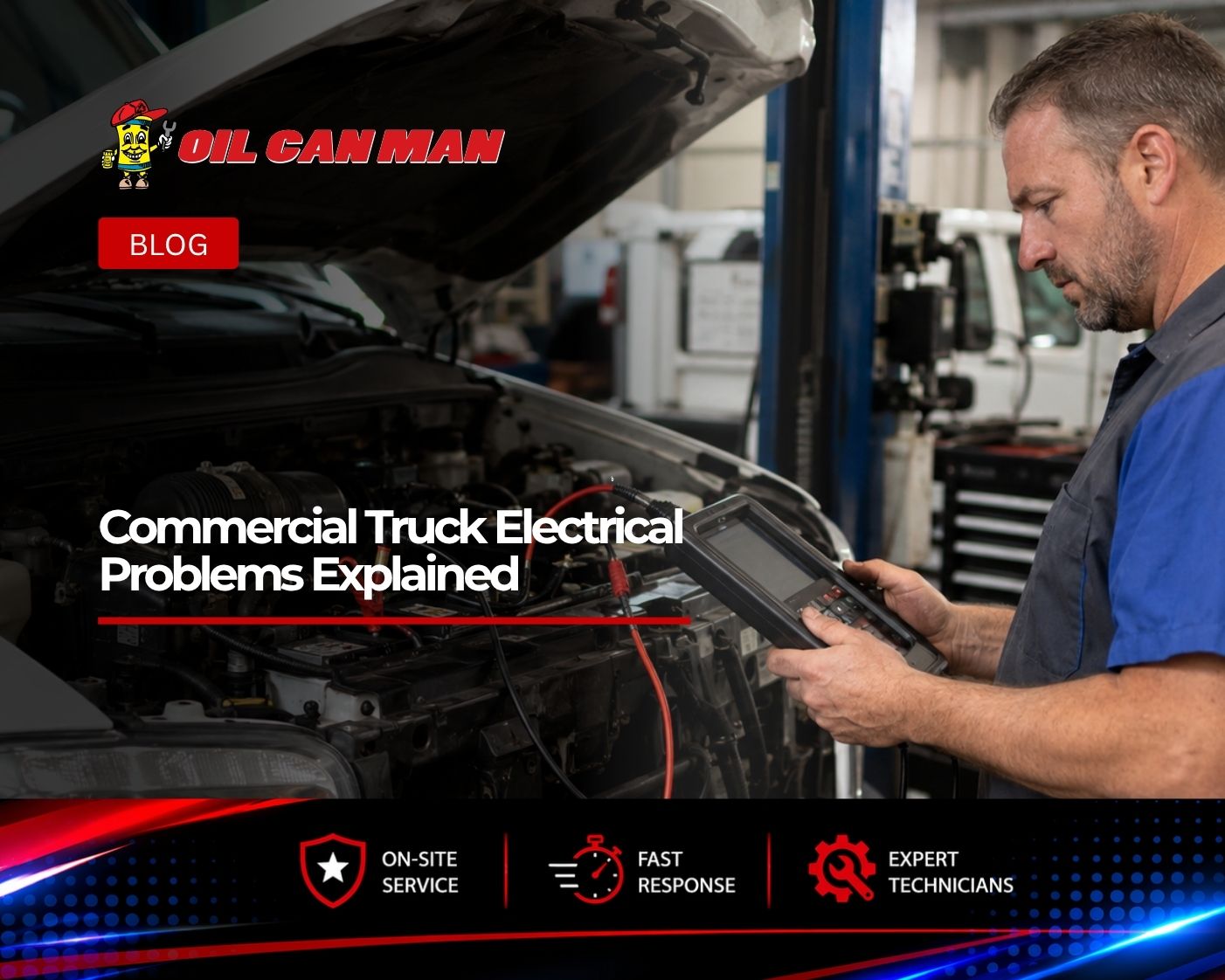
Professional truck electrical diagnostics may include code retrieval, circuit testing, live-data review, connector inspection, and comparison with the correct wiring information for the vehicle configuration.
Aftermarket equipment can make semi truck electrical problems more complicated when an installation introduces additional loads, relays, wiring, or control interfaces. A repair history that includes liftgates, lighting, telematics, refrigeration equipment, body equipment, or other electrical modifications can provide an important diagnostic clue.
Repeated jump-starting may get a vehicle running, but it does not explain why battery charge became too low. Fleets should follow manufacturer procedures rather than improvising around truck electrical systems.
Safe Checks Drivers Can Make
Drivers can collect useful information without opening harnesses or probing circuits. They can note:
- Whether the engine cranks normally, slowly, or not at all
- Which warning lamps or dashboard messages appear
- Whether headlights, brake lights, turn signals, and trailer lights work
- Visible corrosion or obviously loose battery connections
- Damage around trailer plugs or exposed wiring
- Whether the fault appears after rain, warm-up, vibration, or use of specific equipment
- Whether the truck recently required a jump-start
Drivers should not bypass fuses, install higher-rated fuses, or probe unfamiliar high-current circuits.
Which Electrical Problems Need Immediate Repair?
Not every electrical complaint carries the same operational priority.
Request immediate professional assessment when there is smoke, a burning odor, arcing, overheated wiring, repeated fuse failure, loss of required lighting, a charging fault threatening continued operation, or an electrical problem involving a safety-critical system.
Schedule prompt commercial vehicle electrical repair for recurring no-start conditions, unexplained battery discharge, intermittent warning messages, trailer-connector faults, or repeated accessory power loss.
Add developing issues to fleet electrical maintenance when inspections reveal early corrosion, loose connections, worn loom protection, or other deterioration before the circuit stops functioning.
For motor carriers subject to federal requirements, 49 CFR 396.3 requires systematic inspection, repair, and maintenance of vehicles under their control and requires records documenting inspection, repair, and maintenance activity.
Document Intermittent Problems Before the Service Call
Intermittent electrical complaints are easier to investigate when the repair request contains more than “electrical issue.”
Record the vehicle number, date and time, weather, operating condition, dashboard message, connected trailer or equipment, recent jump-starts, and previous wiring or accessory work.
A short photo or video of an intermittent warning light or lighting fault may also help when it can be recorded safely while the vehicle is stationary.
Consider three South Florida delivery trucks reporting different electrical symptoms.
One cranks slowly every morning. A second loses trailer lights after heavy rain. A third develops intermittent sensor communication faults after auxiliary equipment was installed.
Treating all three as battery failures wastes diagnostic time. The first needs starting and charging evaluation. The second needs the trailer circuit and moisture-prone connectors inspected. The third needs installation history, wiring information, and network diagnosis.
That is the difference between repeatedly replacing parts and disciplined truck electrical diagnostics.
Oil Can Man’s guide to comprehensive mobile fleet service includes battery and electrical-system checks among preventive fleet services and recognizes that major or specialized work may be better suited to the Fort Lauderdale repair facility.
Keep Electrical Faults From Becoming Repeat Downtime
Commercial truck electrical problems are especially disruptive when the symptom disappears before service begins. Better driver notes, preventive inspections, secure connections, and structured testing give fleet managers a stronger basis for deciding what needs repair and how urgently to act.
Oil Can Man supports businesses with mobile fleet maintenance and commercial vehicle repair throughout its South Florida service area, with facility-based service available when appropriate. Its current contact information lists (954) 764-8117 as the primary service number.
Call Oil Can Man at (954) 764-8117 to describe the vehicle, electrical symptoms, operating conditions, and repair history and discuss the appropriate next step for your fleet.
FAQs
What are the most common electrical problems in commercial trucks?
Common problem areas include weak batteries, charging-system faults, corroded grounds, damaged wiring, blown fuses, faulty relays, parasitic draws, starter circuits, trailer connections, lighting circuits, and intermittent electronic communication. The symptom alone may not identify the failed component.
Why does my truck battery keep dying even after replacement?
The battery may not be the root cause. Charging problems, poor cable connections, unintended electrical loads, accessories that remain active, or wiring faults can discharge a healthy battery. Starting and charging-system testing can help isolate the source.
Can a truck operate with an electrical warning light?
It depends on the system and fault. A nonessential accessory problem may have a different priority from a charging failure, required lighting fault, overheating wire, or warning involving a safety-critical system. When the effect is unclear, the vehicle should be professionally assessed before continued operation.
Can mobile service handle commercial truck electrical problems?
Some battery, charging, wiring, lighting, connector, and diagnostic work may be suitable for mobile service. Faults requiring extensive disassembly, specialized equipment, or more involved testing may be better handled at a repair facility. Oil Can Man currently provides both mobile fleet service and facility-based repair options.