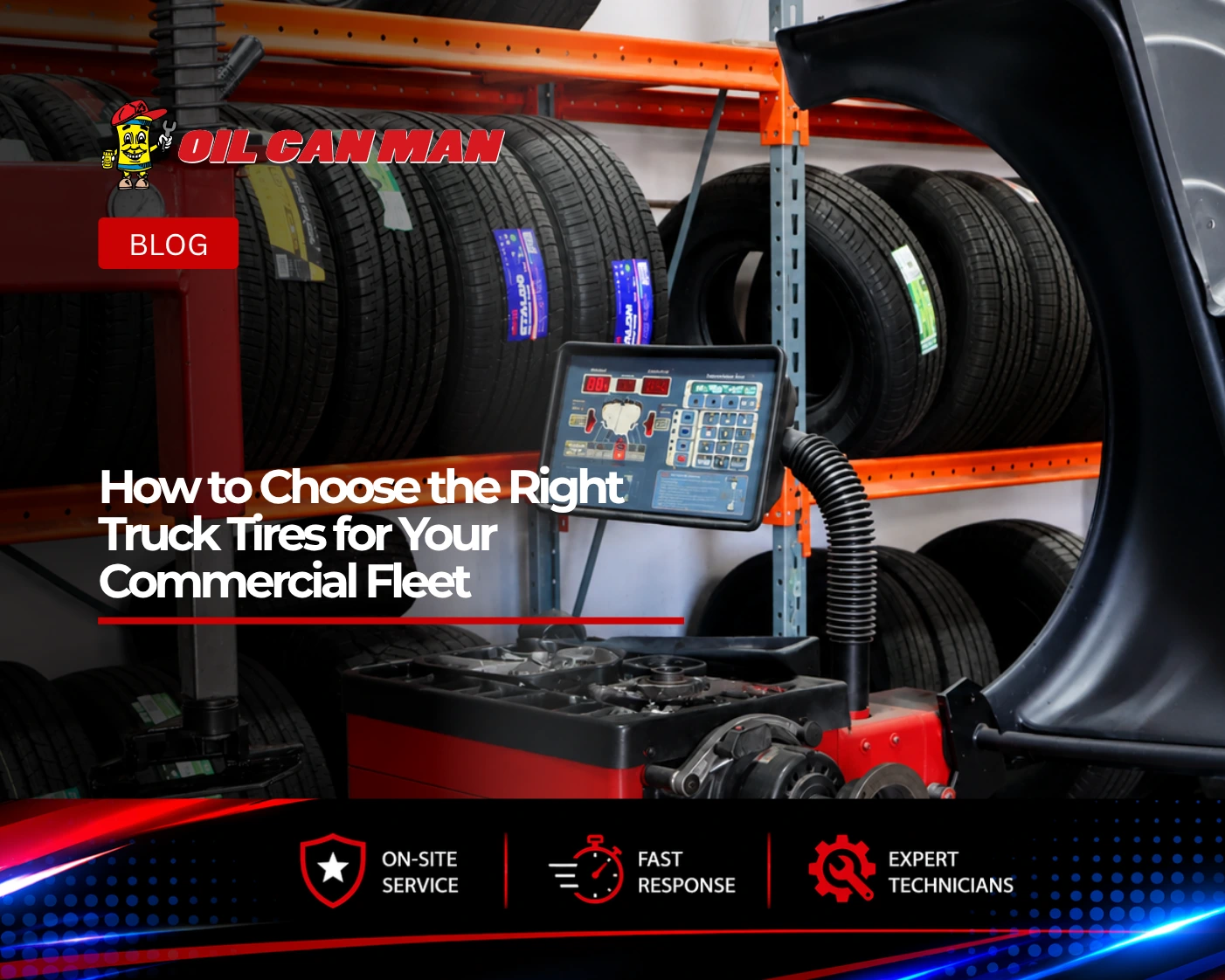
Better Tire Decisions Start With the Work Your Fleet Performs
One unexpected tire failure can cost far more than the price of a replacement tire. Delayed deliveries, roadside service, missed appointments, increased fuel consumption, and unnecessary downtime all reduce fleet profitability. Choosing the right commercial truck tires is one of the simplest ways to improve reliability while lowering long-term operating costs.
For fleet managers in Fort Lauderdale, the best tire strategy begins with vehicle application, axle position, load, route conditions, and total cost of ownership. Oil Can Man has helped South Florida fleets stay productive for decades by identifying tire problems before they become expensive breakdowns. Every tire recommendation should also fit into a broader preventive maintenance strategy, which is why tire planning should be coordinated with broader commercial vehicle maintenance.
Why Commercial Truck Tires Matter for Fleet Performance
Commercial truck tires influence nearly every aspect of fleet performance. Tire condition affects braking distance, steering response, traction, fuel economy, ride quality, and DOT compliance. Poor tire selection or neglected maintenance can lead to uneven wear, excessive heat buildup, frequent pressure loss, roadside failures, and reduced vehicle control under heavy loads.
Successful fleet managers look beyond the purchase price. They monitor tire pressure, tread depth, mileage, repair history, alignment, and cost per mile to identify trends before they become expensive repairs. This proactive approach reduces downtime, improves safety, and helps every vehicle stay productive.
Match Truck Tires for Fleets to the Application
The best truck tires for fleets depend on how each vehicle generates revenue. A dump truck working on construction sites has different tire requirements than a delivery van making dozens of city stops each day. Matching the tire to the application helps maximize service life while improving performance.
Construction vehicles often require heavy duty truck tires with stronger casings and aggressive tread patterns that resist cuts, punctures, and impact damage. Delivery vehicles may benefit more from predictable wear, wet-weather traction, and lower rolling resistance.
Route, Load, and Duty Cycle
Route conditions play a significant role in tire selection.
Long-haul highway fleets often benefit from rib-style tread designs that reduce rolling resistance and promote even wear over thousands of highway miles. Trucks operating in industrial yards, construction projects, gravel roads, or mixed terrain require tires built to withstand harsh surfaces and repeated impacts.
Fleet managers should evaluate gross axle weights, cargo patterns, towing requirements, fully loaded trips, and manufacturer recommendations before selecting heavy duty truck tires. Choosing the proper load rating protects both safety and tire longevity.
Local delivery fleets also experience repeated braking, curb contact, tight turns, and stop-and-go traffic. These operating conditions generate additional heat and shoulder wear, making durability and casing strength more valuable than maximum highway efficiency.
Understand Steer, Drive, Trailer, and All-Position Tires
Every axle position performs a different job.
Steer tires are responsible for handling precision, water evacuation, predictable steering, and even front-axle wear. Drive tires provide traction during acceleration, braking, and torque transfer while supporting stability under varying road conditions. Trailer tires are engineered primarily for load carrying, straight tracking, and long service life.
All-position tires may be appropriate in certain fleet applications when their tread design, load capacity, and intended service match manufacturer recommendations.
Using the wrong tire design in the wrong position can reduce tire life, increase operating costs, and negatively affect vehicle handling.
Check Load Capacity and Compliance Requirements
Commercial fleet safety starts with proper load management.
Never exceed the maximum load capacity marked on a tire’s sidewall. Federal commercial vehicle tire safety requirements establish standards for damaged tires, exposed cords, inflation, and minimum tread depth. Front tires on covered commercial vehicles generally require at least 4/32 inch of tread, while other tires generally require at least 2/32 inch.
Fleet managers should verify tire size, load range, inflation recommendations, rim compatibility, and axle ratings before approving replacements. Heavy duty truck tires should also provide adequate casing strength for repeated high-load service. Maintaining documented tire specifications improves purchasing consistency while supporting DOT compliance.
Choose Tread for South Florida Conditions
South Florida creates unique demands for commercial truck tires.
Fleets operating throughout Fort Lauderdale, Miami, Palm Beach, and surrounding communities regularly encounter heavy rain, standing water, extreme pavement temperatures, construction debris, and year-round driving conditions.
Truck tires for fleets working in these environments should balance wet-weather traction, heat resistance, durability, and long-term wear. Choosing the right tread pattern helps reduce hydroplaning risk while improving overall fleet reliability.
Oil Can Man regularly helps fleet operators evaluate tread wear patterns that may indicate inflation problems, suspension issues, or alignment concerns before those conditions create costly roadside failures.
Balance Rolling Resistance With Durability
Rolling resistance measures the amount of energy required for a tire to roll under load. Lower rolling resistance generally improves fuel economy, but efficiency should never come at the expense of durability or traction.
The EPA reports that verified low rolling resistance truck tires and retreads can reduce costs and emissions by 3 percent or more for certain long-haul Class 8 tractor-trailer applications. Fleet managers should evaluate these potential savings alongside axle position, operating conditions, inflation management, expected mileage, and overall service demands.
Plan Tire Service Before the Next Breakdown
Waiting until a tire fails usually results in higher repair costs, scheduling disruptions, and unnecessary downtime.
Oil Can Man provides truck tire services and sales for trucks, trailers, vans, and heavy equipment throughout South Florida. Routine inspections identify pressure problems, alignment wear, damaged casings, irregular tread patterns, and tires approaching commercial truck tire replacement before they interrupt operations.
Compare Purchase Price With Total Cost
The lowest-priced tire is not always the least expensive option over its lifetime.
Fleet managers should compare expected mileage, fuel efficiency, repair frequency, retreatdability, casing quality, roadside service exposure, downtime risk, warranty coverage, and cost per mile before making purchasing decisions.
For example, imagine a Fort Lauderdale delivery fleet with twelve box trucks experiencing consistent outer-edge tire wear. Simply replacing the tires without diagnosing the underlying issue may lead to another premature replacement cycle. A professional alignment inspection could identify steering or suspension problems affecting multiple vehicles. Correcting the cause before commercial truck tire replacement protects the investment while extending tire life across the fleet.
Replacement decisions should also reflect each vehicle’s remaining service life. Oil Can Man’s fleet vehicle replacement strategy guide helps fleet managers determine whether continued maintenance or vehicle replacement offers the better long-term investment.
Retread or Replace Based on Casing Condition
Retreading can significantly reduce operating costs when the original casing remains structurally sound.
The Tire Retread & Repair Information Bureau explains that modern steel radial truck casings are designed for multiple tread lives when properly maintained. Its information on commercial truck tire retreading explains how the process works and why inspection quality matters.
Commercial truck tire replacement is generally appropriate when a casing has sidewall damage, exposed cords, severe irregular wear, repeated repairs, impact damage, or structural concerns. Professional inspections should determine whether retreading remains a safe option. Long-term value should always be balanced with safety and reliability rather than purchase price alone.
Build a Preventive Truck Tire Maintenance Program
A preventive truck tire maintenance program consistently delivers lower operating costs than reactive repairs.
Routine inspections help fleets detect problems early while maximizing tire life and reducing emergency service calls. A comprehensive maintenance program should include pre-trip inspections, cold-pressure readings, tread-depth measurements, sidewall inspections, valve checks, balancing, alignment, rotation when appropriate, and detailed repair records.
NHTSA recommends regular inspections of inflation, tread wear, and tire damage together with rotation, balancing, and alignment. Its tire safety and maintenance tips provide useful guidance for commercial vehicle operators and driver training.
Warning signs include uneven tread wear, sidewall cracking, bulges, vibration, steering pull, recurring air loss, reduced wet-weather traction, exposed cords, and repeated flats. Vehicles showing these symptoms should be inspected before returning to service.
Truck tire maintenance can also be coordinated with mobile trailer repair services to reduce multiple service interruptions and keep more vehicles on the road.
Protect Uptime With a Smarter Fleet Tire Strategy
Choosing commercial truck tires requires more than comparing tread patterns or purchase prices. Every tire decision should support fleet uptime, safety, compliance, fuel efficiency, and long-term operating costs. Evaluating vehicle application, load requirements, axle position, tread design, regional driving conditions, casing quality, maintenance history, and total lifecycle value helps fleets make smarter investments.
Oil Can Man supports commercial fleets throughout Fort Lauderdale and South Florida with inspections, preventive maintenance, truck tire maintenance, mobile fleet service, and commercial truck tire replacement. Whether you manage a handful of work trucks or an entire commercial fleet, experienced technicians can help identify problems before they become expensive breakdowns. Reduce downtime, extend tire life, and improve fleet reliability by contacting Oil Can Man or calling +1 954-764-8117 to schedule professional fleet tire service.
Frequently Asked Questions
How often should a fleet inspect tire pressure?
Drivers should complete pre-trip inspections daily, while accurate pressure readings should be taken regularly with cold tires. High-mileage, heavily loaded, or severe-duty vehicles may require more frequent inspections.
When should a commercial truck tire be replaced?
Replace commercial truck tires when tread reaches legal or company replacement thresholds, casing damage affects safety, repairs are no longer appropriate, or performance concerns increase operational risk.
Are retreaded tires suitable for commercial fleets?
Yes, when the casing remains structurally sound, the retreading process follows industry standards, and the tire is installed in an appropriate application and axle position.
Can alignment problems shorten tire life?
Absolutely. Poor alignment accelerates shoulder wear, causes steering pull, reduces fuel efficiency, and shortens tire life. Correcting alignment issues is an important part of effective fleet tire management.