The Cheapest Maintenance Quote Can Become the Most Expensive Choice
A low labor rate means very little if your trucks spend hours traveling to a repair shop, approvals get delayed, maintenance records are incomplete, or the provider cannot handle the vehicles and equipment your business actually operates. For fleet managers, choosing a fleet maintenance company is an operational decision, not simply a repair-price comparison.
The right provider should fit the way your fleet works. That means understanding your vehicle classes, service locations, preventive maintenance requirements, repair priorities, reporting needs, and what happens when a job cannot reasonably be completed in the field. For South Florida businesses, Oil Can Man’s mobile fleet maintenance services combine on-site support with access to a Fort Lauderdale repair facility when more extensive shop work is appropriate.
Before choosing a provider, use the following checklist to compare operational fit, service coverage, communication, documentation, and fleet availability.
1. Confirm the Provider Can Service the Vehicles You Actually Operate
Start with vehicle and equipment capability.
A fleet of light-duty service vans has different maintenance requirements from a mixed operation that includes box trucks, commercial trailers, forklifts, diesel trucks, or hydraulically operated equipment.
Ask potential fleet maintenance vendors:
- What vehicle classes do you regularly service?
- Can you support both gasoline and diesel vehicles?
- Do you work on trailers as well as powered vehicles?
- Can you service hydraulic equipment when needed?
- Which repairs can be completed on-site?
- Which repairs normally require a facility?
- How do you handle work outside your technical scope?
Do not accept vague answers such as “we work on everything.” Ask how the provider would handle the specific makes, vehicle classes, trailers, and equipment in your operation.
2. Compare Mobile Service With Facility Capabilities
Mobile maintenance can be valuable when several vehicles are parked at the same yard, job site, warehouse, or operating location. Routine maintenance, inspections, diagnostics, and appropriate repairs may be completed without sending every vehicle away from the business.
However, mobile service is not automatically the right answer for every repair.
Major disassembly, structural repairs, specialized equipment, or extensive component work may be more appropriate in a repair facility.
When evaluating a fleet maintenance provider, ask:
- Which services are routinely performed at fleet locations?
- How are jobs evaluated before dispatch?
- What happens when the technician discovers that shop equipment is required?
- Can multiple vehicles be scheduled during one service visit?
- How are vehicles prioritized when several units need attention?
A strong commercial fleet maintenance service should be able to explain when mobile repair makes operational sense and when facility-based service is the better choice.
3. Review the Preventive Maintenance Process
A fleet service company should do more than react when something breaks.
Ask how the provider organizes:
- Mileage-based service requirements
- Engine-hour-based maintenance where applicable
- Manufacturer recommendations
- Inspection findings
- Previous repair history
- Recurring problems
- Upcoming maintenance
- Vehicle-specific service records
Maintenance intervals should not be identical for every fleet. Vehicle configuration, manufacturer requirements, load, idle time, duty cycle, operating environment, mileage, and service history can all affect the maintenance plan.
For motor carriers subject to FMCSA requirements, 49 CFR §396.3 requires systematic inspection, repair, and maintenance of covered vehicles and specifies maintenance-record requirements.
That makes documentation an important vendor-selection question, not an administrative afterthought.
4. Ask to See What the Repair Documentation Looks Like
Good documentation helps fleet managers answer three basic questions:
- What was inspected?
- What was repaired?
- What still needs attention?
Ask a prospective provider to explain its normal reporting process.
Useful records may include vehicle identification, service date, mileage or engine hours when relevant, work performed, inspection findings, parts used, recommended follow-up, and upcoming maintenance needs.
Clear reporting also helps when multiple managers, drivers, locations, or vendors are involved.
If a provider cannot explain how service history is documented, consider how difficult it may become to track repeated failures, upcoming maintenance, or unresolved repair recommendations.
5. Evaluate DOT Inspection Support Carefully
If your operation uses commercial motor vehicles subject to federal inspection requirements, ask exactly what the provider means when it offers DOT inspection support.
Do not treat annual or periodic inspections, driver pre-trip inspections, roadside inspections, and preventive maintenance inspections as interchangeable.
FMCSA states that covered commercial vehicles must undergo a periodic inspection at least once every 12 months under §396.17, subject to the applicable rules and inspection requirements.
Questions to ask include:
- Does the provider perform the inspection applicable to our vehicles?
- Are inspectors qualified for the inspection being performed?
- What documentation will we receive?
- How are defects communicated?
- How are repairs handled when an inspection identifies a problem?
- Can inspection scheduling be coordinated across multiple vehicles?
Oil Can Man currently offers on-site DOT inspection services for South Florida commercial fleets alongside its broader fleet maintenance services.
6. Check Specialty Repair Coverage Before You Need It
A provider may be suitable for preventive maintenance but still require your team to coordinate several additional vendors when more specialized problems occur.
Review the services your fleet is most likely to require.
For example, companies operating liftgates, forklifts, trailers, dump equipment, or other hydraulically operated equipment may benefit from access to verified hydraulic repair services.
Businesses operating commercial trailers should also determine whether the provider can handle the types of trailer repair and maintenance their operation requires.
The objective is not necessarily to find one company that claims to do everything. It is to understand exactly what your primary provider can handle and what happens when another specialist is required.
Turn These Questions Into a Vendor Meeting Checklist
If vehicles are already losing productive time because maintenance requires multiple appointments, vendors, or unnecessary trips away from your operating location, review your current service process before the next breakdown.
Oil Can Man can discuss your fleet mix, maintenance requirements, service locations, and repair needs to determine which work may be appropriate for mobile service and which jobs are better suited to facility-based repair.
7. Evaluate Communication and Repair Approval Procedures
Repair delays are not always mechanical.
A vehicle may sit while the provider waits for authorization, a manager waits for diagnostic information, or both sides try to determine which work has already been approved.
Ask each fleet maintenance company:
- Who receives repair findings?
- How are estimates communicated?
- Can approval limits be established?
- What happens if additional damage is discovered?
- Who approves parts or additional labor?
- How are urgent items separated from work that can be scheduled later?
- How are updates provided when the scope changes?
Clear approval procedures are especially useful for fleets with several managers, locations, or vehicle types.
8. Ask How the Provider Handles Recalls and Outside Work
Your maintenance vendor will not necessarily perform every required repair.
Safety recalls, manufacturer-specific campaigns, warranty work, specialized body repairs, or other issues may need to be referred elsewhere.
NHTSA provides a VIN and license-plate recall lookup tool that fleet operators can use to check for open safety recalls.
Ask prospective providers how they communicate when a vehicle problem falls outside their scope. A provider that clearly identifies its limits can make planning easier than one that overpromises capabilities.
A Simple Fleet Maintenance Provider Comparison Framework
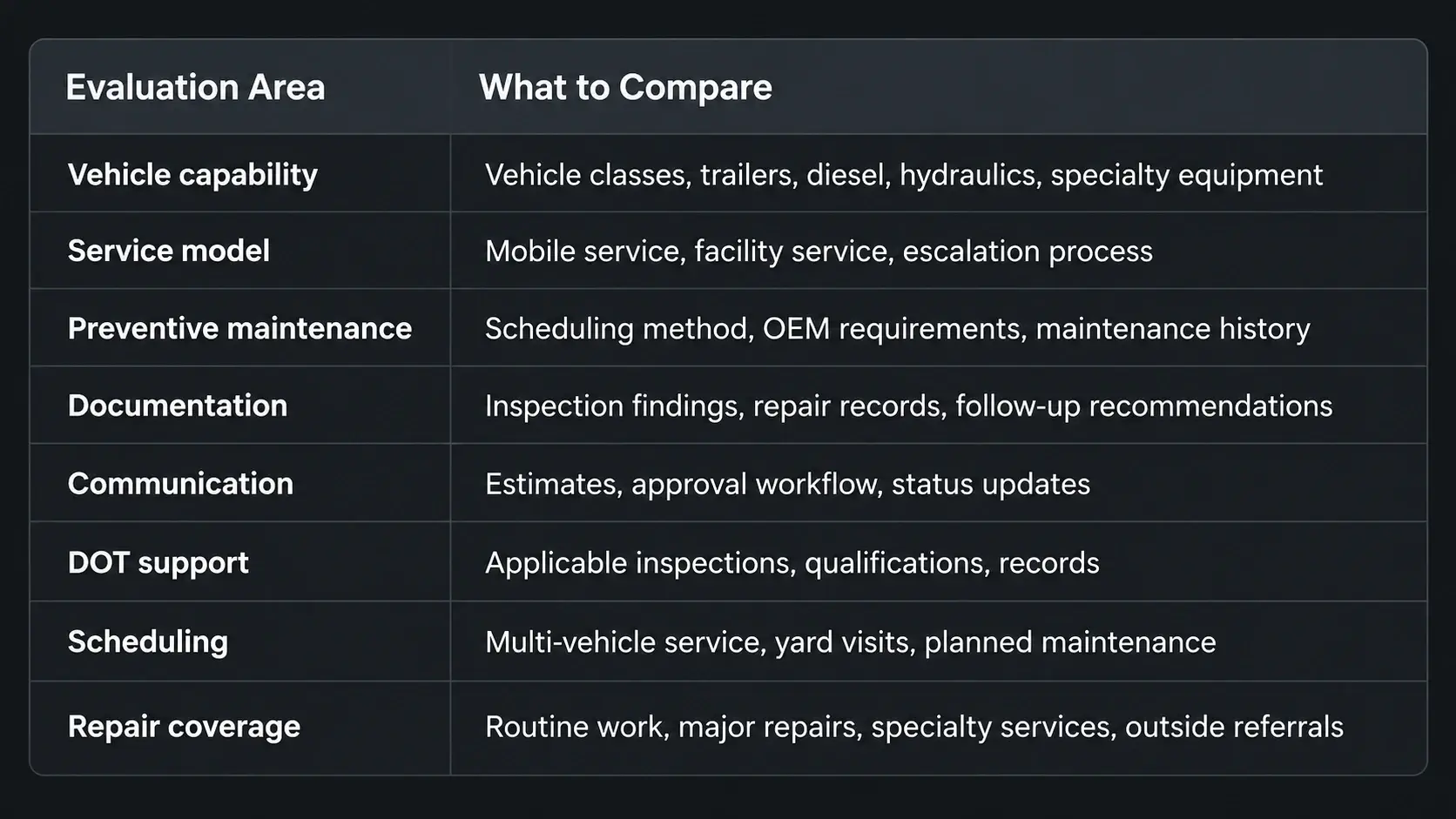
Avoid choosing solely on hourly labor rate. Compare how each provider supports the complete maintenance workflow and how that process affects fleet availability.
A 20-Vehicle Contractor Fleet
Consider a contractor operating 20 service trucks plus several commercial trailers.
Four trucks are due for preventive maintenance, one trailer has an electrical problem, and another vehicle has developed a hydraulic issue.
Sending every unit to separate repair facilities could require driver time, vehicle transfers, several appointments, and additional coordination.
A provider with appropriate mobile capability might schedule suitable preventive maintenance and diagnostics at the fleet yard. The hydraulic problem could be evaluated to determine whether mobile repair is practical, while work requiring extensive equipment or disassembly could be routed to a facility.
The advantage is not that every repair happens on-site. The advantage is having a defined process for deciding where and how each vehicle should be serviced.
Questions to Ask Before Signing With a Fleet Maintenance Provider
Before making your final decision, ask:
- Which vehicles and equipment in our fleet can you service?
- Which services can you perform at our location?
- What normally requires shop service?
- How do you build preventive maintenance schedules?
- What documentation will we receive after service?
- How do repair approvals work?
- Can several vehicles be serviced during one scheduled visit?
- What DOT inspection services do you provide?
- Can you support our trailers, diesel vehicles, or hydraulic equipment?
- What happens when a repair is outside your capabilities?
The quality and specificity of the answers are often more useful than a generic sales proposal.
Choose a Fleet Maintenance Partner Around the Way Your Business Operates
The right fleet maintenance company should fit your vehicles, operating schedule, maintenance requirements, reporting expectations, and service locations.
For businesses across Broward, Miami-Dade, Palm Beach, and the surrounding South Florida service area, Oil Can Man provides mobile fleet maintenance and commercial-vehicle repair, with additional facility-based capabilities in Fort Lauderdale.
Call (954) 764-8117 to discuss your fleet size, vehicle types, maintenance schedule, or current repair needs. You can also contact Oil Can Man to discuss a fleet service plan and determine whether mobile or facility-based service is appropriate for your operation.
Frequently Asked Questions
What should I look for in a fleet maintenance company?
Compare vehicle capability, preventive maintenance processes, mobile and shop service options, documentation, communication, specialty repair coverage, scheduling, and how the provider handles work outside its scope.
Is mobile fleet maintenance better than using a repair shop?
Not in every situation. Mobile service can reduce unnecessary vehicle travel for suitable maintenance and repairs, while major disassembly, structural work, or repairs requiring specialized equipment may be better handled at a facility.
What records should a fleet maintenance provider supply?
Records should clearly identify the vehicle, work performed, inspection or diagnostic findings, service date, and relevant follow-up recommendations. Fleets subject to specific regulatory requirements should ensure their records satisfy those requirements.
Can one fleet maintenance provider handle preventive maintenance and DOT inspections?
Some providers can support both, but fleet managers should verify the exact services offered, inspector qualifications where applicable, documentation process, vehicle classes supported, and which repairs can be performed on-site.