Clutch Slip Can Turn Into a Vehicle-Down Problem
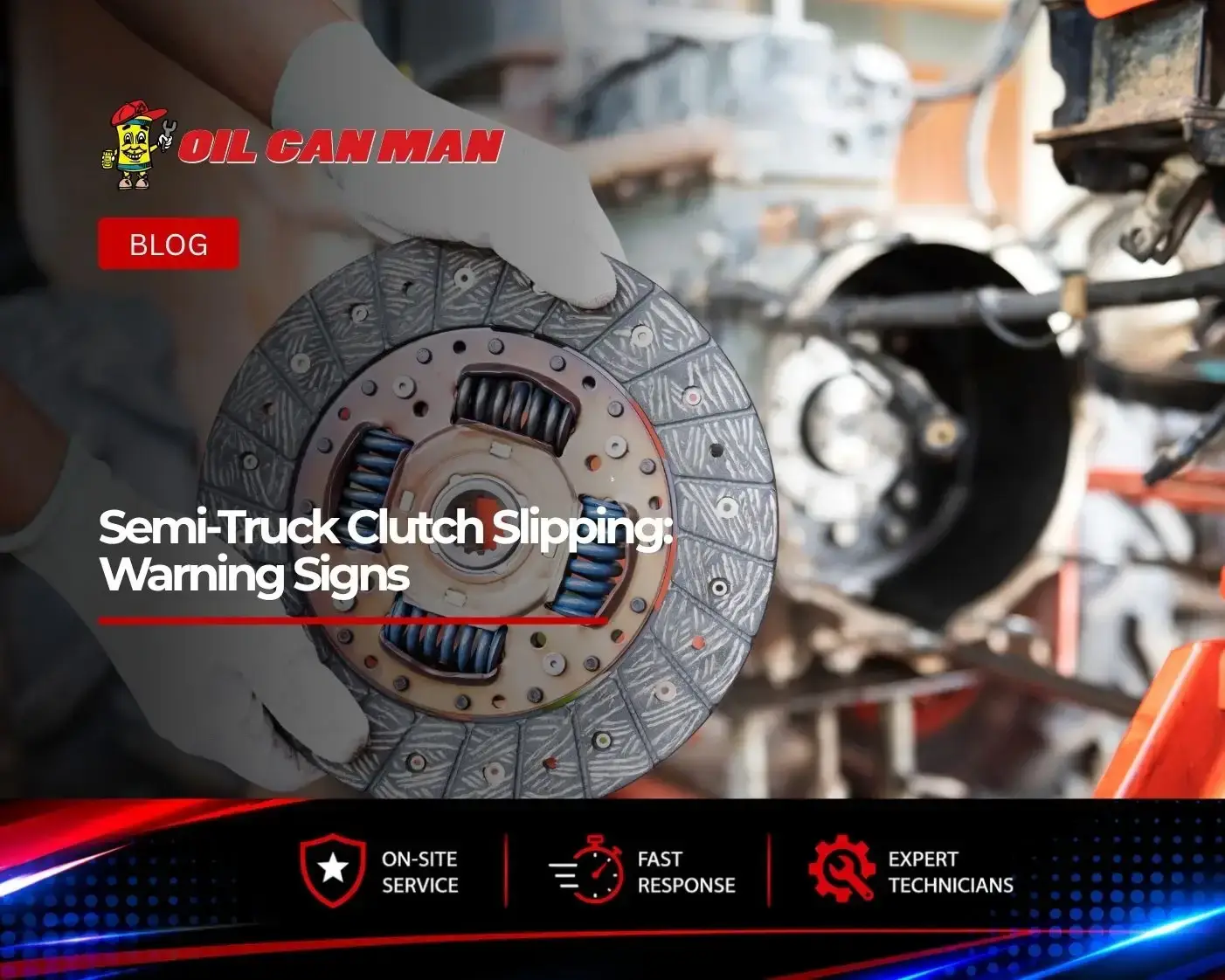
When engine RPM rises but road speed does not increase with it, the clutch may no longer be transferring engine torque effectively. Semi truck clutch slipping often becomes most noticeable while accelerating, climbing, pulling a load, or starting from a stop. For a fleet manager, the concern is not only drivability. Continued slip generates heat and can turn a manageable clutch issue into additional component damage and unplanned downtime.
Oil Can Man provides mobile fleet maintenance plus transmission, clutch, and rear-end service for commercial fleets throughout South Florida. Its current production site confirms clutch service and replacement, mobile driveline work when appropriate, and facility-based repair in Fort Lauderdale for more involved jobs.
Signs of a Bad Semi-Truck Clutch
Clutch complaints do not all point to the same failure. The operating condition when the symptom appears is important.
Engine RPM Rises Without Matching Acceleration
The classic slipping symptom is an increase in engine speed without a proportional increase in transmission input or vehicle acceleration. On Eaton UltraShift PLUS applications, the transmission control system detects clutch slip by comparing engine speed with input-shaft speed. That electronic strategy illustrates the basic mechanical problem: engine torque is not being transferred through the clutch as expected.
For a manual truck, drivers may first notice semi truck clutch slipping while pulling a grade, accelerating with cargo, or applying heavier throttle.
Slipping Gets Worse Under Load
A marginal clutch may appear acceptable during light operation but slip when torque demand increases. Payload, route profile, stop-and-go work, frequent low-speed maneuvering, and driver technique can all affect clutch heat and wear.
Eaton’s Clutch Failure Analysis Guide identifies excessive heat as a major cause of clutch failure and notes that an improperly adjusted or slipping clutch can generate enough heat to damage friction and metal components.
Difficult Shifting or Clutch Drag
A truck that is difficult to put into gear may have a release problem rather than a slipping problem. Eaton’s current Heavy-Duty Clutch Service Manual notes that worn input-shaft splines can prevent driven discs from moving freely and contribute to poor clutch release, also called clutch drag.
That distinction matters because clutch drag and clutch slip require different diagnostic paths.
Burning Odor After Heavy Clutch Use
A truck clutch burning smell after pulling, backing, maneuvering, or repeated stop-and-go operation may indicate excessive friction heat. Eaton warns that slipping and improper clutch operation can produce temperatures high enough to damage the driven discs, intermediate plate, pressure plate, and flywheel.
A persistent truck clutch burning smell, smoke, or rapidly worsening drivability deserves prompt professional inspection.
Pedal Feel, Chatter, or Repeated Adjustment Complaints
Changes in pedal feel, clutch chatter, inconsistent engagement, or repeated adjustment requests can point toward linkage, release-system, friction-surface, or internal clutch problems.
These are signs of a bad semi-truck clutch, but they do not prove that the entire clutch assembly needs replacement. Diagnosis should account for the clutch design, linkage type, wear condition, contamination, release bearing, pressure plate, and flywheel.
What Causes Semi Truck Clutch Slipping?
Normal Friction Wear
Clutch facings wear as they engage and transfer torque. Eventually, the assembly may lose enough usable friction capacity to slip under load.
Eaton’s clutch-slip diagnostic information includes wear, physical damage, and a worn-out clutch among possible causes.
Incorrect Adjustment
Some manual-adjust clutch designs require periodic adjustment. As wear progresses, an improperly adjusted clutch can begin slipping and generating excessive heat.
However, semi-truck clutch adjustment is not a universal fix. Self-adjusting and electronically controlled clutch systems follow different service procedures. Eaton specifically recommends self-adjusting clutches for hydraulic clutch linkages because pedal free play does not provide the same wear warning available with mechanical linkage.
A semi-truck clutch adjustment should therefore follow the clutch and vehicle manufacturer’s service procedure rather than an assumed measurement.
If a fleet truck repeatedly needs adjustment or continues slipping afterward, Oil Can Man’s transmission and clutch service can evaluate whether the complaint involves adjustment, wear, contamination, or another driveline condition.
Oil or Grease Contamination
Friction material cannot work correctly when contaminated. Eaton lists oil contamination, excessive release-bearing greasing, and engine oil reaching clutch facings among possible causes of clutch-slip faults.
The leak or contamination source needs to be corrected along with evaluating the clutch. Replacing friction components without addressing the source can allow the problem to return.
Driver Technique and Excessive Heat
Starting in an inappropriate gear, excessive slipping during takeoff, holding a truck on a grade with clutch engagement, or extended low-speed maneuvering can create significant clutch heat. Eaton’s driver guidance for automated manual transmissions similarly warns that prolonged clutch slip during takeoff can overheat the clutch and eventually cause failure.
Driver technique is only one possible factor. Fleet managers should not automatically blame the operator when mechanical wear, adjustment, contamination, or incorrect component application may also be involved.
When Should the Truck Come Out of Service?
A driver should report the problem promptly rather than repeatedly applying more throttle to compensate for loss of pulling power.
Prioritize professional inspection when:
- RPM rises noticeably without matching acceleration
- Slipping becomes severe under load or on grades
- The truck struggles to pull away normally
- Shifting or clutch release deteriorates significantly
- A strong burning odor or smoke develops
- The symptom becomes rapidly worse
- The truck cannot perform its assigned route reliably
Detailed clutch disassembly, adjustment, or transmission work should be left to qualified technicians using the applicable manufacturer procedures.
If clutch performance is disrupting route availability, Oil Can Man’s fleet service can help determine whether field diagnosis or facility-based heavy-duty clutch repair is the better next step.
Adjustment, Repair, or Truck Clutch Replacement?
The repair decision should follow inspection rather than mileage alone.
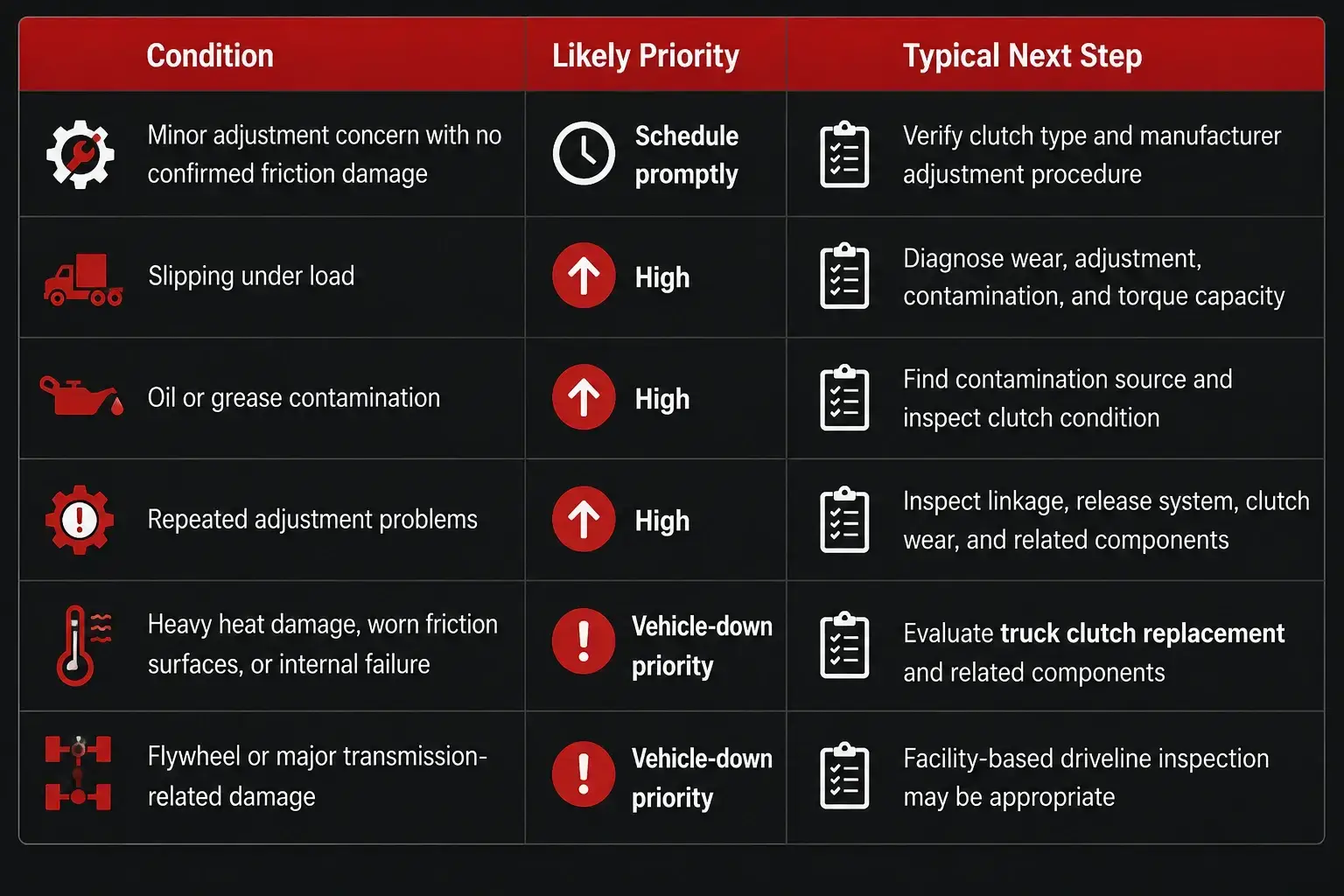
A truck clutch replacement may involve more than installing a friction disc. Eaton’s service procedures call for inspection of the flywheel, pilot bearing, input shaft, release components, and related transmission hardware.
Continued semi truck clutch slipping can also create enough heat to damage the flywheel. Eaton notes that a clutch that remains out of adjustment may begin slipping, creating heat that can ultimately require clutch replacement and potentially damage the flywheel.
Two Similar Complaints
Consider a South Florida distribution fleet with two manual-transmission tractors.
Truck A shows a change in clutch engagement but still transfers power normally. Truck B experiences rising RPM without matching acceleration while loaded and develops a hot friction odor after a route.
Truck A may warrant inspection of clutch adjustment, linkage, and wear before the condition progresses. Truck B should receive higher repair priority because confirmed slip under load suggests the clutch is already struggling to transfer torque.
Sending both trucks out with the same adjustment request could overlook a larger problem on Truck B. Good heavy-duty clutch repair starts with symptom-specific diagnosis.
Preventive Clutch Checks for Fleet Operations
Fleet managers can incorporate clutch condition into preventive fleet maintenance by tracking:
- Driver reports of slipping or difficult shifting
- Changes in clutch engagement or pedal behavior
- Burning odors after operation
- Adjustment history
- Fluid or oil leaks near the clutch housing
- Route and payload conditions when symptoms appear
- Repeated driver complaints on the same vehicle
Oil Can Man’s existing guide to regular clutch service also covers basic clutch warning signs. The new heavy-duty diagnostic approach is especially useful for fleet managers deciding how quickly a commercial truck should be removed from its schedule.
Address Clutch Slip Before the Truck Loses Pulling Power
A slipping clutch is not simply an inconvenience at the pedal. It affects how reliably engine torque reaches the drivetrain and whether the truck can perform the work assigned to it.
Oil Can Man provides transmission, clutch, rear-end, and mobile fleet service throughout South Florida, with a Fort Lauderdale facility available for larger driveline repairs. Its current contact information lists (954) 764-8117 as the primary service number.
Call Oil Can Man at (954) 764-8117 to describe the truck, clutch symptoms, load conditions, adjustment history, and when the slipping occurs so the team can discuss the appropriate mobile or facility-based service option.
FAQs
What are the most common signs of a bad semi-truck clutch?
Common warning signs include engine RPM rising without matching acceleration, slipping under load, difficult shifting, clutch drag, chatter, changes in pedal engagement, burning odors, and recurring adjustment problems. Diagnosis is important because release-system faults and clutch slip are not the same condition.
Can a semi-truck clutch be adjusted instead of replaced?
Some manual-adjust clutches can be adjusted when wear and component condition remain within the manufacturer’s service limits. Self-adjusting and electronically actuated clutches use different procedures. Adjustment will not correct badly worn, contaminated, heat-damaged, or physically failed friction components.
What causes a semi-truck clutch to slip under load?
Possible causes include friction-surface wear, incorrect adjustment, oil or grease contamination, excessive heat, component damage, or a clutch that is not correctly matched to the application’s torque requirements.
Can mobile service handle heavy-duty clutch repair?
Oil Can Man currently advertises mobile clutch repair and replacement for commercial fleets, while noting that larger or more complex driveline repairs may be handled at its Fort Lauderdale facility. The appropriate service location depends on the truck, diagnosis, required equipment, and scope of work.