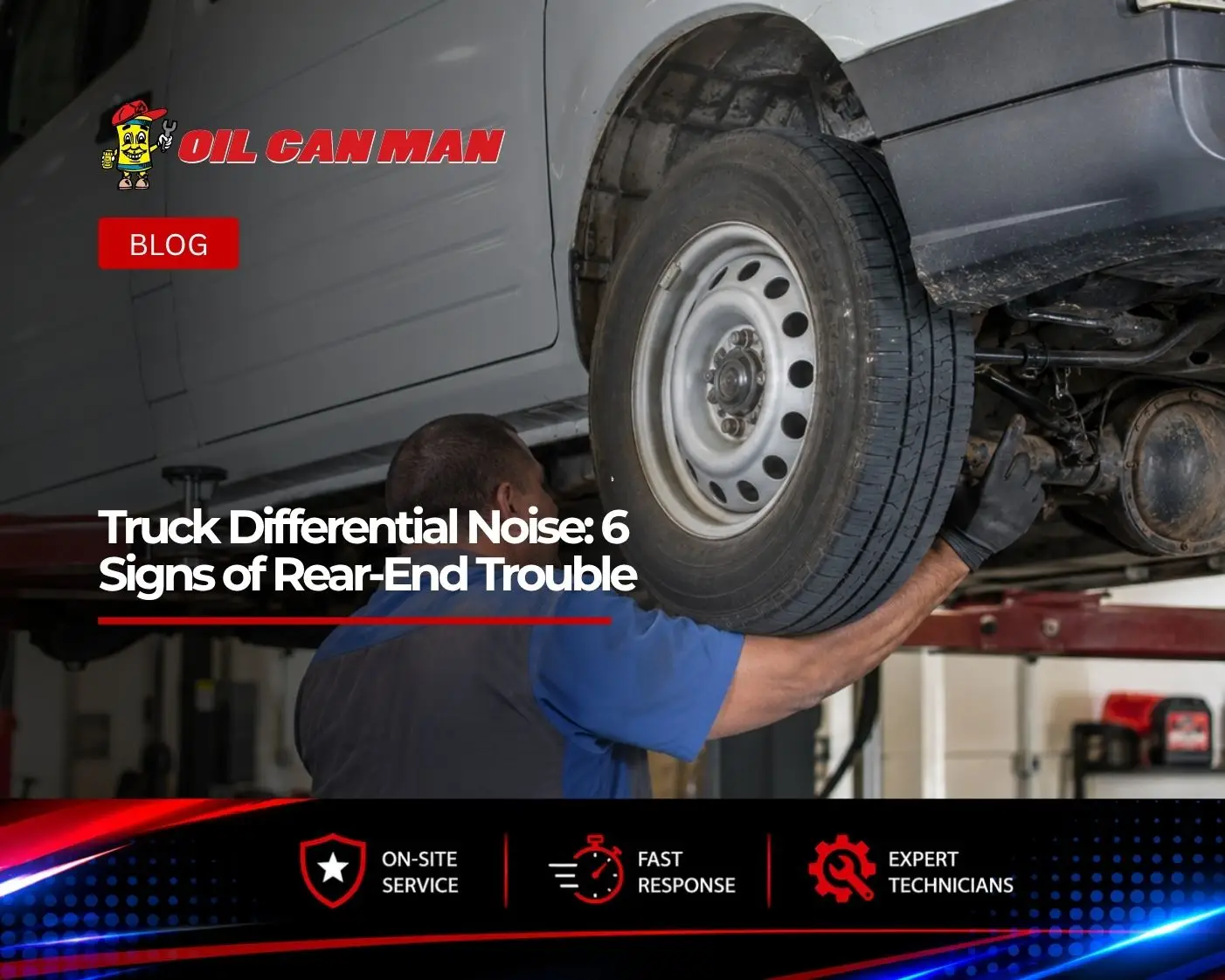
Rear-End Noise Is a Diagnostic Clue, Not a Final Diagnosis
A new whine, howl, rumble, or clunk from the rear of a commercial truck deserves attention. Truck differential noise can involve bearings, ring-and-pinion gears, lubricant condition, seals, or previous repair issues, but tires, wheel ends, U-joints, driveshaft components, and transmission problems can create similar symptoms.
For fleet operators across South Florida, Oil Can Man provides mobile fleet maintenance plus transmission, clutch, rear-end, axle, bearing, and differential service. Larger driveline work can also be handled at its Fort Lauderdale facility when mobile repair is not appropriate.
The best driver report is more specific than “the rear end is noisy.” Record whether the sound changes with road speed, acceleration, coasting, turning, or load, and note any vibration, lubricant leakage, or recent driveline work.
1. Whining or Howling That Changes With Load
A rear differential whining noise that becomes more noticeable while accelerating, pulling a load, or coasting can help technicians narrow the diagnostic path.
Possible inspection areas include:
- Ring-and-pinion gears
- Pinion bearings
- Differential bearings
- Gear contact pattern
- Backlash
- Lubricant condition
Load matters because gear tooth contact changes as torque moves through the axle.
That does not mean a whine automatically proves the gears are damaged. Dana’s commercial axle service procedures require controlled measurements for backlash, bearing preload, runout, and gear-tooth contact during differential setup. Review Dana Spicer commercial axle service procedures
A professional truck differential repair should therefore begin with diagnosis rather than replacing the gear set based on sound alone.
2. Growling or Rumbling That Follows Vehicle Speed
A low growl or rumble that increases with road speed can point toward a rotating component farther back in the driveline.
Possible sources include:
- Differential bearings
- Pinion bearings
- Axle bearings
- Wheel-end bearings
- Tires
A suspected differential bearing failure should still be confirmed through inspection. Tire and wheel-end conditions can create noise that seems to come from the differential.
Oil Can Man’s existing truck tire wear guide explains how axle tracking, wheel ends, suspension, inflation, and tire condition can provide additional diagnostic clues.
For a fleet manager, this is an important distinction. Replacing internal differential components will not correct a noise that is actually originating at a wheel end or tire.
3. Clunking When Power Is Applied or Released
A clunk when the truck begins moving, changes direction, or transitions between acceleration and coast may indicate excessive movement somewhere in the driveline.
Possible areas include:
- U-joints
- Driveshaft connections
- Differential components
- Ring-and-pinion wear or setup
- Transmission or clutch components
Dana’s heavy-duty driveshaft service documentation explains that universal joints, slip members, center bearings, tubing, and related components are all part of the driveline system and can contribute to vibration or operating problems when worn or damaged. Review Dana Spicer driveshaft service guidance
That is why truck rear end noise should be diagnosed as part of the complete torque path rather than assuming the differential itself has failed.
Oil Can Man’s semi-truck clutch slipping guide provides additional context for separating clutch and power-transfer problems from symptoms occurring farther downstream in the driveline.
4. Vibration Along With Rear-Axle Noise
Vibration deserves additional attention when it develops at the same time as a new whine, growl, or clunk.
Ask the driver whether the vibration:
- Changes with road speed
- Becomes stronger under load
- Changes during coast
- Is felt through the floor or seat
- Began after recent driveline work
A vibrating truck does not automatically have a bad differential. Driveshaft imbalance, U-joints, center bearings, wheel ends, tires, and axle components can all contribute.
Dana’s driveshaft documentation specifically addresses balance, torsional stiffness, slip assemblies, and component condition as factors in driveline noise and vibration.
If a truck has developed new rear-end noise, vibration, clunking, or leakage, Oil Can Man can inspect the driveline and determine whether mobile diagnosis or facility-based transmission, clutch, and rear-end service is the appropriate next step.
5. Differential Lubricant Leaks
Visible lubricant around the differential housing, pinion area, or axle should not be ignored just because the truck is still operating normally.
Fleet personnel can safely document:
- Where leakage appears
- Whether it is new or recurring
- Whether noise developed at the same time
- Previous axle or differential repairs
- Whether the condition is getting worse
A seal leak does not always mean the seal itself is the root problem. Bearing movement, surface condition, breather problems, installation issues, or other mechanical conditions may contribute.
Volvo Trucks’ driver guidance for rear axles instructs operators to verify differential lubricant level and use the approved oil for the specific vehicle. That illustrates why axle lubrication should follow the applicable vehicle or axle manufacturer’s specification rather than a generic fluid recommendation. Review Volvo Trucks rear-axle lubricant guidance
6. Grinding, Unusual Heat, or Rapidly Increasing Noise
Grinding, substantially increasing noise, lubricant loss, strong vibration, or unusual heat around the axle area should receive greater repair priority.
These symptoms can accompany internal wear, bearing problems, inadequate lubrication, gear damage, or another serious driveline condition.
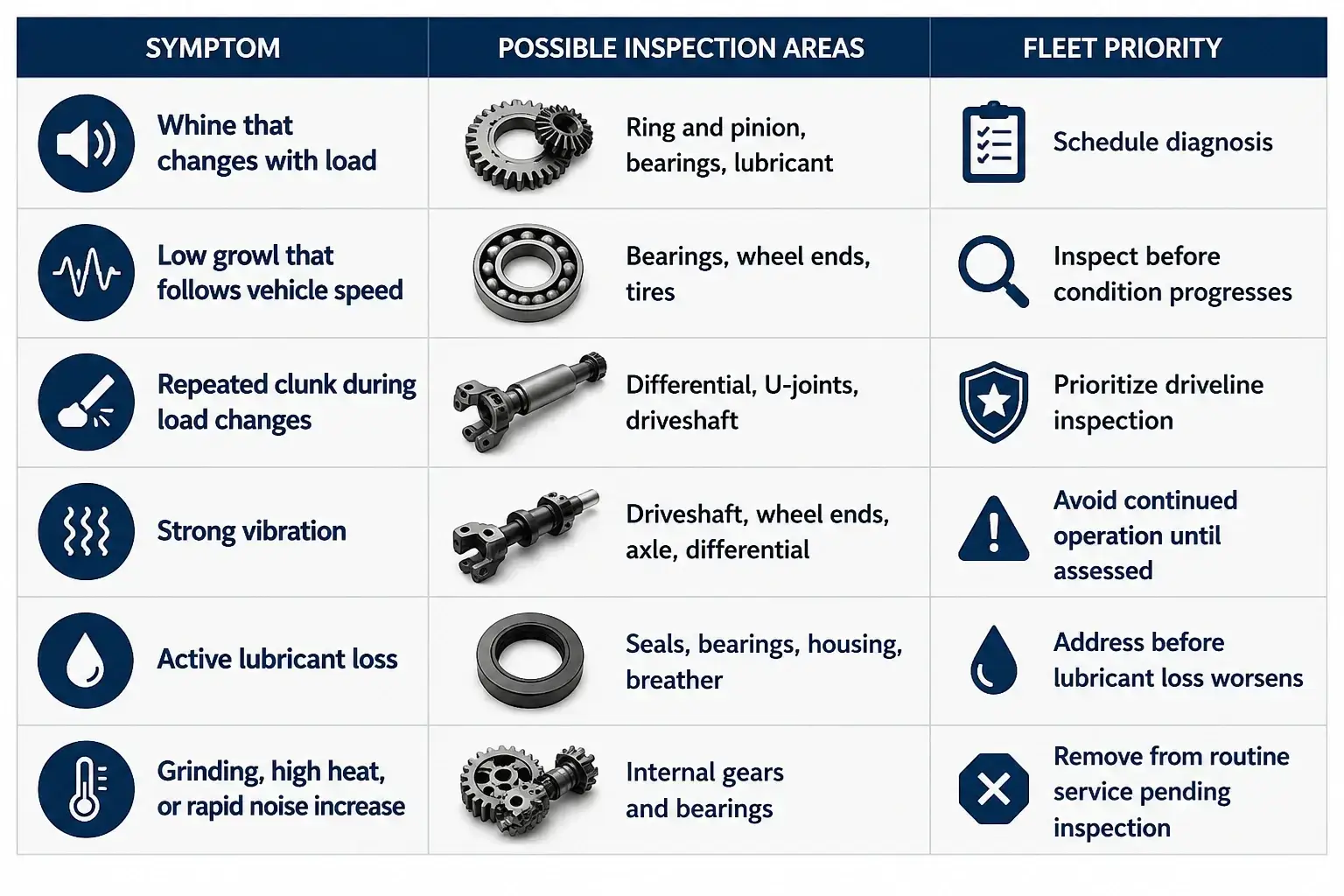
This table helps prioritize inspection. It does not diagnose the failed component.
Why Previous Rear-End Repairs Matter
Repair history can be extremely useful when truck differential noise appears after previous axle work.
Dana’s commercial axle failure-analysis guidance recommends documenting the complaint, reviewing previous maintenance and repair records, examining unusual noise or vibration, identifying the actual failure cause, and correcting that cause instead of simply replacing the damaged part. Review Dana commercial axle failure-analysis guidance
That matters because repeat rear-end problems may involve:
- Incorrect setup
- Bearing or shim problems
- Lubrication issues
- Contamination
- Related driveline faults
- A root cause left unresolved during an earlier repair
Fleet managers should therefore provide technicians with previous repair invoices and driver complaints whenever possible.
Repair, Overhaul, or Replace?
The correct truck differential repair depends on what inspection reveals.
A more limited repair may be appropriate when the problem involves a serviceable seal, bearing, or related component and the remaining assembly is within specification.
More extensive work may be required when technicians find:
- Damaged ring-and-pinion gears
- Multiple damaged bearings
- Improper gear contact
- Internal contamination
- Damage caused by lubricant loss
- Significant wear
- Problems following previous internal repairs
Eaton’s differential service documentation illustrates how internal differential work requires measurement of existing backlash, inspection of pinion bearing condition, and comparison with vehicle or gear-set specifications. Review Eaton differential service guidance
Internal gear setup should therefore be performed with the specifications and measuring procedures appropriate to the axle.
Mobile Diagnosis or Shop Repair?
Mobile driveline service can make sense when the truck is at a fleet yard, job site, or business location and the required inspection or repair is suitable for field work.
Facility service may make more sense for:
- Internal differential disassembly
- Precision gear setup
- Extensive bearing replacement
- Major axle repair
- Complex rebuilding
Oil Can Man’s current production site confirms mobile driveline repair as well as facility-based work for larger repairs.
Make Rear-End Symptoms Part of Fleet Maintenance
Fleet managers can incorporate driveline condition into broader commercial vehicle maintenance planning by tracking:
- Driver noise complaints
- Vibration
- Lubricant leaks
- Previous axle repairs
- Changes during acceleration or coast
- Tire and wheel-end history
This turns a vague complaint into usable maintenance data.
Address Rear-End Noise Before It Becomes a Bigger Fleet Problem
New truck differential noise should be treated as diagnostic information, not an automatic verdict that the entire differential needs replacement. The goal is to identify whether the source is the gears, bearings, axle, wheel end, driveshaft, transmission, tires, or another related component before deciding on the repair.
Oil Can Man provides transmission, clutch, rear-end, axle, bearing, differential, and fleet repair services across Broward, Miami-Dade, and Palm Beach, with mobile service when appropriate and a Fort Lauderdale facility for larger work. The current production website lists (954) 764-8117 and the facility at 730 NW 7th Street, Fort Lauderdale, FL 33311.
Call Oil Can Man at (954) 764-8117 and describe the truck, when the noise occurs, whether it changes under load or coast, and any vibration, leakage, or previous driveline work so the appropriate service approach can be determined.
FAQs
What does a whining differential sound like?
A differential-related whine is often described as a steady high-pitched howl or whine that follows vehicle speed and may change when the driveline moves between acceleration and coast. However, similar noises can come from bearings, tires, or other driveline components.
Can a bad differential bearing cause a growling noise?
Yes, worn bearings can contribute to growling, rumbling, or whining, but differential bearing failure should be confirmed through inspection. Axle bearings and wheel-end components can create similar sounds.
Can I keep driving a truck with rear axle noise?
It depends on the cause and severity. New rear axle noise should be reported and inspected. Grinding, significant vibration, lubricant loss, excessive heat, loss of drive, or a rapidly worsening condition warrants removing the truck from routine service until it can be professionally evaluated.
Does differential noise always mean the gears need replacement?
No. Noise can involve lubricant condition, bearings, seals, gear setup, wheel ends, driveshaft components, tires, or other drivetrain systems. Diagnosis should identify the source before a gear set or complete differential is replaced.