Tire Wear Is a Diagnostic Clue, Not Just a Replacement Trigger
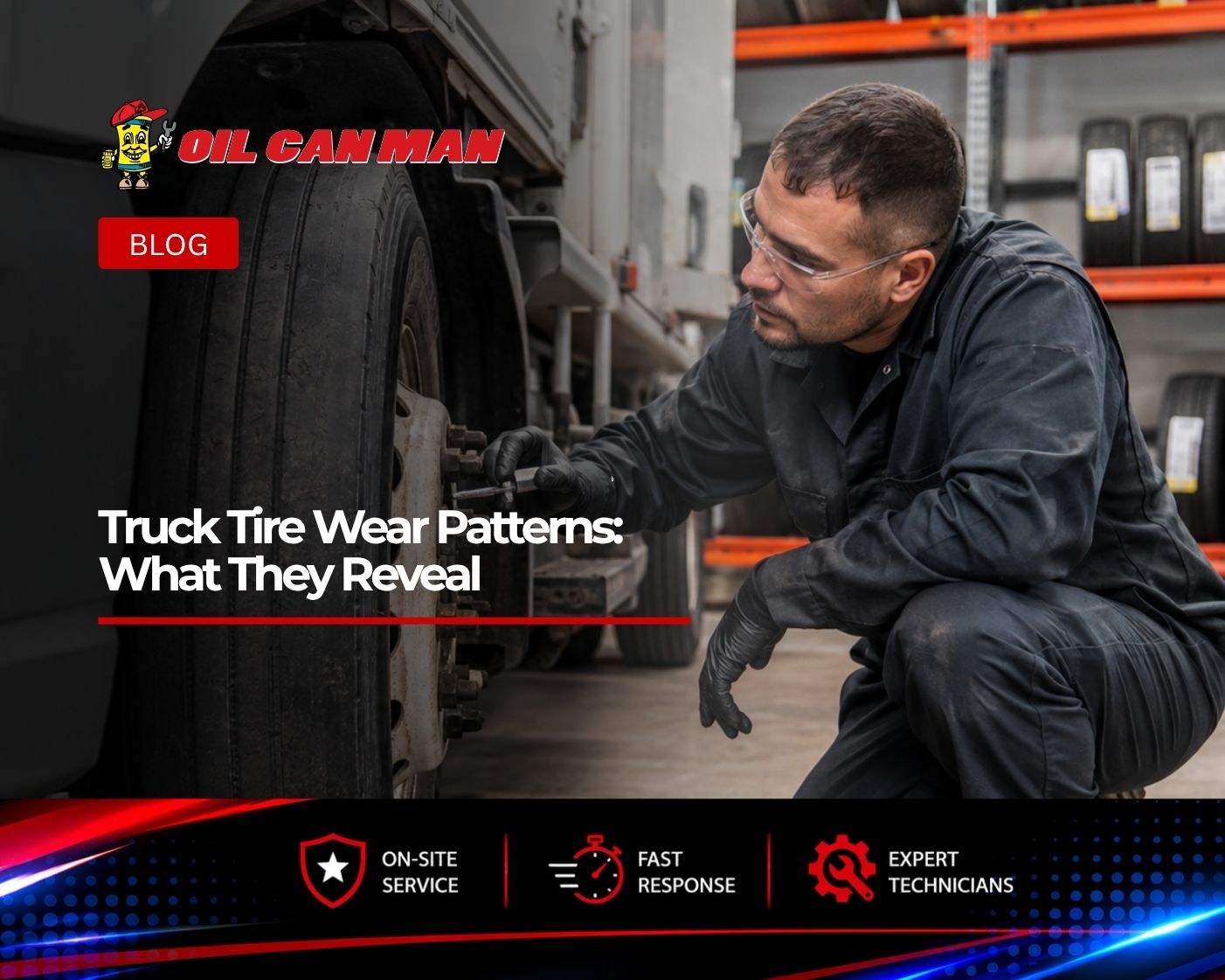
For a fleet manager, truck tire wear patterns can reveal much more than how much tread remains. Irregular wear may provide an early clue about inflation, alignment, suspension, wheel-end condition, braking, axle tracking, load distribution, or operating conditions. Reading those clues before replacing the tire can help prevent the same pattern from developing on the next set.
For businesses running box trucks, service vehicles, tractors, trailers, and mixed fleets across South Florida, Oil Can Man provides mobile fleet maintenance plus commercial tire service that includes tire repair, replacement, sales, and preventive inspections, with facility-based service available when appropriate.
What Common Truck Tire Wear Patterns Reveal
A wear pattern is best treated as evidence, not a final diagnosis. Michelin’s commercial tire guidance shows that similar irregular patterns may have several possible causes depending on whether the tire is in a steer, drive, or trailer position.
Center Wear and Shoulder Wear
When the center of the tread is wearing noticeably faster, inflation and load should be among the first things reviewed. Michelin notes that overinflation can contribute to premature center wear on box-truck tires. However, heavy commercial tire patterns can be more complicated, so the tire’s position, load history, mechanical condition, and pressure history should also be considered.
Wear concentrated toward both shoulders can point toward underinflation or load-related conditions. Improper pressure changes the tire’s footprint and can produce uneven truck tire wear, internal heat, and additional stress. Federal regulations also require commercial vehicles covered by the rule to operate with sufficient cold inflation pressure for the load being carried.
Do not simply add or remove pressure based on the appearance of the tread. Confirm the correct specification for the vehicle, axle load, tire, and application.
One-Sided Wear and Feathering
When tread depth gradually decreases from one side of a steer tire to the other, alignment should move high on the inspection list. Michelin identifies camber, toe, and axle parallelism as possible causes of one-sided wear. Feathering, where the edges of tread ribs develop a directional high-and-low feel, is commonly associated with lateral forces such as excessive toe.
This is where truck alignment tire wear becomes especially useful as a maintenance signal. Bridgestone recommends an alignment check when fleets see irregular wear, handling complaints, vehicle damage, or replacement of alignment-related components. Drive and trailer axle alignment can also influence what appears at the steer tires.
Oil Can Man’s kingpin and front-end repair services include inspection and service involving steering, suspension, bushings, and axle alignment, giving fleet managers a path to investigate the mechanical cause instead of replacing tires alone.
Cupping, Scalloping, and Irregular Depressions
Cupping truck tires develop alternating or localized high-and-low areas around the tread. Depending on the axle position, possible contributors include mismatched inflation pressures, mismatched dual tire diameters, worn suspension parts, wheel balance problems, loose wheel bearings, or other mechanical conditions.
Because cupping truck tires can have several causes, replacing the worn tire without checking the related vehicle components may allow the pattern to return. The technician needs to consider the tire position and inspect the associated suspension, wheel end, pressure, and dual-matching conditions.
If your fleet is repeatedly replacing tires because of irregular wear, Oil Can Man can evaluate the tire condition and related maintenance needs through its commercial truck tire services and determine whether mobile or facility-based work is appropriate.
Flat Spots and Diagonal Wear
A single abrasion-style flat spot may follow a braking or skid event, while multiple repeating flat areas can involve shocks, wheel bearings, balance, inflation differences, or tire-diameter differences. On trailers, Michelin associates diagonal wear with factors including axle misalignment, bearing adjustment, mismatched duals, pressure differences, and sometimes an initial brake-skid condition.
Semi truck tire wear patterns therefore need to be evaluated by axle position. A diagonal pattern on a trailer should not automatically receive the same diagnosis as an irregular steer-tire pattern.
Measure the Pattern Before Moving the Tire
Good commercial tire tread wear documentation makes diagnosis easier. Before rotating or removing an irregularly worn tire, photograph the complete tread, a close-up of the affected area, the sidewall and tire position, and the tread gauge showing measurable wear. Record the vehicle number, axle and wheel position, mileage, cold inflation pressure, and tread depth across the inner, center, and outer portions of the tread.
This gives the technician a record of where the pattern developed. Once a tire moves to another position, some of that diagnostic context can be lost.
There is no single measurement interval that fits every commercial fleet. Bridgestone recommends tread checks during pre-trip and post-trip inspections and describes a weekly pressure check as realistic for many fleets. Yokohama recommends frequent cold-pressure checks, such as daily during continual service, and periodic professional tire inspections during normal preventive-maintenance intervals. Fleet policy should account for mileage, duty cycle, vehicle class, manufacturer guidance, and route conditions.
South Florida fleets that experience frequent curb contact, stop-and-go routes, heavy loads, construction sites, or mixed highway and urban operation may benefit from recording tread measurements often enough to identify a trend before the tire reaches its removal point.
DOT Tire Requirements Set Minimum Safety Limits
For commercial vehicles subject to 49 CFR 393.75, front tires on a bus, truck, or truck tractor must have at least 4/32 inch of tread in a major groove. Other covered tires generally require at least 2/32 inch. Measurements are not taken at tread tie bars, humps, or fillets.
Tread depth is only part of the regulation. A vehicle also cannot be operated on a tire with exposed ply or belt material, tread or sidewall separation, a flat or audible leak, or a cut exposing ply or belt material. Tires must also have adequate cold inflation pressure for the load carried.
Those are regulatory minimums, not a recommendation to wait until every tire reaches the legal limit. Developing truck tire wear patterns may justify inspection, alignment, repair, rotation, or replacement earlier.
Decide Whether to Align, Repair, Rotate, or Replace
A practical fleet decision process is:
- Check for immediate safety or regulatory concerns. Exposed belt material, separation, an active leak, serious damage, or tread at an applicable legal minimum should be addressed before the vehicle returns to service.
- Confirm inflation and loading. If the pattern suggests pressure-related wear, compare cold pressure and vehicle loading with the applicable manufacturer requirements.
- Investigate alignment-related wear. One-sided wear or feathering calls for alignment and steering or suspension inspection rather than tire replacement alone.
- Investigate mechanical irregular wear. Cupping, repeating flat spots, and diagonal wear may require suspension, wheel-end, brake, balance, axle, or alignment diagnosis depending on tire position.
- Then decide the tire’s disposition. After correcting the cause, determine whether the tire remains serviceable, can be repositioned under the tire manufacturer’s recommendations, qualifies for retreading, or needs replacement.
Michelin’s position-specific guides show why the corrective decision changes according to the exact wear condition and casing condition rather than following one universal rotation-or-replacement rule.
Oil Can Man’s mobile fleet maintenance and tire services can help fleet managers connect abnormal wear to the vehicle system that needs attention, while on-site DOT inspection services can support broader commercial vehicle inspection planning.
Hypothetical Mixed-Fleet Example
Consider a South Florida delivery operation with three different tire complaints.
A box truck shows accelerated center wear. A tractor has feathering across one steer tire. A trailer develops repeating diagonal patches.
The box truck should start with pressure, load, and tire-condition review. The tractor’s truck alignment tire wear points toward alignment and front-end inspection. The trailer requires consideration of axle tracking, wheel-end condition, pressure matching, and possible brake-related history.
Those three semi truck tire wear patterns should not receive the same repair order. Recording position-specific tread measurements allows the fleet manager to prioritize the actual cause while deciding whether the tire can remain in service.
Turn Tire Wear Into a Preventive Maintenance Signal
The most valuable part of truck tire wear patterns is what they reveal before the next tire is installed. Consistent inspection and fleet electrical maintenance are different disciplines, but the same preventive principle applies: identify a developing condition, document it, correct the root cause, and track whether it returns.
Oil Can Man provides tire service, front-end repair, and fleet maintenance for commercial vehicles throughout its South Florida service area, with mobile and facility-based options depending on the service required.
Call Oil Can Man at (954) 764-8117 to discuss uneven truck tire wear, tire condition, alignment concerns, or preventive fleet maintenance and determine the appropriate next step for your vehicles. The number is listed on Oil Can Man’s current production website.
FAQs
What do uneven truck tire wear patterns usually mean?
They can point to inflation, alignment, suspension, wheel-end, braking, axle-tracking, balance, or loading issues. The tire’s axle position matters, so the pattern should be diagnosed rather than assigned one universal cause.
What causes feathering on commercial truck tires?
Feathering is commonly associated with lateral forces caused by alignment problems, particularly excessive toe. Drive-axle misalignment can also contribute by forcing the driver to compensate at the steering axle.
How often should fleets measure commercial tire tread wear?
Tread condition should be monitored during regular driver inspections, with actual tread measurements incorporated into preventive maintenance and taken whenever abnormal wear appears. Inspection frequency should reflect vehicle use and manufacturer guidance rather than one universal mileage interval.
What is the minimum DOT tread depth for commercial truck tires?
For vehicles covered by 49 CFR 393.75, front tires on buses, trucks, and truck tractors require at least 4/32 inch in a major tread groove. Other covered tire positions generally require at least 2/32 inch.