One Missed Box Truck Inspection Can Disrupt an Entire Delivery Schedule
A box truck rarely develops a problem at a convenient time. A brake concern, damaged roll-up door, weak battery, hydraulic liftgate problem, or tire issue can turn a fully scheduled vehicle into an unavailable asset just when deliveries or crews depend on it most.
That is why box truck maintenance should be built around how the vehicle actually works, not treated like routine passenger-car service. Delivery routes, payload, idling, stop-and-go driving, frequent door cycles, and liftgate use can all change which components deserve closer attention. For South Florida businesses, Oil Can Man’s mobile fleet maintenance services can help coordinate preventive maintenance at the fleet location when appropriate, while larger repairs can be handled at its Fort Lauderdale facility.
Use this box truck maintenance checklist as a planning framework, then build actual service intervals around the vehicle manufacturer’s recommendations, operating conditions, mileage, engine hours, load, and maintenance history.
1. Engine, Oil, Filters, and Fluids
Start with the systems that keep the truck moving.
A box truck PM service may involve checking or servicing:
- Engine oil and filter
- Coolant
- Transmission fluid
- Brake fluid where applicable
- Power-steering fluid where applicable
- Diesel exhaust fluid on equipped vehicles
- Fuel and air filters
- Belts and hoses
- Visible fluid leaks
Avoid assigning one mileage interval to every truck. A vehicle spending much of the day idling or operating in heavy stop-and-go traffic may accumulate engine wear differently from a truck that spends most of its time cruising at highway speed.
Oil Can Man currently provides mobile oil change and preventive maintenance services for commercial fleets across South Florida.
2. Inspect Brakes Before Route Conditions Expose the Problem
Box trucks frequently operate loaded and may make repeated stops throughout a workday. That makes brake condition an important part of a box truck preventive maintenance program.
Maintenance inspections may evaluate items such as:
- Brake wear
- Rotors or drums as applicable
- Brake lines and hoses
- Air-brake components on equipped vehicles
- Warning indicators
- Parking brake operation
- Changes in braking performance reported by drivers
Brake problems should be evaluated by qualified technicians rather than diagnosed from a single symptom.
For trucks needing professional service, Oil Can Man provides commercial fleet brake repair and inspection services in South Florida.
3. Make Tire Condition Part of Every Box Truck Inspection Checklist
Payload, curb contact, turning, alignment issues, pressure, and suspension condition can all influence commercial tire wear.
A practical inspection should consider:
- Tire pressure
- Tread condition
- Uneven wear
- Cuts or visible damage
- Sidewall condition
- Wheel and rim condition
- Signs that alignment or suspension issues may be affecting wear
For commercial vehicles subject to federal requirements, 49 CFR §393.75 contains federal tire condition, tread-depth, loading, and inflation requirements. The regulation should be applied according to the vehicle and operation involved.
Oil Can Man also offers commercial truck and fleet tire services, including mobile and facility-based options.
4. Check Steering and Suspension for Developing Wear
A box truck may carry substantial loads while navigating loading areas, job sites, urban routes, curbs, and uneven pavement.
Fleet maintenance should therefore include attention to:
- Steering response
- Excessive play
- Suspension components
- Shocks and related components
- Abnormal noises
- Vehicle pulling
- Changes in handling
- Uneven tire wear
Do not automatically assume one symptom identifies a specific failed component. Steering, suspension, tires, alignment, and other front-end parts can produce overlapping symptoms.
5. Inspect Batteries, Lighting, and Electrical Systems
A vehicle that starts reliably in the morning can still develop electrical issues that interfere with operations later in the route.
Include:
- Battery condition
- Charging-system concerns
- Exterior lighting
- Brake lights
- Turn signals
- Marker lights where equipped
- Interior cargo lighting
- Warning indicators
- Driver-reported intermittent electrical problems
Electrical concerns are particularly important when a truck performs repeated short trips, spends significant time idling, or powers additional equipment.
6. Do Not Forget the Box Itself
A generic truck checklist can overlook the equipment that makes a box truck useful to the business.
Inspect the cargo body for:
- Floor deterioration
- Loose or damaged panels
- Water intrusion
- Door alignment
- Latches and hardware
- Roll-up door tracks
- Rollers and cables
- Damage affecting normal cargo access
A roll-up door that becomes increasingly difficult to operate is not simply an inconvenience. It can interfere with loading schedules and eventually make the cargo area difficult to use.
Oil Can Man’s current trailer and box-truck repair services include work involving doors, floors, lighting, wiring, and other commercial body components.
7. Include the Liftgate When the Truck Has One
A liftgate-equipped box truck adds another maintenance system that needs attention.
Depending on the equipment and manufacturer requirements, inspection may consider:
- Hydraulic leaks
- Hoses
- Cylinders
- Platform condition
- Controls
- Mounting points
- Abnormal movement or noise
A slow or inconsistent liftgate does not automatically mean a specific hydraulic component has failed. Hydraulic problems can have several causes and should be properly diagnosed.
Is Your Box Truck PM Program Catching These Issues Early Enough?
If several trucks are due for service at once, sending each vehicle to separate appointments can complicate scheduling.
Oil Can Man can review the maintenance needs of your box truck fleet and determine which preventive services or repairs may be appropriate for mobile service at your yard and which jobs are better suited to the Fort Lauderdale facility.
8. Turn Driver Reports Into Maintenance Information
Drivers often notice changes before a scheduled PM visit.
Encourage drivers to report issues such as:
- New vibrations
- Warning lights
- Changes in braking
- Steering changes
- Fluid leaks
- Difficult door operation
- Liftgate problems
- Unusual noises
- Starting problems
The objective is not to have drivers diagnose the repair. Their job is to communicate changes so the maintenance team can decide whether inspection is needed.
This can be especially useful for high-utilization box truck fleets where vehicles are rarely parked long enough for developing problems to become obvious to a fleet manager.
9. Keep Box Truck Maintenance Records Organized
Maintenance records are part of managing the vehicle, not paperwork to reconstruct later.
For motor carriers covered by federal requirements, 49 CFR §396.3 requires systematic inspection, repair, and maintenance and identifies records that must be maintained, including vehicle identification, maintenance due dates, and records showing the date and nature of inspections, repairs, and maintenance. eCFR
A useful internal record can also help a fleet manager track:
- Last service date
- Mileage or engine hours
- Repairs performed
- Repeated defects
- Upcoming maintenance
- Outstanding recommendations
- Driver-reported concerns
Patterns are easier to spot when maintenance history stays connected to the individual vehicle.
10. Separate Preventive Maintenance From the Required Periodic Inspection
Routine box truck fleet maintenance and a federal periodic inspection should not be treated as the same thing.
For commercial motor vehicles subject to the rule, 49 CFR §396.17 requires the applicable periodic inspection at least once during the preceding 12 months and specifies documentation requirements. eCFR
Preventive maintenance, meanwhile, should continue according to actual vehicle needs and operating conditions.
Fleet managers can also use the NHTSA recall lookup resource to check a specific vehicle for unrepaired safety recalls by VIN or license plate where supported. NHTSA
Mobile Service or Facility Repair?
Not every maintenance item requires the same service environment.
Mobile service may make sense when:
- Multiple box trucks need scheduled PM
- Appropriate inspections can be completed at the fleet yard
- Routine service can be performed safely on-site
- Removing vehicles from operation would create unnecessary scheduling disruption
Facility service may be more appropriate when:
- Major disassembly is required
- Structural repairs are involved
- Specialized shop equipment is necessary
- The repair is not practical or safe to perform in the field
The goal is not to force every repair into a mobile model. It is to choose the service method that fits the work.
A Local Delivery Fleet
Consider a delivery company operating 12 box trucks.
Three are approaching scheduled preventive maintenance, one driver reports vibration, another truck has a roll-up door that has started binding, and one liftgate is operating more slowly than usual.
Instead of waiting for several separate breakdowns, the fleet manager could group the trucks for inspection, document each concern, schedule appropriate routine work together, and determine which vehicles need additional diagnosis or facility repair.
That turns box truck maintenance into an operating process instead of a series of emergency decisions.
Build a Box Truck Maintenance Plan Around Your Actual Routes
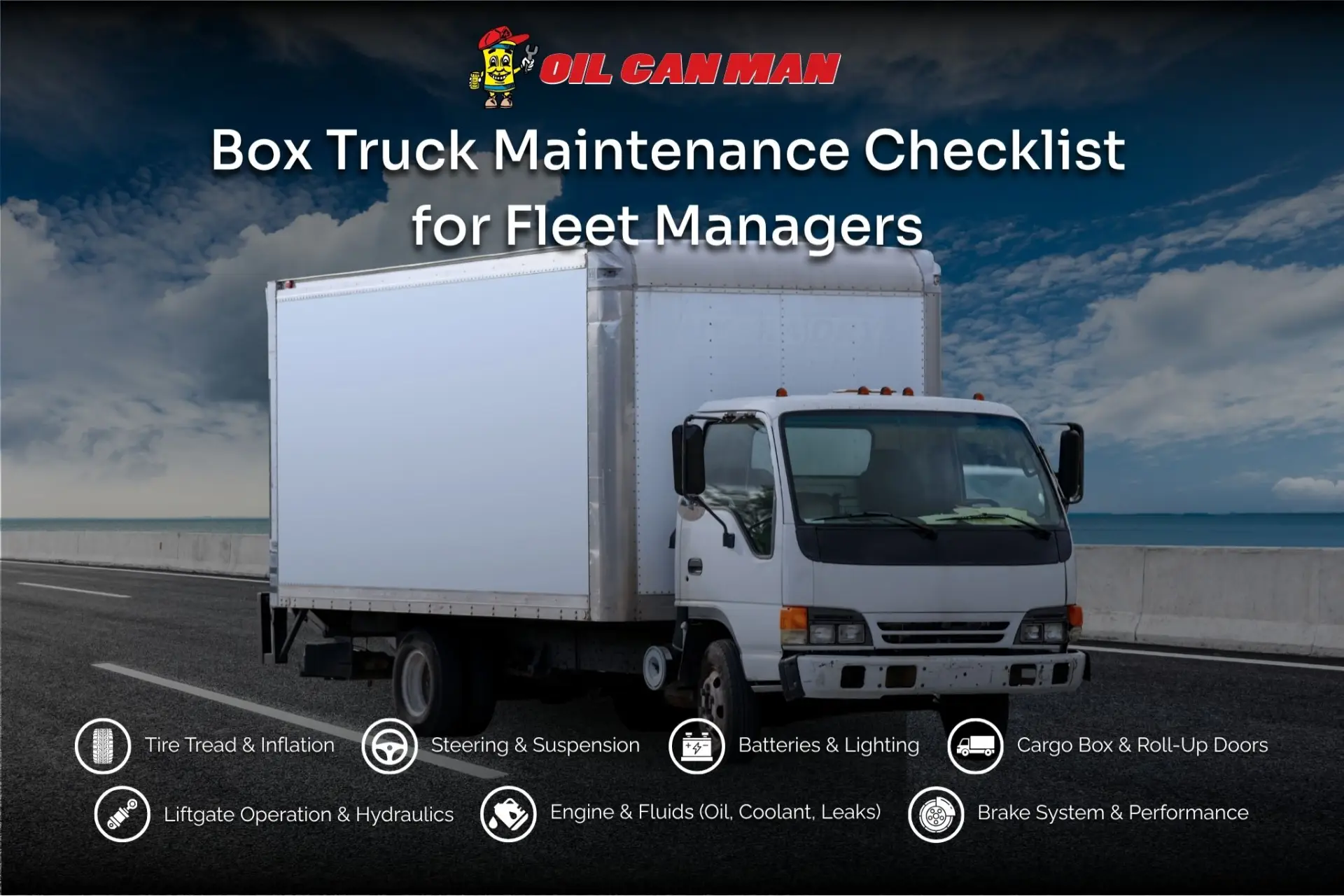
The most useful box truck maintenance checklist is not the longest one. It is the one your fleet consistently uses and adjusts according to vehicle specifications, payload, route conditions, idling, usage, driver feedback, service history, and manufacturer guidance.
Oil Can Man provides mobile fleet maintenance and commercial vehicle repair across Broward, Miami-Dade, Palm Beach, and the surrounding South Florida service area, with facility-based repair available in Fort Lauderdale when the work requires it.
Call Oil Can Man at (954) 764-8117 to discuss your box truck fleet, preventive maintenance schedule, or current repair concerns and determine whether mobile or facility-based service is the appropriate next step.
Frequently Asked Questions
How often should a box truck receive preventive maintenance?
There is no single interval that fits every box truck. Follow the applicable manufacturer recommendations while considering mileage, engine hours, payload, idling, route conditions, vehicle age, and maintenance history.
What should be included in a box truck maintenance checklist?
Typical areas include engine fluids and filters, brakes, tires, steering, suspension, batteries, lighting, cargo floors, roll-up doors, liftgates where equipped, leaks, driver-reported defects, and maintenance records.
Can box truck maintenance be performed at a fleet yard?
Many preventive maintenance and inspection tasks may be suitable for mobile service. Repairs requiring major disassembly, structural work, or specialized equipment may be better handled at a repair facility.
Is preventive maintenance the same as a DOT periodic inspection?
No. Routine preventive maintenance is an ongoing maintenance process. Applicable commercial motor vehicles may also be subject to the separate periodic inspection requirements in 49 CFR §396.17.