The First Five Minutes of a Repair Request Can Shape What Happens Next
A truck is down, a driver is waiting, and the next route or job is already on the schedule. Calling a repair provider and saying, “The truck isn’t working,” may be accurate, but it leaves several important questions unanswered. What truck is it? Does it start? What happened before it stopped? Are there warning lights? Can the vehicle move safely?
For fleet managers, providing useful information at the start can help a service provider determine what type of diagnosis may be needed and whether mobile service is a reasonable starting point. Oil Can Man’s mobile fleet maintenance and repair service supports commercial fleets across South Florida with both on-site and facility-based service.
The goal is not to diagnose the truck over the phone. It is to give the technician or service coordinator enough information to prepare for the next step.
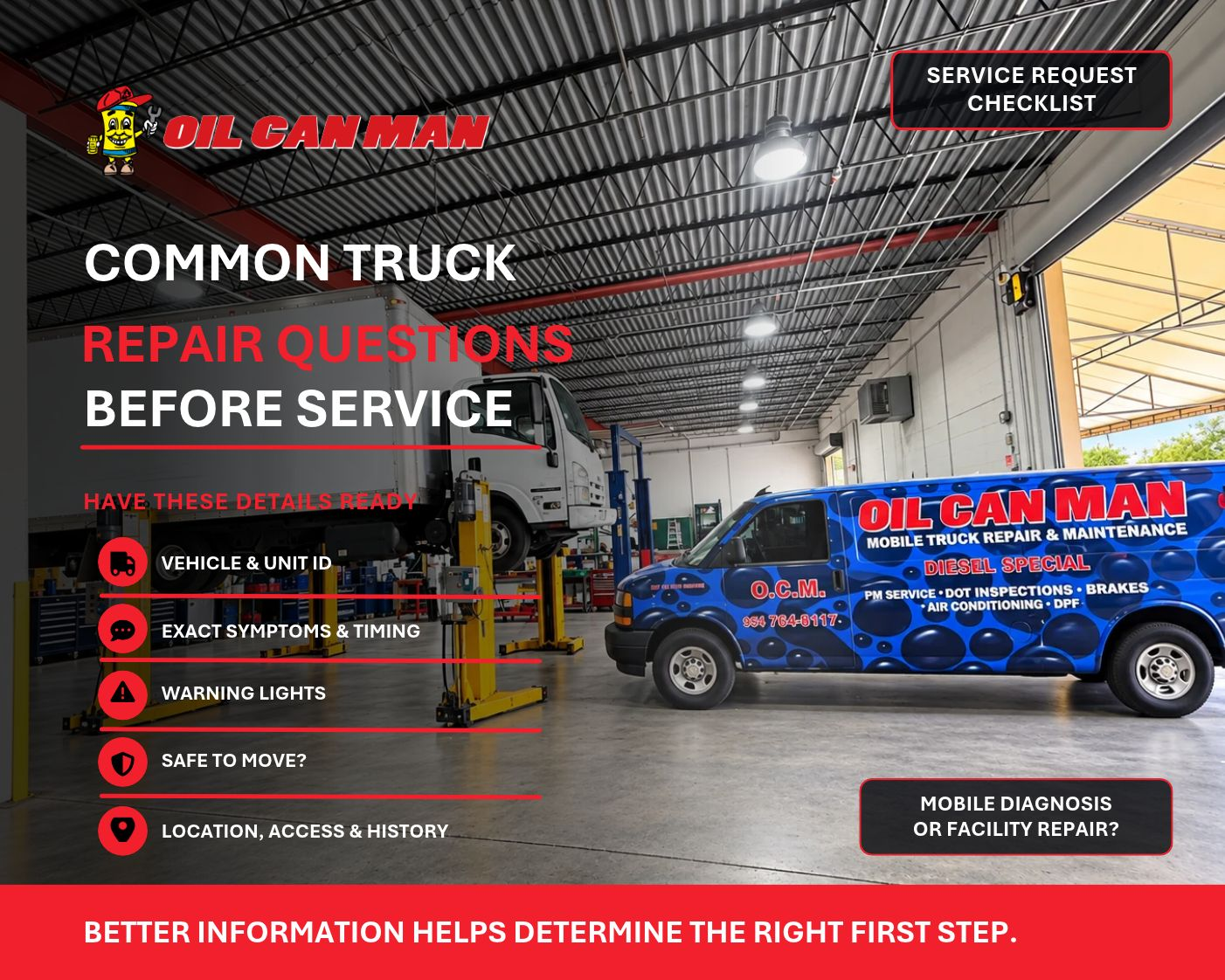
1. Which Vehicle or Unit Needs Service?
Start with exact vehicle identification.
Useful details include:
- Internal fleet or unit number
- Vehicle type
- Make and model
- Model year when known
- VIN when requested
- Engine type when relevant
- Tractor or trailer number
- Equipment identification for forklifts or specialty units
This becomes especially important when multiple similar trucks operate from the same location.
“White box truck at the back of the yard” leaves room for confusion.
“Unit 214, 2022 diesel box truck” gives the service team a much clearer starting point.
2. What Exactly Is the Driver Experiencing?
One of the most important truck repair questions is also one of the simplest:
What is the truck actually doing?
Avoid starting with a diagnosis unless one has already been confirmed.
Instead of:
The alternator is bad.
Report:
The truck needed a jump this morning, the battery warning light appeared, and the lights became dim while the engine was running.
Instead of:
The transmission is failing.
Report:
The truck hesitates before engaging drive, and a transmission warning message appears after it warms up.
Useful symptoms may include:
- No-start or slow cranking
- Loss of power
- Overheating
- Fluid leak
- Unusual noise
- Vibration
- Steering change
- Brake concern
- Warning light
- Smoke
- Electrical problem
- Poor shifting
- Hydraulic weakness
- Trailer electrical issue
Symptoms help determine what needs diagnosis without assuming which component has failed.
3. When Does the Problem Occur?
Timing can completely change the diagnostic path.
Tell the mechanic whether the issue occurs:
- During startup
- Only when the engine is cold
- After the vehicle warms up
- Under load
- At highway speed
- While braking
- During acceleration
- During turns
- While idling
- Intermittently
- Every time the vehicle operates
Also mention when the problem first appeared and whether it is becoming more frequent.
A fault that happens only after an hour of operation presents a different diagnostic situation from one that occurs immediately at startup.
4. Are There Warning Lights or Fault Messages?
Do not clear warning messages before recording them if doing so is unnecessary.
If the driver sees:
- Check-engine light
- ABS warning
- Battery or charging warning
- Transmission warning
- Brake system message
- DPF or emissions warning
- Temperature warning
- Low-pressure warning
record exactly what appeared.
A photo of the dashboard can be useful when it can be taken safely while the vehicle is parked.
Fault information can help guide mobile truck diagnostics, but a warning light does not automatically identify the failed component. Additional testing may still be necessary.
5. Can the Vehicle Move Safely?
This is one of the most important questions to answer before requesting repair.
Tell the service provider whether:
- The truck starts
- The engine runs normally
- The truck can move
- Braking or steering is affected
- A fluid leak is active
- The vehicle is overheating
- A tire or wheel issue is present
- The trailer can be moved
- The unit is blocking an operating area
Do not continue operating a vehicle simply to make a repair request easier if the condition could affect safe operation.
The answer can also help determine whether mobile diagnosis should be considered before arranging transportation to a facility.
What Should You Tell Oil Can Man Before Requesting Service?
If one of your commercial vehicles develops a problem at a yard, job site, warehouse, or operating location, gather the basic facts before making the service request.
Provide the unit number, vehicle type, exact symptoms, warning lights, location, whether it moves safely, and any recent repair history.
Oil Can Man can use those details to help determine whether the next step may involve mobile fleet service or work better suited to the Fort Lauderdale repair facility. For a broader look at how mobile service works during an unexpected breakdown, see the 24/7 roadside fleet repair guide.
6. Where Is the Vehicle and What Is Access Like?
“Miami” or “Fort Lauderdale” is not enough for a technician preparing for a service call.
Useful location information can include:
- Business or job-site address
- Yard, building, or gate location
- Where the vehicle is parked
- Gate or security instructions
- Contact person on-site
- Whether the truck is indoors or outdoors
- Whether there is enough space around the vehicle
- Whether a trailer is attached
- Any site-specific access restrictions
Access matters because the repair environment can affect what can reasonably be done in the field.
A truck parked in an open fleet yard presents a different working situation from one positioned inside a crowded loading area.
7. Can You Send Photos or Video?
Photos and short videos can add useful context when they are captured safely.
Helpful examples may include:
- Dashboard warning messages
- Visible fluid beneath the vehicle
- Damaged hose or belt
- Trailer damage
- Tire damage
- Location of the vehicle
- Visible component damage
- A short recording of an unusual noise
Do not place yourself under an unsafe vehicle, approach moving components, open pressurized systems, or take other risks just to capture an image.
Photos provide context. They do not replace diagnosis.
8. Has This Truck Had a Similar Repair Before?
Previous repair history can be one of the most valuable pieces of truck repair information.
Tell the mechanic if:
- The same symptom happened previously
- The same component was recently replaced
- The vehicle recently received maintenance
- Another shop diagnosed the issue
- A repair recommendation is still open
- The problem began immediately after other work
- Several similar fleet vehicles have developed the same concern
Repeat problems often deserve a broader diagnostic review, not treatment as an unrelated event.
Keeping organized service history also helps fleet managers evaluate repair patterns and provider performance. Oil Can Man’s guide on choosing a fleet maintenance company includes documentation, communication, service coverage, and repair escalation among the factors fleets should evaluate.
9. Is a Tractor, Trailer, or Piece of Equipment Paired With the Unit?
Commercial repair requests sometimes involve more than one asset.
For example:
- A tractor may be attached to a specific trailer
- A trailer lighting complaint may originate from the tractor connection
- A hydraulic problem may involve truck-mounted equipment
- A forklift attachment may have its own hydraulic circuit
- A work truck may operate PTO-driven equipment
Tell the service provider exactly which assets are connected and which component is showing the symptom.
That helps avoid diagnosing the wrong side of a paired system.
10. What Is the Operational Deadline?
A fleet manager should explain the operational situation without turning it into an unrealistic repair-time expectation.
Useful information includes:
- Vehicle needed for tomorrow’s route
- Truck currently assigned to an active project
- Replacement vehicle available
- Driver waiting at the location
- Unit can remain parked until scheduled maintenance
- Multiple vehicles at the same site also need service
This helps communicate priority.
It does not guarantee that a diagnosis or repair can be completed by a particular time. Parts, repair complexity, access, diagnostic findings, and whether the work belongs in the field or facility can all affect the next step.
Mobile Service or Facility Repair?
One reason to gather this information is to answer a larger question:
Where should the truck be diagnosed and repaired?
Mobile service may be practical when the problem can be safely diagnosed or repaired at the vehicle’s location without major disassembly or specialized shop equipment.
Facility service may be more appropriate when the repair involves:
- Major disassembly
- Extensive mechanical work
- Structural repair
- Heavy shop equipment
- Specialized procedures
- Work that cannot reasonably or safely be completed at the operating location
The right answer depends on the actual diagnosis.
Two Similar Service Calls
Consider a South Florida fleet with two trucks that drivers describe as “not starting.”
For Truck A, the fleet manager reports slow cranking, dim electrical equipment, a recent battery warning light, and that the truck is parked in an accessible fleet yard.
For Truck B, the engine cranks normally but will not start, several fault messages are present, and the vehicle previously experienced an intermittent loss-of-power complaint.
The initial description is the same: truck will not start.
The information behind that description suggests two different diagnostic paths.
Neither truck can be accurately diagnosed from the call alone, but the service provider now has much better information for deciding what should happen first.
Frequently Asked Questions
What information should I have before calling a truck mechanic?
Have the vehicle or unit number, vehicle type, current location, exact symptoms, warning lights, whether the truck starts or moves safely, recent repair history, and any useful photos available.
Can a mechanic diagnose a truck from photos or a phone call?
Photos, videos, fault messages, and driver observations can provide useful context, but they do not replace proper inspection and diagnostic testing.
How do I know whether I need mobile truck repair or a repair shop?
The decision depends on the problem, vehicle condition, accessibility, required equipment, amount of disassembly, and diagnostic findings. Some problems are appropriate for mobile service, while others are better handled at a facility.
Should I mention previous repairs when requesting service?
Yes. Repeated symptoms, recently replaced components, unresolved recommendations, and recent maintenance can help technicians understand the vehicle’s history and identify areas that deserve closer evaluation.
Give the Service Team Better Information Before the Truck Gets Touched
A good fleet repair service request does not need a diagnosis. It needs accurate observations.
Before calling, collect the truck or unit identification, symptoms, warning lights, location, whether the vehicle can move safely, recent service history, photos when useful, and any operational deadline.
For South Florida commercial fleets, Oil Can Man supports mobile and facility-based fleet repair depending on what the vehicle actually needs.
Call (954) 764-8117 and provide the vehicle type, unit number, fleet location, current symptoms, warning lights, recent repair history, and whether the vehicle can move safely. You can also contact Oil Can Man about a fleet repair request