When Rising Engine Temperature Becomes a Fleet Problem
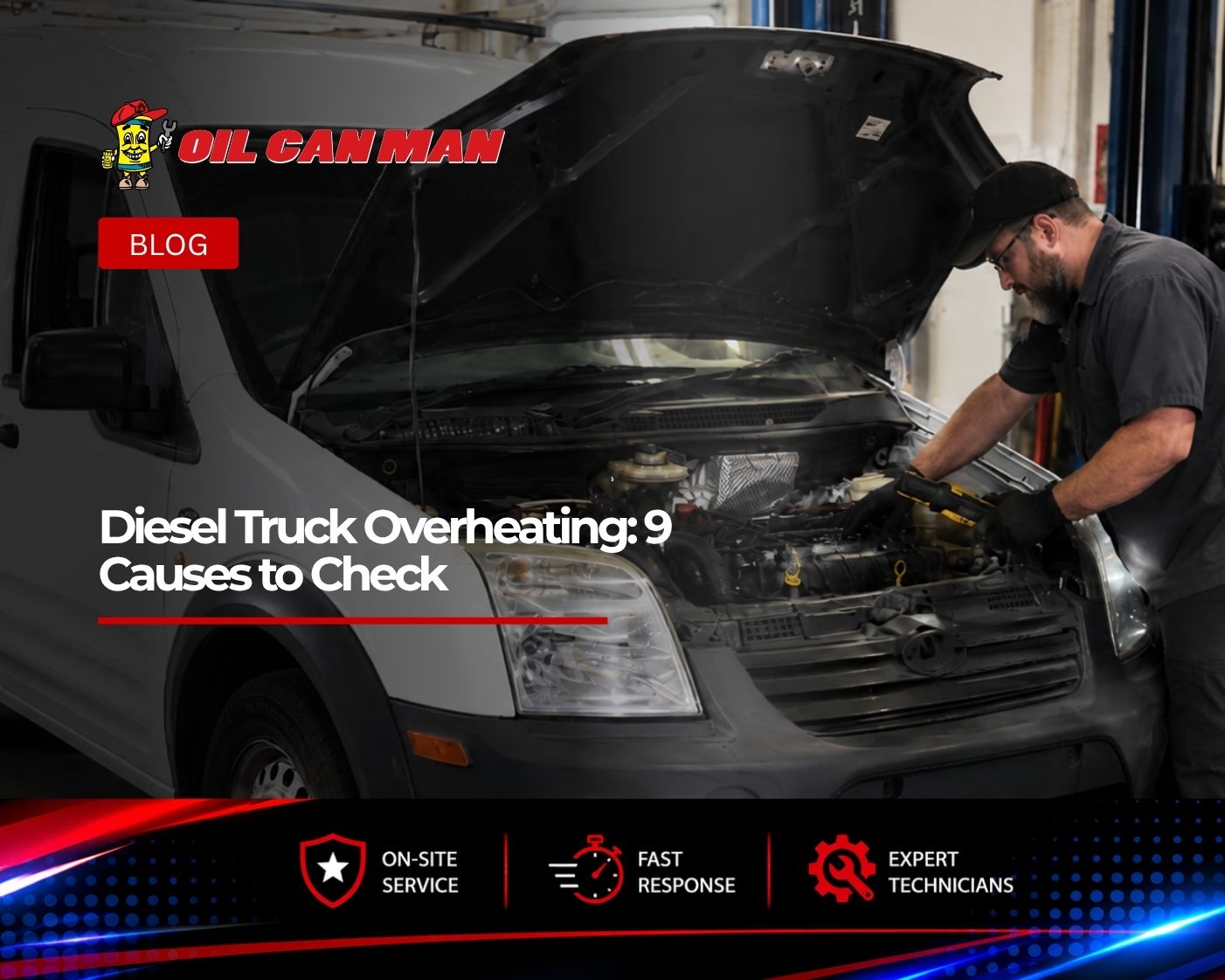
Diesel truck overheating can appear while a vehicle is idling in traffic, climbing a grade, towing a heavy load, or operating continuously in South Florida heat. For a fleet manager, the immediate question is not simply why the gauge is rising. It is whether the truck can be moved safely, whether a minor cooling-system problem is developing, and whether continued operation could turn that problem into serious engine damage.
Oil Can Man provides mobile fleet maintenance and commercial vehicle repair across South Florida, with facility-based service available when a repair requires more extensive work. Its current fleet-service offering includes coolant and fluid service as well as engine and powertrain repairs.
Detroit’s engine operating guidance advises operators to respond quickly when an engine overheats and to shut the engine down as soon as practical when serious engine problems appear. It also warns against working around a hot, pressurized cooling system without appropriate precautions.
9 Common Diesel Engine Overheating Causes
1. Low Coolant
Without the correct coolant level, the system may not be able to carry enough heat away from the engine. Low coolant should therefore trigger a search for the reason it dropped rather than repeated topping off.
A diesel coolant leak may leave puddles, dried coolant residue, or a declining reservoir level. Cummins recommends inspecting hoses, fittings, thermostat housings, radiator cores, water-pump seals, and other cooling-system components when investigating external coolant loss.
2. External Coolant Leaks
Hoses, clamps, radiator connections, water-pump seals, coolant manifolds, and other fittings can develop external leaks. Some leaks are easy to see when the vehicle is parked, while others appear only after the system reaches operating pressure and temperature.
A technician may perform cooling-system pressure testing when visual inspection does not identify the source. Cummins specifically includes pressure testing in its coolant-loss diagnostic guidance.
For fleets, a recurring diesel coolant leak should be documented by vehicle, operating condition, coolant consumption, and any visible residue so technicians have a better starting point.
3. Internal Coolant Leaks
Coolant can also be lost internally through engine components. Depending on the engine, possible sources may include cylinder-head gaskets, cylinder heads, liners, oil coolers, aftercoolers, or other internal passages.
Internal loss is usually more complex than replacing a leaking hose. Cummins recommends reviewing the driver’s complaint, service history, engine-control information, and appropriate OEM diagnostic procedures before deciding which component has failed.
4. Restricted or Blocked Radiator Airflow
The radiator has to transfer engine heat into the surrounding air. Dirt, bugs, debris, damaged fins, contamination between heat exchangers, or an internal restriction can reduce that heat transfer.
This may become especially noticeable during heavy South Florida traffic, towing, or prolonged high-load operation. If cleaning or a simple external correction does not restore proper cooling, commercial truck radiator repair or further cooling-system diagnosis may be necessary.
A radiator should not automatically be replaced because the engine runs hot. Airflow, coolant circulation, fan operation, coolant condition, and engine load should be evaluated together.
5. Faulty Thermostat
The thermostat controls coolant flow according to temperature. If it does not open properly, coolant circulation through the radiator may be restricted.
Gates’ heavy-duty thermostat documentation explains that commercial-vehicle thermostats regulate engine operating temperature and are designed to maintain correct cooling-system performance.
Professional truck cooling system repair may therefore include confirming thermostat operation instead of assuming an overheating condition is caused by the radiator.
6. Weak or Failing Water Pump
The water pump circulates coolant through the engine and cooling system. Seal problems, bearing wear, impeller damage, or other failures can reduce circulation or create coolant loss.
Cummins includes failed water-pump seals among possible coolant-loss sources and recommends following engine-specific diagnostic procedures before replacing components.
A truck that overheats despite having coolant in the reservoir may still have a circulation problem, so fluid level alone does not rule out cooling-system failure.
7. Fan or Fan-Clutch Problems
A cooling fan becomes particularly important at low road speeds because natural airflow through the radiator is reduced. That makes fan operation an important diagnostic area when there is truck overheating at idle or during slow-moving traffic.
Horton’s commercial fan-drive inspection guidance calls for checking fan-drive wear, air supply where applicable, belts, tensioners, fan components, and surrounding shrouds for conditions that can affect cooling performance.
This is one reason truck overheating at idle may require a different diagnostic approach than a truck that overheats only while pulling a heavy load uphill.
8. Damaged, Soft, or Collapsing Coolant Hoses and Air Pockets
Cooling-system hoses deteriorate from age, heat, chemical exposure, and repeated pressure cycles. Internal deterioration can be less obvious than an external crack.
Gates recommends inspecting coolant hoses for soft areas, cracking around fittings, bulging, and other deterioration. Its heavy-duty hose information also notes that coolant-hose damage can begin internally.
Air trapped after coolant loss or cooling-system service can also interfere with normal circulation on some engine designs. Proper filling and bleeding procedures should follow the applicable OEM service information rather than a universal method.
If several fleet vehicles are showing cooling-system deterioration, Oil Can Man can incorporate coolant, hose, belt, and fluid checks into mobile fleet maintenance and determine whether the repair is appropriate for mobile service or the Fort Lauderdale facility.
9. Head-Gasket or Other Major Engine Problems
A head-gasket problem can allow coolant to escape internally or permit combustion gases to enter the cooling system. Depending on the failure, technicians may find unexplained coolant loss, abnormal cooling-system pressure, coolant contamination, or other symptoms.
These signs do not prove that the head gasket has failed. Cummins lists head-gasket deterioration among several possible internal coolant-loss paths and recommends structured troubleshooting before component replacement.
Oil Can Man’s existing guide to costly diesel engine repairs also identifies overheating and head-gasket damage as potentially serious diesel-engine concerns.
What Should a Driver Do When a Diesel Truck Overheats?
Drivers should pay attention to the temperature gauge, high-temperature warning, loss of power, coolant warning, steam, unusual smells, or visible leakage.
If the engine temperature continues rising or the vehicle displays a high-temperature warning, the safest approach is to follow the vehicle and engine manufacturer’s shutdown procedure and move to a safe location as soon as conditions permit. Detroit advises shutting down an overheating engine as soon as possible and determining the cause.
Do not remove a pressurized cooling-system cap while the engine is hot. Hot coolant and steam can cause serious injury. Allow the system to cool and use the applicable manufacturer procedure before inspection.
A driver can safely report:
- Whether overheating occurred at idle, highway speed, on a grade, or under load
- Gauge position and warning messages
- Visible coolant beneath the truck
- Steam or coolant odor
- Whether coolant had recently been added
- Whether the problem began after cooling-system service
- Vehicle, engine, mileage, and operating conditions
That information can shorten diagnostic time without asking drivers to perform hazardous roadside repairs.
How Technicians Diagnose an Overheating Truck
Professional diagnosis should establish whether the problem involves coolant loss, coolant circulation, airflow, temperature control, or an internal engine condition.
Depending on the vehicle, truck cooling system repair diagnosis may include:
- Cooling-system pressure testing
- Inspection for external leakage
- Cooling fan and fan-drive checks
- Hose and belt inspection
- Thermostat evaluation
- Coolant condition and level checks
- Temperature-sensor and scan-data review
- Radiator airflow inspection
- Testing for combustion gases or internal leakage when indicated
Cummins specifically recommends collecting the driver’s complaint, service history, and ECM information before advanced coolant-loss diagnosis.
Minor Cooling Repair or Engine-Threatening Failure?
A leaking hose, loose connection, deteriorated belt, thermostat problem, or accessible external cooling-system fault may represent a relatively contained repair if caught early.
By contrast, continued diesel truck overheating accompanied by rapid coolant loss, coolant contamination, repeated pressure problems, or suspected internal leakage may require more extensive diagnosis and potentially shop-based engine work.
Similarly, commercial truck radiator repair should be based on what testing reveals. An airflow restriction may need cleaning, while a leaking or internally restricted radiator may require repair or replacement depending on its condition and the vehicle application.
Mobile service can make sense when an overheating truck is safely parked, and the cause can be diagnosed or repaired with field-appropriate equipment. Extensive engine disassembly or major internal damage is better suited to facility-based service. Oil Can Man currently supports both mobile repair and a Fort Lauderdale shop.
Trucks Running Hot
Consider a delivery fleet with three trucks reporting temperature concerns.
Truck A runs hot mainly while idling in urban traffic. Truck B loses coolant and leaves residue near a hose connection. Truck C overheats under load and repeatedly loses coolant without an obvious external leak.
Truck A may require fan, airflow, and cooling-system evaluation. Truck B provides evidence of a likely external leak. Truck C deserves higher-priority diagnosis because internal leakage or another significant cooling-system problem may be involved.
Treating all three vehicles as needing the same radiator replacement would overlook the different diesel engine overheating causes behind the symptoms.
Seasonal Cooling-System Checklist for South Florida Fleets
Before periods of sustained high heat, heavy towing, or high vehicle utilization, fleet managers can add a cooling-system review to preventive maintenance service. Oil Can Man’s current preventive-maintenance offering includes fluid, belt, and general fleet inspections.
Review:
- Coolant level and condition
- Evidence of leaks or dried residue
- Radiator and heat-exchanger airflow
- Hoses, clamps, belts, and tensioners
- Fan and fan-drive operation
- Vehicle temperature history
- Repeated coolant additions
- Driver overheating reports
- Service history and OEM coolant schedule
Oil Can Man’s guide to regular fleet fluid checks also emphasizes coolant monitoring as part of preventive maintenance for South Florida fleets.
Do not create one universal coolant-change or inspection interval for every truck. Follow the vehicle and engine manufacturer’s requirements while adjusting inspection frequency for duty cycle, idle time, loads, age, and operating conditions.
Address Overheating Before It Becomes an Engine Repair
The key to managing diesel truck overheating is identifying why the engine cannot control temperature before repeatedly sending the vehicle back into service.
Oil Can Man provides mobile fleet maintenance and commercial vehicle repair throughout Broward, Miami-Dade, Palm Beach, and the broader South Florida service area, with facility-based repairs available in Fort Lauderdale when the work requires them. The current production website confirms 24/7 fleet support and lists (954) 764-8117 as the primary service number.
Call Oil Can Man at (954) 764-8117 to describe the truck, overheating conditions, warning messages, coolant-loss history, and operating symptoms so the team can determine the appropriate next step.
FAQs
Why does my diesel truck overheat while idling but cool down when driving?
Reduced airflow at low road speed can make fan operation, the fan clutch, radiator airflow, and related cooling components more important. Diagnosis should also consider coolant level, thermostat operation, and other cooling-system conditions rather than assuming the fan is the only cause.
Can a diesel coolant leak cause engine overheating?
Yes. Coolant loss can reduce the cooling system’s ability to control engine temperature. External leaks may involve hoses, fittings, radiator components, thermostat housings, or water-pump seals, while internal coolant loss can involve more complex engine components.
Should I keep driving if the temperature warning comes on?
A continuing high-temperature warning should not be ignored. Follow the vehicle and engine manufacturer’s instructions and get the truck safely stopped as soon as conditions allow. Detroit’s operating guidance recommends shutting down an overheating engine promptly to help avoid additional damage.
Can a mobile mechanic diagnose an overheating commercial truck?
Many accessible cooling-system inspections, leak checks, fluid services, and engine diagnostics may be suitable for mobile service. Repairs requiring major disassembly, extensive internal engine work, or specialized shop equipment may be better handled at a facility. Oil Can Man currently offers both mobile fleet service and facility-based repair.