A PTO Problem Can Stop the Equipment Before It Stops the Truck
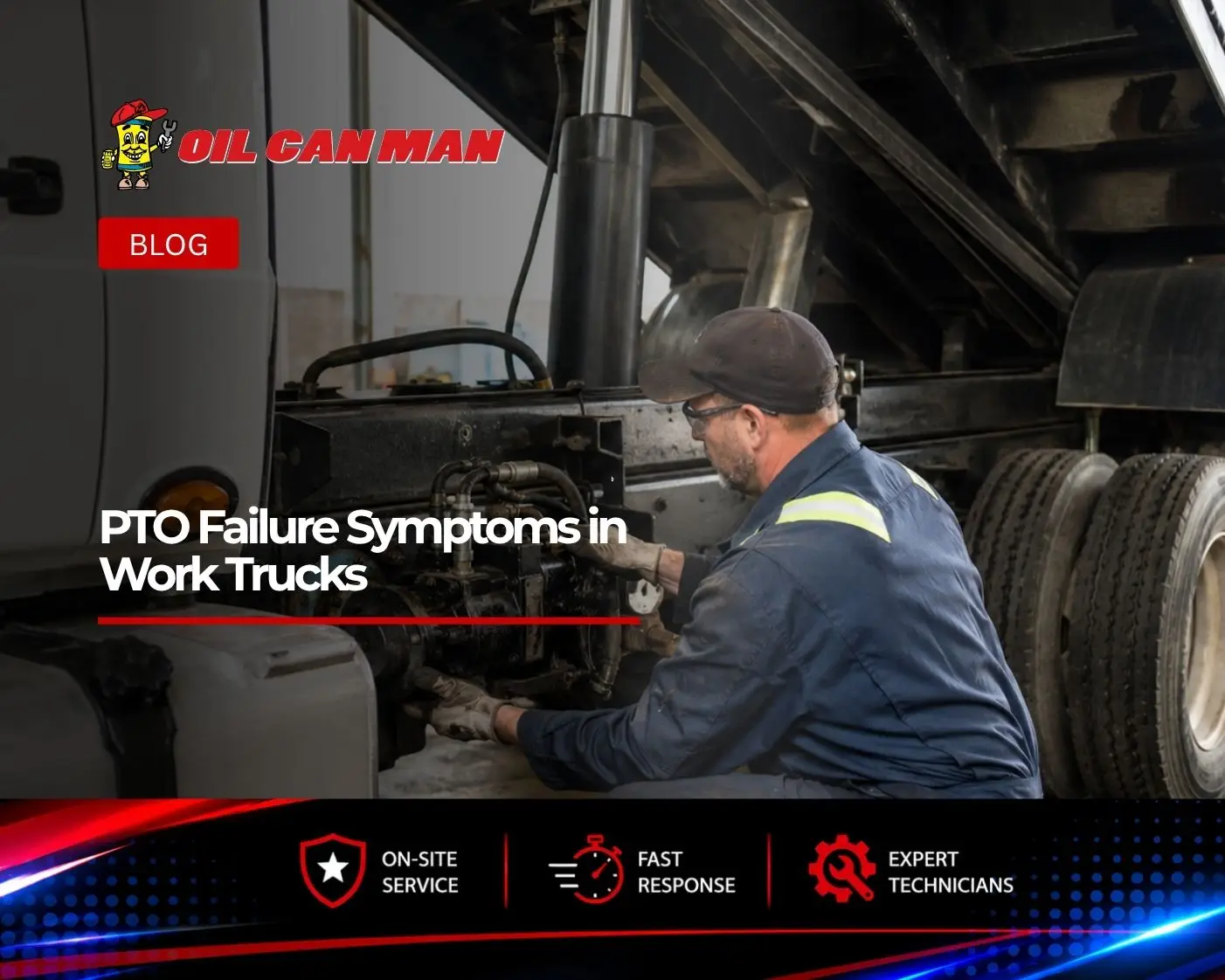
A work truck may still start, drive, and steer normally while the equipment that makes it productive is completely disabled. Common PTO failure symptoms include failure to engage, intermittent operation, grinding, vibration, leaks, overheating, and hydraulic equipment that suddenly slows or weakens.
For dump trucks, tow equipment, lift systems, cranes, pumps, and other vocational applications, a power take-off sits at an important connection between the truck drivetrain and the auxiliary equipment. Oil Can Man provides mobile fleet maintenance, hydraulic repair, and powertrain service throughout Broward, Miami-Dade, and Palm Beach, with larger repairs available at its Fort Lauderdale facility when necessary.
The important diagnostic question is whether the problem begins with the PTO controls, the PTO itself, or the hydraulic system it is driving.
Common PTO Failure Symptoms Fleet Managers Should Know
Truck PTO Not Engaging
A truck PTO not engaging does not automatically mean the PTO gears have failed.
Depending on the PTO and vehicle, possible causes can include an electrical fault, damaged wiring, a failed switch or solenoid, insufficient air pressure on an air-shift system, a control-system interlock, or an internal shifting problem.
The Muncie TG Series PTO troubleshooting guide lists electrical shorts, insufficient air pressure, air-valve faults, shifter problems, fuse failures, and solenoid faults among possible causes of non-engagement.
This is why PTO troubleshooting should begin by identifying what the driver actually observes. Does the indicator respond? Is there an engagement sound? Does the PTO engage intermittently? Does the auxiliary equipment remain stationary even though the PTO appears to be operating?
Grinding, Clicking, or Abnormal Noise
Grinding during engagement deserves prompt attention.
Muncie’s troubleshooting information associates PTO whining, rattling, and clicking with conditions such as incorrect gear backlash or damaged gear teeth. Eaton’s current Endurant XD PTO integration guidance also notes that grinding can occur when PTO engagement is not correctly coordinated with transmission control.
If a driver reports a new grinding or abnormal mechanical noise, repeatedly cycling the PTO switch is not a good diagnostic strategy. Manufacturer guidance recommends shutting the system down when unnatural noise occurs and investigating the cause.
Unusual Vibration
Vibration can come from the PTO, pump connection, auxiliary driveshaft, mounting condition, or the equipment being driven.
Muncie specifically identifies driveshaft phasing, angularity, and slip movement as areas to evaluate during PTO troubleshooting. Its documentation also identifies unsupported direct-mounted pumps as a potential contributor to housing problems.
For fleets experiencing repeated dump truck PTO problems, technicians should look beyond the PTO housing itself and inspect how the PTO, pump, transmission, mounts, and driven equipment interact.
Oil or Hydraulic Leaks
Leaks around a PTO can involve a shaft seal, mounting surface, bearing cover, cracked housing, or related hydraulic components.
Document any visible leak before the truck returns to work. Drivers can report where fluid appears and whether the auxiliary equipment has become slower or noisier, but qualified technicians should handle hydraulic fittings and pressurized lines.
Oil Can Man’s hydraulic repair services currently include mobile work on pumps, hoses, cylinders, and complete hydraulic systems for trucks and other commercial equipment.
Slow or Weak Auxiliary Equipment
When a dump body, lift, or other hydraulic equipment moves slowly, the PTO is only one possible cause.
PTO hydraulic pump problems may involve low hydraulic fluid, pump wear, restricted flow, contamination, a valve problem, leakage, or insufficient system pressure. The PTO could also be turning correctly while the hydraulic side fails to convert that mechanical input into usable hydraulic power.
Oil Can Man’s existing hydraulic systems troubleshooting guide covers pressure loss, slow hydraulic response, overheating, leaks, pumps, valves, hoses, and contamination.
The key is not to replace the PTO simply because the equipment is moving slowly.
Excessive Heat
Heat can develop in either the PTO or hydraulic system when components are incorrectly applied, poorly lubricated, overloaded, slipping, restricted, or operating under abnormal conditions.
Parker Chelsea’s PTO service documentation notes that burnt clutch components can be associated with low lubricant levels, misapplication, or engagement at excessive RPM.
Repeated overheating combined with declining auxiliary performance can therefore point toward PTO hydraulic pump problems, PTO clutch problems, lubrication issues, or a broader system fault.
Separate Electrical, Mechanical, and Hydraulic Causes
The most useful PTO troubleshooting process separates the system into three areas rather than assuming every complaint requires power take-off repair.
1. Electrical and Control Side
Start with what the vehicle reports.
Technicians may evaluate the PTO switch, indicator, wiring, grounds, fuses, relays, solenoids, air-shift controls, vehicle interlocks, and transmission control logic according to the specific chassis and PTO manufacturer’s procedures.
Modern transmission-controlled PTO systems can refuse engagement when required control inputs or confirmation signals are missing. Eaton’s documentation shows that PTO operation can be prevented by faults in the engagement-control circuit.
2. Mechanical PTO Side
If controls are functioning, inspection may move toward gears, shafts, bearings, clutch components, mounting hardware, backlash, pump supports, or auxiliary driveline condition.
Noise, vibration, partial engagement, metal damage, repeated leaks, or inability to remain engaged can move the diagnosis toward actual power take-off repair.
3. Hydraulic Side
If the PTO engages and rotates correctly but the equipment is still slow, weak, erratic, or unable to perform under load, technicians should investigate hydraulic pressure, flow, fluid condition, hoses, valves, cylinders, and pump condition.
Oil Can Man provides both mobile hydraulic repair and fleet maintenance services, which can help determine whether diagnosis can be completed at the fleet location or whether more extensive shop work is appropriate.
Why PTO Problems Sometimes Return After Repair
Repeated PTO failure symptoms after previous repairs are an important clue.
The replaced component may not have been the root cause. Repeat failure can involve incorrect application, installation problems, control faults, improper gear engagement, loose mounting hardware, pump support, driveline alignment, hydraulic contamination, or another component placing abnormal load on the PTO.
Muncie’s documentation recommends checking PTO installation for leaks and loose hardware after initial use and inspecting mounting hardware, adjustments, pump shaft connections, gears, and related PTO-system components during scheduled maintenance.
A repeated failure should therefore trigger a system-level review rather than another automatic replacement of the same component.
One Dump Truck, Three Possible Systems
Consider a hypothetical South Florida contractor whose dump truck suddenly raises its body much more slowly than normal.
If the PTO switch does not activate and there is no indication of engagement, the diagnostic path may begin with electrical or control circuits.
If engagement produces grinding or heavy vibration, mechanical PTO inspection becomes more important.
If the PTO engages normally but the dump body is weak under load, the investigation may move toward hydraulic pressure, pump condition, fluid, valves, hoses, or cylinders.
Those are three different versions of dump truck PTO problems, and replacing the hydraulic pump or PTO without testing the system could miss the actual fault.
When Drivers Should Shut the Auxiliary Equipment Down
Drivers should stop PTO operation and report the problem when there is severe grinding, abnormal vibration, smoke, a major leak, unexpected equipment movement, or an auxiliary system that is no longer responding normally.
They should not crawl under a running PTO-equipped truck, work around rotating shafts, or attempt repairs to pressurized hydraulic components.
The Muncie PTO operator guidance instructs operators to disengage the PTO when driven equipment is not in use, keep clear of rotating components, secure the vehicle before service, and block raised equipment before anyone works underneath it.
Build PTO Checks Into Preventive Maintenance
Fleet maintenance should consider the PTO as part of a larger system that includes controls, transmission lubrication, mounting hardware, pump connections, hydraulic fluid, hoses, and driven equipment.
Useful inspection points include:
- Transmission and hydraulic fluid condition
- Visible PTO and hydraulic leaks
- Mounting hardware
- Electrical controls and wiring
- Pump mounting and support
- Driveshaft and coupling condition where applicable
- Unusual noise or vibration
- Changes in auxiliary equipment speed
- Repeated driver complaints
Do not apply one universal PTO maintenance interval to every work truck. Muncie’s FR-series manual, for example, recommends servicing the PTO with the transmission and gives a 100-hour inspection example for severe-duty applications, while also stating that actual intervals depend on the application and service history. Fleets should follow the documentation for the specific PTO, transmission, pump, and vehicle.
Oil Can Man’s transmission, clutch, and rear-end services can also support work-truck driveline diagnosis when the problem extends beyond the hydraulic system.
Diagnose PTO Failure Before the Truck Loses Its Working Function
The most important PTO failure symptoms are changes from normal operation: failure to engage, new noise, vibration, leaks, overheating, inconsistent operation, or auxiliary equipment that becomes noticeably slower or weaker.
Oil Can Man supports commercial fleets throughout Broward, Miami-Dade, and Palm Beach with mobile hydraulic repair, fleet maintenance, and powertrain services, while larger repairs can be handled at its Fort Lauderdale facility. Its current contact page confirms (954) 764-8117 as the primary service number.
Call Oil Can Man at (954) 764-8117 to describe the truck, PTO symptoms, auxiliary equipment, operating conditions, recent repairs, and whether the problem appears electrical, mechanical, or hydraulic so the team can determine the appropriate next step.
FAQs
Why is my truck PTO not engaging?
A truck PTO not engaging may involve electrical wiring, switches, fuses, solenoids, air pressure, shift mechanisms, transmission control logic, or internal PTO damage. The correct cause depends on the PTO design and vehicle configuration.
Can a bad hydraulic pump look like a PTO failure?
Yes. The PTO may engage normally while worn pumps, low fluid, restricted flow, valve faults, leaks, or other hydraulic problems prevent the equipment from operating correctly. Diagnosis should confirm whether mechanical power is reaching the pump before condemning the PTO.
What causes repeated dump truck PTO problems?
Repeat failures can involve incorrect PTO application, gear engagement, loose mounting hardware, poor pump support, driveline alignment, control-system problems, lubrication, or hydraulic-system conditions that were not corrected during the earlier repair.
Can mobile service diagnose PTO-related work-truck problems?
Some electrical, hydraulic, control, leak, and accessible mechanical diagnosis may be suitable for mobile service. Repairs requiring major PTO or transmission disassembly, specialized equipment, or extensive internal work may be better suited to a repair facility. Oil Can Man currently provides both mobile fleet service and a Fort Lauderdale repair facility.