Your Next PM Should Be Based on How the Truck Works, Not Just the Odometer
Two tractor-trailers can accumulate the same mileage while experiencing very different wear. One may spend most of its time cruising at highway speed, while another idles for hours, pulls heavier loads, makes frequent stops, operates in dense traffic, or works in harsh conditions. Putting both on exactly the same tractor-trailer maintenance schedule can overlook how differently they are being used.
Fleet managers should start with manufacturer requirements, then adjust maintenance planning around mileage, engine hours, payload, route type, idle time, operating environment, driver-reported defects, and previous repair history. For South Florida fleets, Oil Can Man’s mobile fleet maintenance services can support scheduled maintenance at the fleet location when appropriate, while repairs requiring shop equipment can be handled at the Fort Lauderdale facility. Oil Can Man
Build the Maintenance Schedule Around Duty Cycle
There is no federal rule establishing one universal mileage interval for preventive maintenance. FMCSA guidance explains that systematic maintenance generally means a regular or scheduled program and that maintenance intervals may be fleet-specific or even vehicle-specific. FMCSA
That makes duty cycle one of the most important inputs in a semi-truck maintenance schedule.
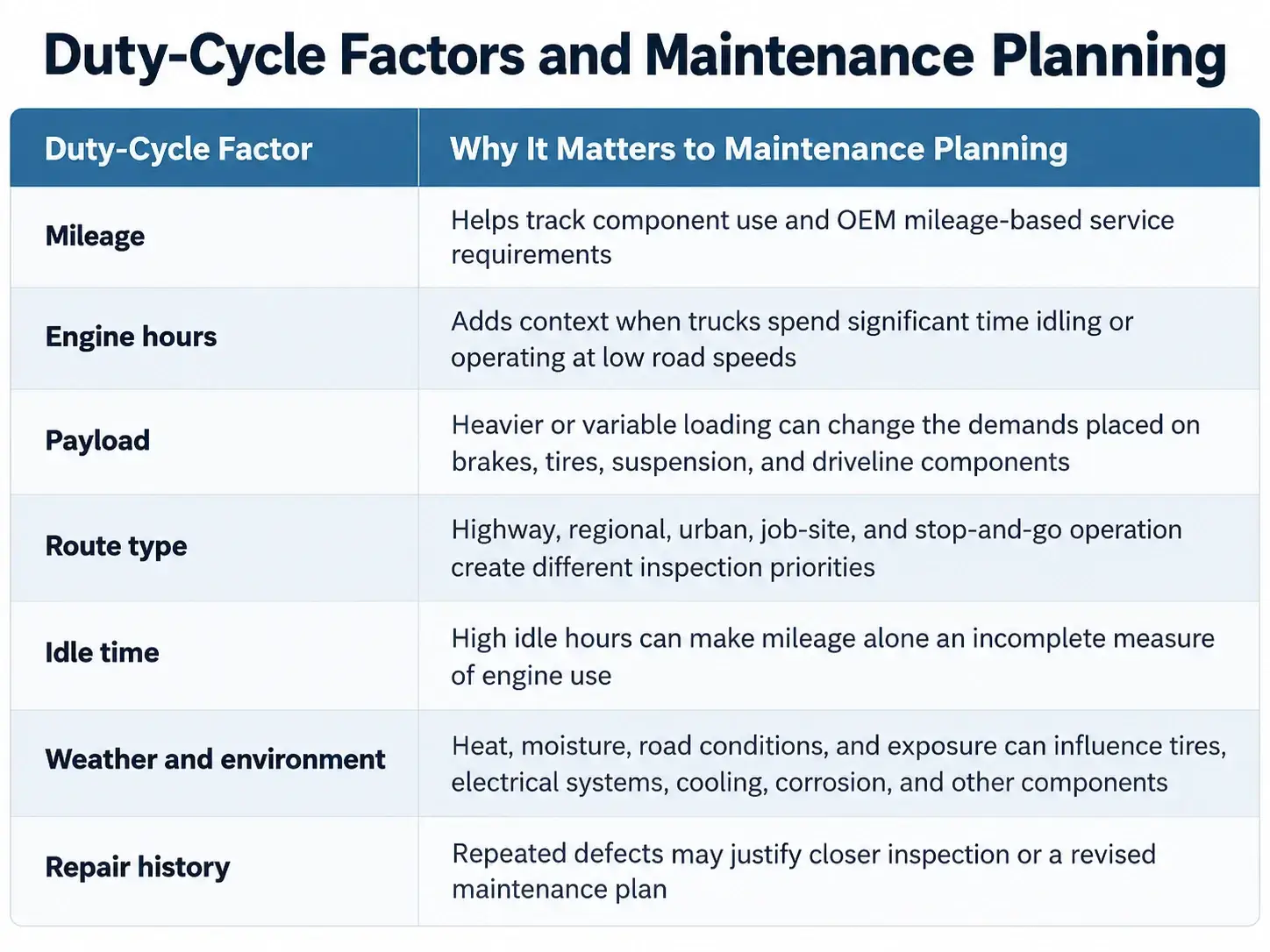
The correct intervals should come from applicable tractor, engine, transmission, axle, tire, and component manufacturer guidance combined with the fleet’s actual operating data.
Separate Tractor Maintenance From Trailer Maintenance
A complete tractor-trailer preventive maintenance program should treat the power unit and trailer as connected assets without assuming their maintenance needs are identical.
Tractor Maintenance Priorities
Depending on configuration and manufacturer requirements, a tractor PM review may include:
- Engine oil and filters
- Fuel and air filtration
- Cooling system condition
- Belts and hoses
- Transmission and driveline
- Steering components
- Suspension
- Brake and air systems
- Tires and wheels
- Wheel ends
- Batteries and charging system
- Lighting and electrical systems
- Visible leaks
- Driver-reported defects
Oil and filter intervals should not be copied from another fleet or generic internet chart. Engine specification, duty cycle, idle hours, operating conditions, and manufacturer recommendations matter.
Oil Can Man’s oil change and preventive maintenance services currently include scheduled maintenance for commercial fleet vehicles through mobile and facility-based service.
Trailer Maintenance Priorities
The trailer requires its own maintenance history and inspection routine.
A trailer PM checklist may address:
- Trailer brakes
- Air lines and connections
- Tires
- Wheels and wheel ends
- Suspension
- Lights
- Wiring and connectors
- Coupling components
- Landing gear where applicable
- Doors and cargo-access hardware
- Floors and structural condition
- Visible damage or leaks
- Defects reported by drivers
Oil Can Man’s current commercial trailer repair services cover preventive maintenance along with doors, lighting, wiring, brakes, floors, and other verified trailer repair needs.
Use Duty Cycle to Change Inspection Priorities
Duty cycle does not automatically tell a fleet manager that a particular component has failed. It tells the maintenance team where closer attention may be justified.
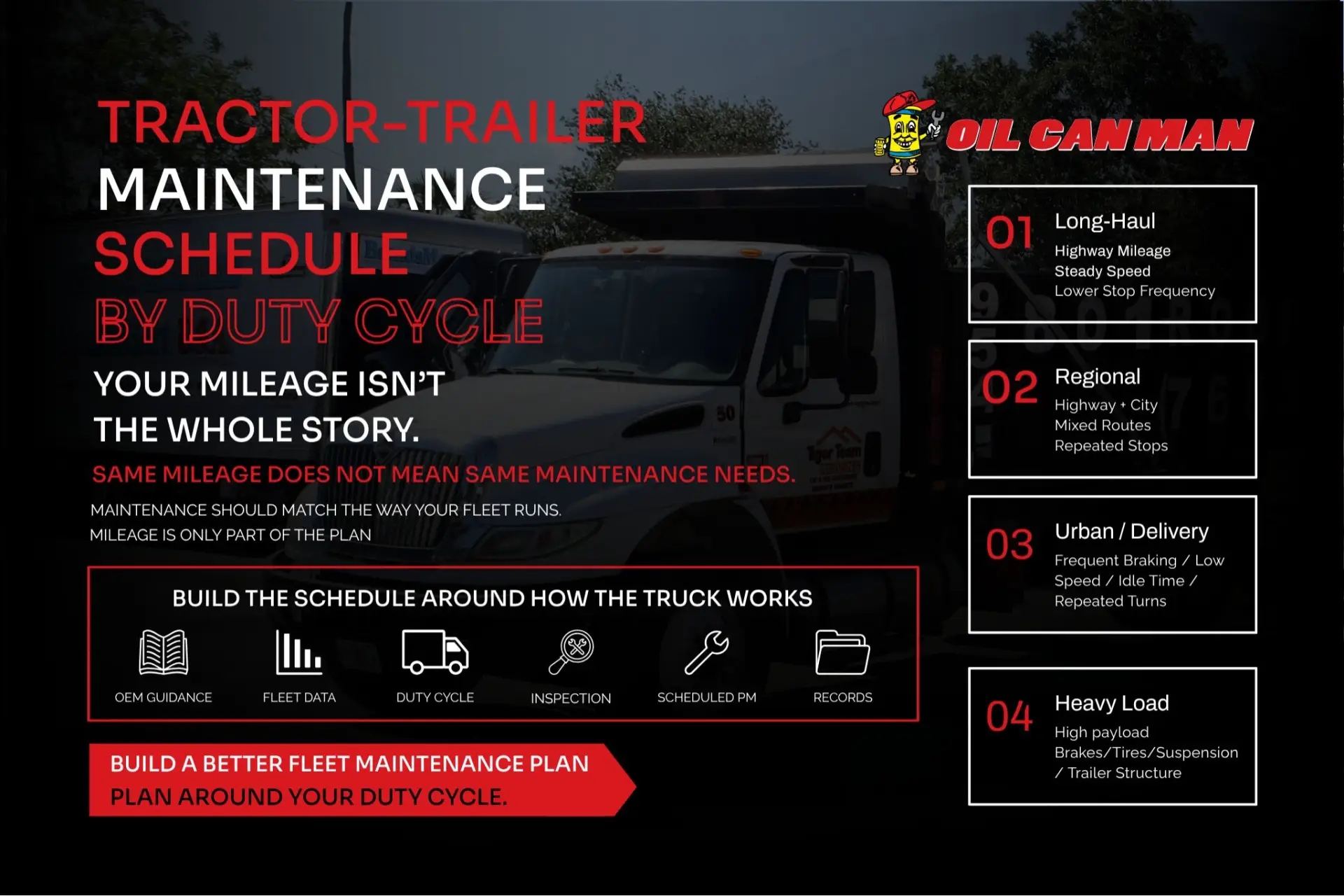
For example, long-haul tractors accumulating steady highway mileage may place more emphasis on mileage-driven OEM service intervals, tire condition, wheel ends, fluids, cooling, and driveline condition.
Regional trucks operating a mixture of highway and urban routes may require maintenance planning that considers both mileage and stop frequency.
Urban or delivery-oriented tractors experiencing repeated braking, turns, idling, and low-speed operation may deserve closer monitoring of brakes, tires, steering, suspension, cooling, and engine-hour-based requirements.
Heavy-load applications may change inspection priorities for brakes, tires, suspension, coupling components, driveline systems, and trailer structure.
The important point is not to create arbitrary “severe duty” mileage numbers. Use the applicable OEM definitions and actual operating data.
Make Maintenance Records Part of the Schedule
A schedule is difficult to manage when fleet managers cannot quickly determine what has already been completed and what is coming due.
Under 49 CFR §396.3, covered motor carriers must systematically inspect, repair, and maintain vehicles under their control. Required records include vehicle identification, a way to show the nature and due date of inspection and maintenance operations, and records showing the date and nature of inspections, repairs, and maintenance.
Review the current 49 CFR §396.3 inspection, repair, and maintenance requirements when building regulatory recordkeeping procedures.
A practical fleet record can also track:
- Current mileage
- Engine hours when applicable
- Last PM date
- Upcoming service due
- Tractor and trailer identification
- Previous defects
- Repeat repairs
- Open recommendations
- Driver-reported concerns
- Repair completion dates
This helps turn fleet truck maintenance from a reactive repair process into a planned operating system.
Is Your PM Schedule Matching the Way Your Fleet Actually Runs?
If tractors and trailers are serviced only when an odometer threshold appears, high-idle time, heavy loads, repeat defects, or trailer-specific needs may be getting lost in the process.
Oil Can Man can review your fleet mix, operating pattern, and current maintenance needs to help determine which scheduled services may be appropriate at your fleet location and which repairs are better suited to facility-based work.
Preventive Maintenance Is Not the Same as a Required Periodic Inspection
Planned preventive maintenance and federally required inspections serve related but different purposes.
FMCSA’s systematic maintenance requirement does not prescribe one universal PM interval. The carrier determines a regular maintenance program appropriate for its vehicles and operation. FMCSA also states that driver inspection requirements and the periodic inspection requirement are additional to systematic maintenance.
For applicable commercial vehicles, FMCSA states that each segment of a combination vehicle must undergo a periodic inspection at least once every 12 months.
That means an annual periodic inspection should not become the fleet’s entire preventive maintenance program.
Oil Can Man currently offers on-site DOT inspection services for commercial fleets in its South Florida service area. Fleet operators remain responsible for determining and meeting all regulatory requirements applicable to their operation. Oil Can Man
Hypothetical Example: A Regional Tractor-Trailer Fleet
Consider a hypothetical fleet operating tractors and trailers across regional delivery routes.
Some tractors accumulate high highway mileage. Others spend substantial time idling at facilities and making repeated urban stops. Certain trailers carry heavier loads, while others experience frequent door cycles and loading activity.
Using one mileage number for every tractor and trailer would ignore those differences.
A fleet manager could instead:
- Start with the applicable OEM maintenance requirements.
- Track mileage and engine hours where relevant.
- Group vehicles by similar duty cycle.
- Review recurring defects and driver reports.
- Maintain separate tractor and trailer histories.
- Schedule suitable preventive work together at the fleet location.
- Route repairs requiring specialized equipment or major disassembly to a facility.
The result is not a universal maintenance interval. It is a maintenance framework tied to how each part of the fleet actually operates.
Know When Mobile Service Fits and When the Shop Makes More Sense
Mobile service can be practical when multiple tractor-trailers need scheduled inspections or maintenance that can safely be completed at the fleet yard.
Facility-based repair may be more appropriate when a job requires major disassembly, structural work, specialized equipment, or extensive repair.
Oil Can Man’s current production website confirms both on-site service across Broward, Miami-Dade, and Palm Beach and facility-based repair at its Fort Lauderdale location. Oil Can Man
The objective is not to force every service call into one model. It is to match the maintenance or repair to the right working environment.
Build a Maintenance Schedule Around the Way Your Fleet Actually Runs
A reliable tractor-trailer maintenance schedule starts with manufacturer guidance, then accounts for actual mileage, engine hours, load, route type, idle time, environment, inspection findings, and repair history.
If several tractors or trailers are approaching service, or your current schedule does not reflect differences in duty cycle, Oil Can Man can discuss how to organize preventive maintenance around your fleet operation.
Call (954) 764-8117 and describe your tractor and trailer types, fleet size, operating area, typical duty cycle, upcoming maintenance needs, and any recurring defects. Oil Can Man can discuss whether the work is appropriate for mobile service or its Fort Lauderdale facility. The production site currently confirms this as the primary service number. Oil Can Man
You can also contact Oil Can Man about your fleet maintenance needs.
Frequently Asked Questions
How often should a tractor-trailer receive preventive maintenance?
There is no single interval that applies to every fleet. Start with manufacturer requirements and adjust planning based on mileage, engine hours, duty cycle, payload, idle time, environment, service history, and inspection findings. FMCSA also recognizes that systematic maintenance intervals can be fleet-specific or vehicle-specific.
What should a tractor-trailer preventive maintenance schedule include?
Typical areas include tractor fluids and filters, cooling, driveline, brakes, air systems, steering, suspension, tires, wheel ends, electrical systems, plus trailer brakes, tires, suspension, air lines, lights, wiring, couplings, doors, floors, and reported defects.
Does the annual periodic inspection replace preventive maintenance?
No. Systematic preventive maintenance under §396.3 and periodic inspection requirements under §396.17 are separate requirements. FMCSA states that applicable commercial vehicles, including each segment of a combination vehicle, require periodic inspection at least once every 12 months.
Can tractor-trailer preventive maintenance be performed at a fleet yard?
Some scheduled maintenance and inspections may be appropriate for mobile service. Work involving major disassembly, structural repair, specialized shop equipment, or extensive repairs may be better suited to a facility. The appropriate service method depends on the actual work required.