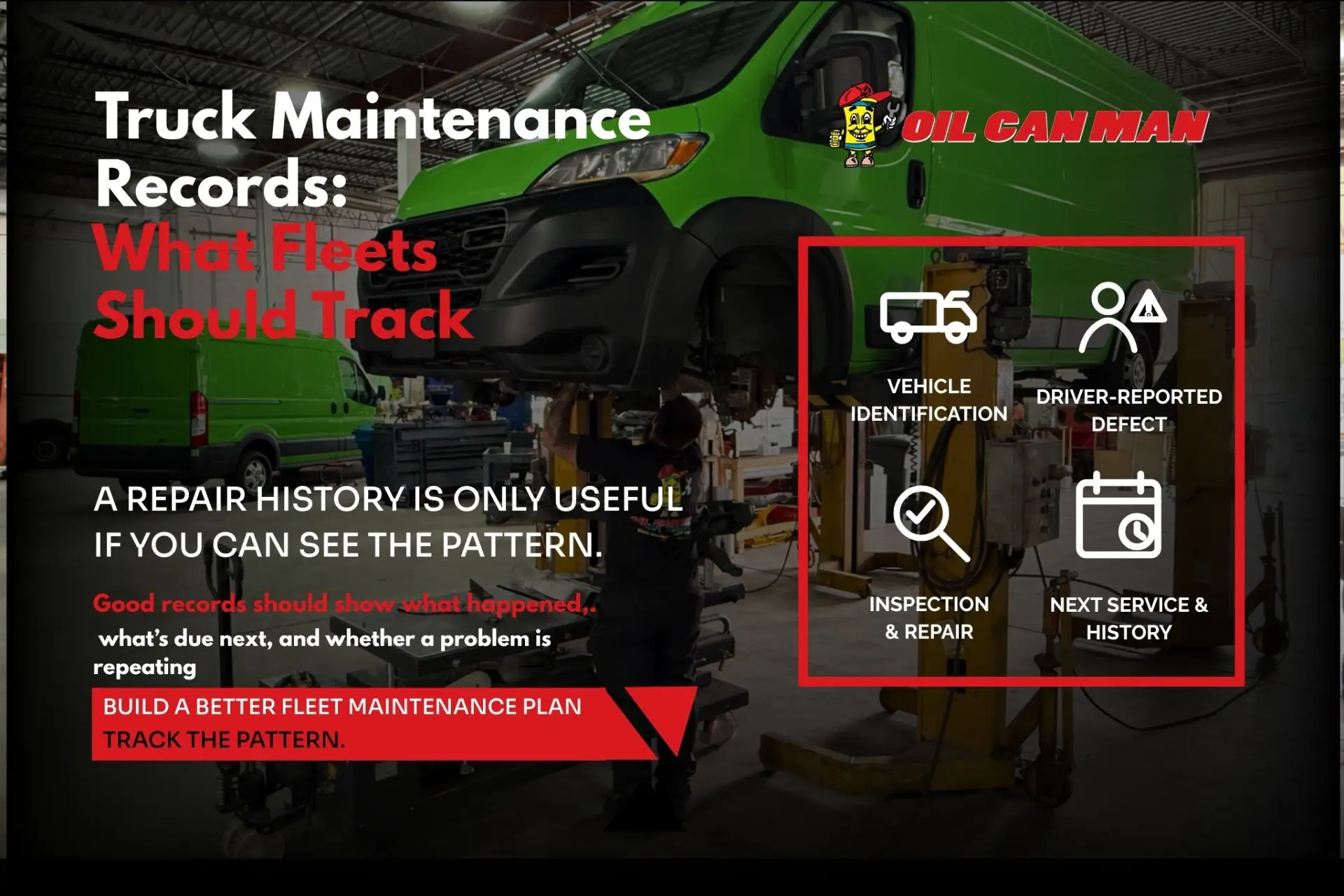
A Repair History Is Only Useful If You Can See the Pattern
A truck returns to service after a repair; the invoice gets filed, and operations move on. Three months later, the same unit develops a similar problem, but the earlier driver complaint is in an email, the inspection notes are on paper, and the previous repair is buried in a vendor invoice. The fleet has records, but it does not have a usable maintenance history.
Good truck maintenance records should let a fleet manager quickly answer three questions: What happened to this vehicle, what is due next, and is a pattern developing? Oil Can Man’s current fleet maintenance service includes preventive maintenance tracking and service reporting for commercial fleets, with mobile and facility-based service across its current South Florida service area.
The goal is not to collect paperwork for its own sake. A useful record system should support maintenance scheduling, repeat-repair detection, communication, regulatory recordkeeping where applicable, and better vehicle lifecycle decisions.
What Every Truck Maintenance Log Should Capture
Whether the fleet uses management software, spreadsheets, work orders, or another system, each vehicle should have a consistent record structure.
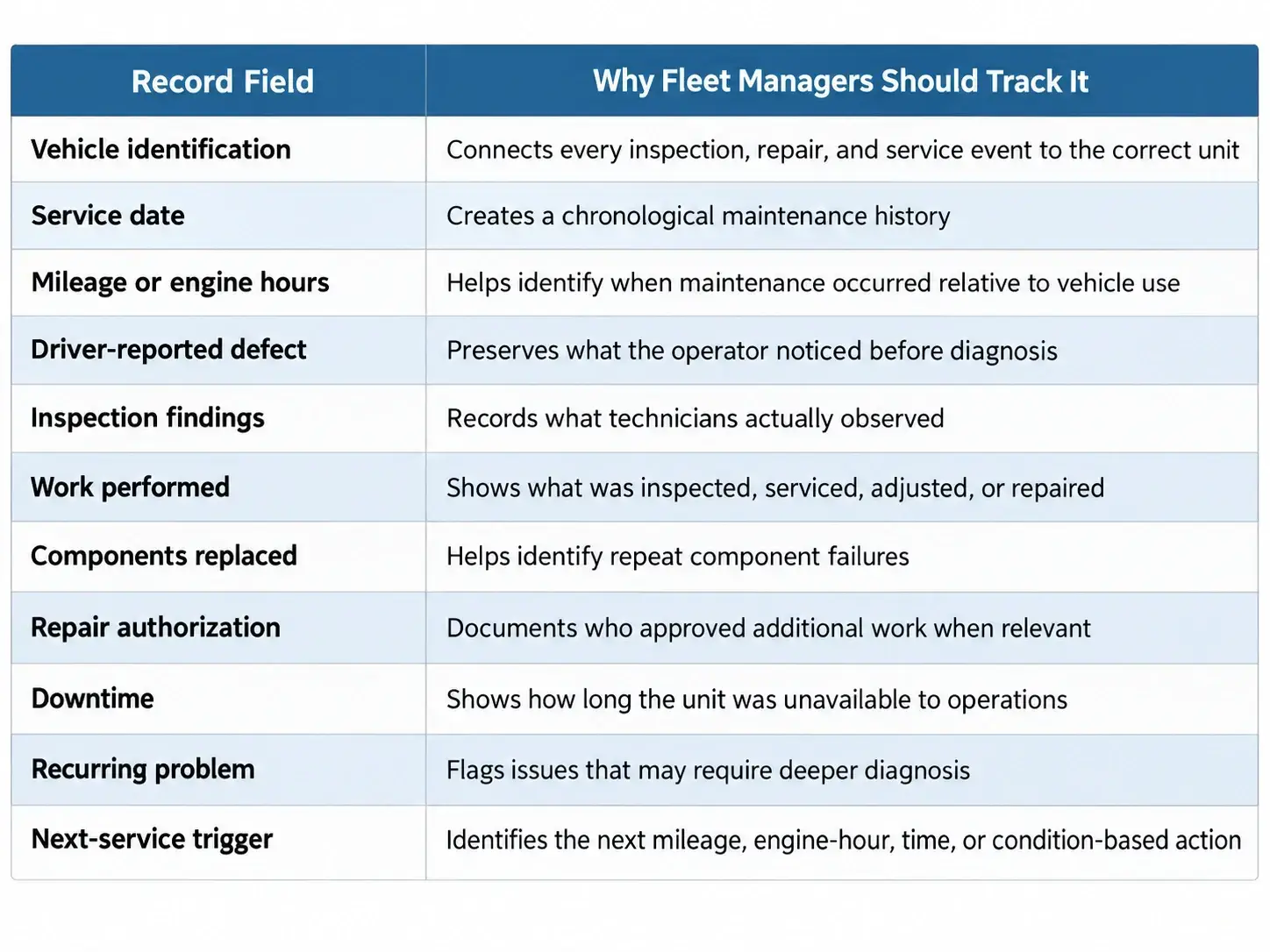
The structure should remain consistent across units. If one technician records “front brake concern,” another writes “brake issue,” and a third uses only an invoice code, trend analysis becomes unnecessarily difficult.
Start With Clear Vehicle Identification
A fleet vehicle maintenance log should make it impossible to confuse one truck with another.
Useful identifying information can include:
- Internal unit number
- VIN or serial number
- Make and model
- Model year
- License plate where useful
- Assigned location or operating group
- Vehicle type or class
For motor carriers subject to 49 CFR §396.3, the current rule requires records for applicable vehicles controlled for 30 consecutive days to include vehicle identification such as company number, make, serial number, and year. If the vehicle is not owned by the carrier, the record must identify the person furnishing it.
The regulatory requirement is the minimum. Fleet managers may track additional fields when they make the maintenance process easier to manage.
Record What the Driver Reported Before the Repair
Drivers often notice a problem before the maintenance department sees it.
A useful record should preserve the original symptom instead of replacing it with the technician’s final repair description.
Examples include:
- Pulling during braking
- New vibration
- Warning light
- Fluid leak
- Difficult starting
- Unusual noise
- Steering change
- Slow hydraulic movement
- Door or liftgate problem
Why keep the original report?
Because the same symptom appearing several times can expose a pattern even when different components were serviced during each visit.
Do not treat the driver’s description as a diagnosis. Record it as an observation, then separately document the inspection findings and repair.
Separate Inspection Findings From Work Performed
One of the most useful improvements in fleet maintenance record-keeping is separating these two fields:
Finding: What condition was discovered?
Action: What was done about it?
For example:
Finding: uneven front tire wear.
Action: tire service completed and front-end inspection recommended.
That is more useful than an entry that only says “tires serviced.”
The same principle applies to brakes, hydraulic systems, suspension, electrical issues, cooling systems, trailers, and other commercial vehicle components.
Tie Preventive Maintenance to a Next-Service Trigger
A service record should not end when today’s work is complete.
It should also tell the fleet manager what happens next.
Depending on the vehicle, manufacturer requirements, and duty cycle, a next-service trigger might be based on:
- Mileage
- Engine hours
- Calendar time
- Inspection findings
- Component condition
- Manufacturer guidance
- Known follow-up work
Oil Can Man’s current preventive maintenance service supports scheduled maintenance for commercial fleet vehicles. The company’s current fleet-service page also states that service intervals are tracked and vehicle reports are provided.
Avoid creating a universal interval for every truck. Vehicle configuration, duty cycle, operating environment, mileage, engine hours, load, and prior service history can all influence maintenance planning.
Use Records to Identify Repeat Repairs
A good truck maintenance log should make recurring problems visible without requiring someone to search through months of invoices.
Consider tracking categories such as:
- Brake-related repairs
- Tires and abnormal wear
- Cooling-system issues
- Electrical faults
- Starting or charging problems
- Hydraulic leaks
- Steering or suspension repairs
- DPF or emissions concerns
- Trailer electrical or brake issues
- Repeated fluid leaks
That history becomes particularly useful when fleet managers review maintenance KPIs. Oil Can Man’s existing fleet maintenance KPI guide discusses service history, repair frequency, downtime, PM compliance, and other information that can help identify reliability trends.
When Your Records Are Spread Across Invoices, Emails, and Driver Notes
If your team has to search several places to reconstruct the history of one vehicle, the problem is not simply administrative.
Important repair patterns may be harder to recognize, upcoming maintenance may be less visible, and conversations between drivers, managers, and service providers become more difficult.
Oil Can Man can discuss how its fleet maintenance program handles service reporting, preventive maintenance tracking, and repair needs while determining which services may be appropriate at your South Florida fleet location and which require facility-based repair.
Track Downtime Alongside the Repair
The repair itself tells only part of the operational story.
For each maintenance event, fleets may benefit from recording:
- Date the problem was reported
- Date service began
- Date the unit returned to service
- Whether towing was required
- Whether the repair was planned or unplanned
- Whether an approval delay occurred
- Whether follow-up work remains open
This does not mean every business needs a sophisticated analytics system.
Even basic vehicle maintenance tracking can reveal that one truck is becoming unavailable more frequently than similar units.
That information can support scheduling, budgeting, and repair-versus-replacement discussions.
Maintenance History Can Support Vehicle Lifecycle Decisions
Mileage and age do not always tell fleet managers whether a unit should remain in service.
Maintenance history adds another layer.
Questions the record should help answer include:
- How often is the vehicle returning for repair?
- Are the same systems failing repeatedly?
- Is downtime becoming more frequent?
- Are major components beginning to require work?
- Is preventive maintenance being completed consistently?
- Are unresolved recommendations accumulating?
Oil Can Man’s fleet vehicle replacement strategy guide discusses using maintenance history, downtime, repair frequency, utilization, and other operating data when evaluating repair-versus-replacement decisions.
Records do not make the decision automatically. They give managers better evidence.
Three Repairs That Look Unrelated
Consider a hypothetical delivery fleet.
Unit 27 develops a steering complaint in January. The driver report is stored in an email, while the repair invoice simply lists replaced components.
In March, another driver reports abnormal front tire wear. That note is entered into a separate spreadsheet.
In May, the truck returns for another front-end concern.
Viewed separately, those events can look like three routine maintenance issues.
A centralized record showing the dates, mileage, driver complaints, inspection findings, parts replaced, and technician recommendations makes it much easier for the fleet manager to see that the same area of the vehicle has generated repeated attention.
That does not prove a specific mechanical cause. It tells the maintenance team that the history deserves review during the next diagnosis.
What FMCSA Requires for Applicable Maintenance Records
For motor carriers subject to 49 CFR §396.3, current federal rules require systematic inspection, repair, and maintenance of vehicles under the carrier’s control. For vehicles covered by the recordkeeping provision, required records include:
- Vehicle identification
- A means of showing the nature and due date of inspection and maintenance operations
- The date and nature of inspections, repairs, and maintenance
The current regulation states that these records must generally be retained where the vehicle is housed or maintained for one year, and for six months after the vehicle leaves the carrier’s control.
Fleet managers should review the current 49 CFR §396.3 regulation directly when establishing regulatory procedures.
This article addresses maintenance records under §396.3. Other inspection or transportation records may have different requirements.
Can Fleet Maintenance Records Be Digital?
Yes, under FMCSA guidance, computerized inspection and maintenance records are permissible if the required minimum information is included and the records can be reproduced on demand.
That gives fleets flexibility to use:
- Fleet management software
- Maintenance databases
- Digital work-order systems
- Structured spreadsheets
- Other reproducible electronic systems
The technology matters less than consistency.
A sophisticated platform with incomplete data can be less useful than a simple system that every driver, manager, and service provider uses correctly.
Build Records That Help You Make the Next Maintenance Decision
Strong truck maintenance records should do more than prove that work occurred. They should help your team understand what happened, what is due next, which problems are repeating, and which vehicles deserve closer attention.
Oil Can Man provides mobile fleet maintenance across Broward, Miami-Dade, and Palm Beach, backed by its Fort Lauderdale repair facility for work that requires a shop environment. Its current website also identifies PM tracking, repair logging, and service reporting as part of its fleet support approach.
Call (954) 764-8117 and describe your fleet size, vehicle types, current maintenance process, and upcoming service needs. Oil Can Man can discuss an appropriate preventive maintenance and repair approach for your operation.
You can also use the Oil Can Man contact page to discuss your fleet service needs.
Frequently Asked Questions
What should be included in truck maintenance records?
A practical record should include vehicle identification, service date, mileage or engine hours, driver-reported defects, inspection findings, work performed, components replaced, downtime, recurring issues, and the next maintenance trigger.
How long must commercial vehicle maintenance records be kept?
For motor carriers covered by 49 CFR §396.3, required records must generally be retained where the vehicle is housed or maintained for one year and for six months after the vehicle leaves the carrier’s control. Other records may have different retention requirements.
Can truck maintenance records be stored electronically?
Yes. FMCSA guidance permits computerized inspection and maintenance records when the required information is included and the records can be reproduced on demand.
Why should fleets track repeat repairs?
A consistent service history can help managers recognize recurring symptoms, repeated component work, downtime patterns, and vehicles that may need deeper diagnosis or lifecycle review.