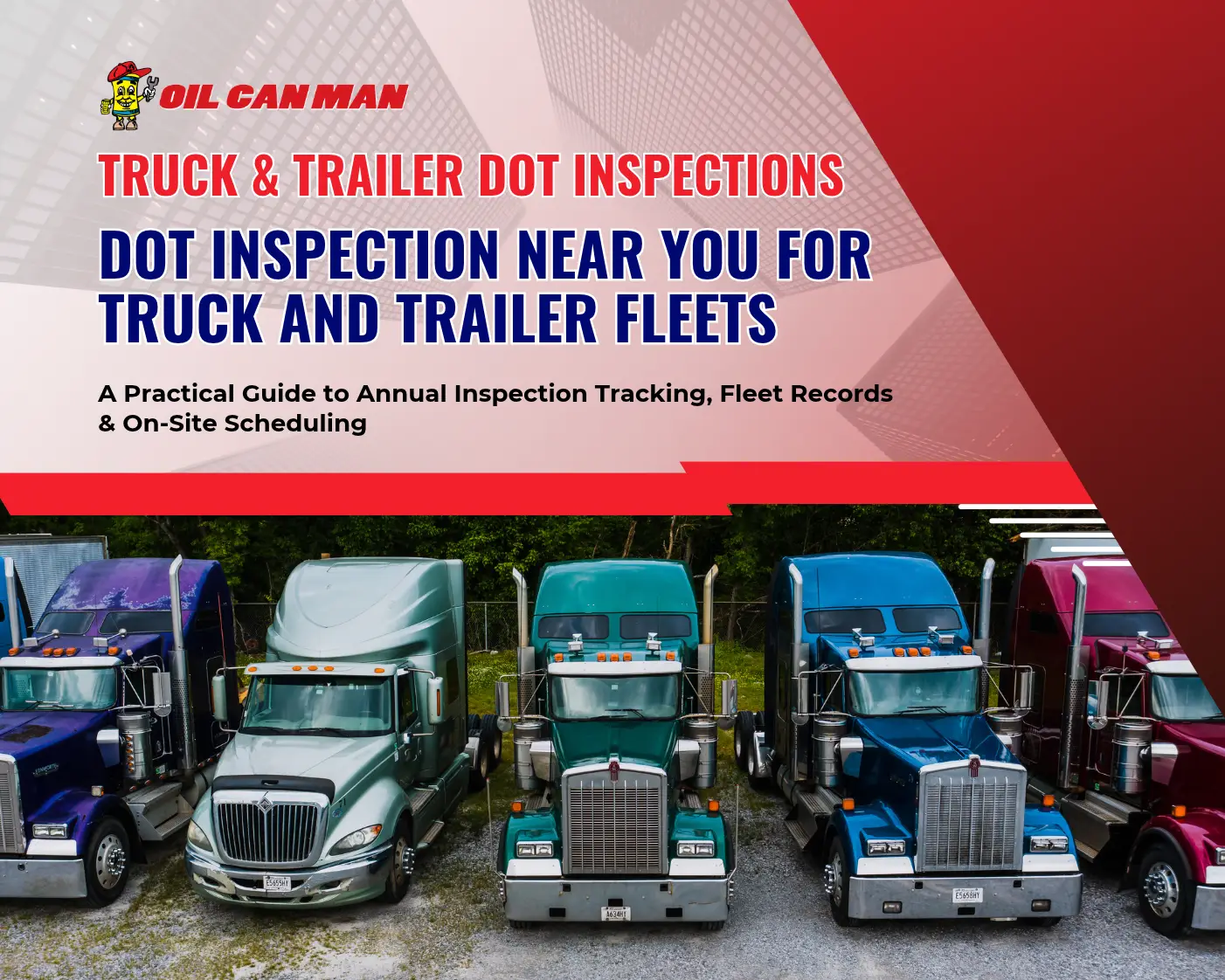
DOT Inspection Near You for Truck and Trailer Fleets
A tractor may have a current annual DOT inspection while the trailer attached to it is overdue. For a fleet manager, that mismatch can affect dispatch decisions, compliance records, and delivery schedules. If you are looking for a DOT inspection near you, start by checking the inspection status of every applicable truck and trailer separately, rather than treating a combined unit as one inspected asset.
Oil Can Man offers on-site DOT inspection services for commercial trucks and trailers in South Florida. This guide explains how to track separate inspection dates, organize the supporting records, and prepare multiple fleet units for an inspection appointment at an eligible yard or work location.
OCM / FLEET COMPLIANCE
01 / DOT INSPECTION PLANNING
Tractor Inspected. But Is Your Trailer Due?
Trucks and trailers need their own inspection records. Avoid last-minute scheduling problems by reviewing upcoming deadlines and coordinating suitable on-site DOT inspections for your South Florida fleet.
Why Trucks and Trailers Need Separate Inspection Records
Trucks and trailers do not always stay together. A dispatcher may assign the same trailer to several trucks, move it between terminals, or use a different trailer for a return load. Consequently, the inspection date for the truck pulling a load tells you nothing by itself about the trailer’s last annual inspection.
Under 49 CFR §396.17, the federal periodic inspection requirement applies to each covered commercial motor vehicle in a combination. That includes each applicable tractor, semitrailer, full trailer, and converter dolly. Inspecting a tractor does not automatically inspect the trailer.
A useful fleet register should therefore give each power unit and each trailer its own record. Identify the asset with its VIN and internal unit number, then track the last passing inspection date, next planning deadline, inspection proof, operating yard, and any follow-up findings. This is particularly important for a semi-truck and trailer DOT inspection program with frequently exchanged equipment.
For a detailed list of vehicle systems inspectors review, use Oil Can Man’s DOT inspection checklist for commercial trucks and trailers. This article focuses on scheduling and individual unit records instead of repeating that checklist.
Understand Annual DOT Inspection Requirements
For covered vehicles, the federal rule generally requires a successful periodic inspection at least once during the preceding 12 months, based on the minimum standards in Appendix A to Part 396. The inspection must be performed by a qualified inspector under 49 CFR §396.19. Equivalent mandatory inspection programs and other applicable rules can affect how requirements are satisfied; check the rules governing your vehicles and operations.
An annual commercial truck inspection is not the same as a driver’s pre-trip assessment, a defect-related Driver Vehicle Inspection Report (DVIR), scheduled preventive maintenance, or an enforcement roadside inspection. A valid annual inspection does not remove the ongoing responsibility to operate and maintain equipment safely.
Under 49 CFR §396.17, acceptable documentation of the passing periodic inspection must be on the vehicle, such as the inspection report or a qualifying sticker or decal containing required information. Under 49 CFR §396.21, the responsible entity must retain the inspection report for 14 months and make it available to authorized officials on demand. The report identifies the vehicle, inspection date, inspector, components reviewed, findings, and certification.
These are two different checks for a fleet coordinator: Is this specific unit currently inspected? And can the required supporting records be produced? A decal alone should not replace the fleet’s documented inspection history.
Track Inspection Dates Across Multiple Fleet Units
Maintain one master register with a separate row for every applicable tractor and trailer. A spreadsheet can work for a smaller fleet if it is consistently updated and supporting reports are easy to retrieve. Larger operations may prefer fleet management software with alerts and document storage.
Field to trackWhy it mattersAsset type and internal IDDistinguishes tractors from individual trailersVIN, plate, and assigned yardIdentifies the exact unit and its locationLast passing inspection dateEstablishes the inspection historyNext inspection planning dateSupports advance appointment coordinationReport and proof locationMakes documentation retrievableOpen defects and repair statusSeparates inspection results from required follow-upResponsible fleet coordinatorGives each upcoming appointment an owner
Review the register before assigning equipment to routes. A trailer that changes drivers, power units, or locations should keep the same inspection record. If a unit lacks acceptable proof or has passed beyond its applicable inspection window, resolve that status before it is put into service. For broader recordkeeping practices, see Oil Can Man’s truck maintenance records guide.
Example: Scheduling Eight Tractors and Fourteen Trailers
Consider a hypothetical logistics company operating eight tractors and fourteen semitrailers from two South Florida yards. Its fleet manager reviews inspection dates on November 19, 2026, and groups units by the next planning deadline.
| Equipment Group | Units | Last Passing Inspection | Illustrative Next Planning Date | Priority |
|---|---|---|---|---|
| Trailers TR01–TR05 | 5 | Nov. 25, 2025 | Nov. 25, 2026 | First: arrange inspection promptly |
| Tractors T01–T03 | 3 | Nov. 27, 2025 | Nov. 27, 2026 | Next: coordinate with trailer visit |
| Trailers TR06–TR14 | 9 | Mar. 15, 2026 | Mar. 15, 2027 | Plan a later batch |
| Tractors T04–T08 | 5 | Apr. 10, 2026 | Apr. 10, 2027 | Plan a later batch |
Hypothetical dates and IDs, not a real customer record. The grouped view is only a scheduling summary; each of the 22 units still requires its own identification, inspection evidence, and date verification. Exact compliance timing depends on the applicable inspection program and rule.
The immediate job is to locate the five trailers and three tractors approaching their deadlines. The manager checks which units are available at the same yard, confirms their records, and asks for a mobile inspection appointment that covers the appropriate equipment. Later groups can be planned around dispatch and maintenance schedules.
Coordinate On-Site Truck and Trailer Inspections
An on-site DOT inspection South Florida appointment can be practical when several trucks and trailers are at one accessible location. Oil Can Man advertises mobile DOT inspection for trucks and trailers across Broward, Miami-Dade, and Palm Beach counties. The number of units, their configurations, site conditions, and inspector availability should be discussed before confirming an appointment.
A fleet manager can make scheduling more efficient by grouping units by yard and due date, identifying which trailers are empty and accessible, and reserving a workable inspection area. Make sure the planned visit accounts for both trailers and power units, not simply the trucks expected to be parked that day.
If an inspector identifies a deficiency, treat the finding as a separate repair or follow-up decision. Do not assume an inspection appointment guarantees a passing result. Some work may be eligible for mobile service; more involved repairs may need Oil Can Man’s Fort Lauderdale shop. For related preventive maintenance planning, see the tractor-trailer maintenance schedule by duty cycle.
Challenges to address before booking
- Trailer swaps: Check the individual trailer’s record even when the assigned tractor is current.
- Different yards: Confirm where each unit will physically be available on inspection day.
- Missing paperwork: Recover the inspection report or acceptable evidence for each unit.
- Different deadlines: Group appointments by approaching dates without overriding unit-level tracking.
- Open defects: Tell the provider about known issues, and determine whether repair must occur before a passing inspection.
02 / ON-SITE DOT INSPECTIONS
Multiple Trucks and Trailers Due for Inspection?
Coordinating separate inspection dates across busy fleet yards can be difficult. Oil Can Man offers mobile DOT inspections for commercial trucks and trailers. Share your unit counts, locations, and preferred dates to discuss an efficient inspection schedule.
TRACTORS / TRAILERS / DUE DATES / YARD LOCATION
NEXT STEP
Truck and Trailer Fleet Inspection Scheduling Checklist
Before contacting Oil Can Man about fleet DOT inspection scheduling, prepare the following:
- List every tractor and trailer requiring inspection, with unit IDs and VINs.
- Confirm the last passing inspection date and available proof for each unit.
- Flag units with approaching deadlines, missing evidence, or overdue status.
- Note the operating yard and expected availability for each unit.
- Identify vehicle and trailer configurations, including combination equipment.
- Gather known defect reports and any outstanding repair needs.
- Provide a proposed date range and a contact person who can access the vehicles.
- Ask how inspection findings, passing documentation, and follow-up work will be handled.
This information helps the service team discuss scope and scheduling. It does not replace the carrier’s legal responsibility to maintain inspection records and keep applicable vehicles in safe operating condition.
Frequently Asked Questions
Does each trailer need a separate annual DOT inspection?
Yes, when the trailer is a covered commercial motor vehicle under the applicable rule. Federal periodic inspection requirements address each vehicle in a combination, so a tractor’s passing inspection does not automatically establish that its trailer has passed.
How often do covered commercial trucks and trailers need periodic inspections?
Generally, at least once during the preceding 12 months under 49 CFR §396.17. An equivalent inspection program may apply in some jurisdictions. Check the specific vehicle and operating requirements when setting internal deadlines.
How long must annual DOT inspection reports be retained?
Under 49 CFR §396.21, the responsible entity must generally retain the original or a copy of the periodic inspection report for 14 months. The vehicle must also carry acceptable evidence of its most recent passing periodic inspection.
Can multiple trucks and trailers be inspected at our fleet yard?
Oil Can Man offers on-site DOT inspection services in its verified South Florida service area. Share the number and type of vehicles, yard address, access conditions, and requested dates so the team can discuss service suitability and scheduling.
What should I send when requesting a fleet inspection appointment?
Provide your fleet count, separate tractor and trailer IDs, last inspection dates, yard locations, equipment configurations, known defects, and preferred appointment window. This makes it easier to plan the right number of unit inspections rather than overlooking a trailer.
03 / DOT INSPECTION SCHEDULING
Keep Every Truck and Trailer Inspection Accounted For.
Missing inspection records or approaching deadlines can disrupt fleet scheduling. Oil Can Man provides on-site DOT inspections for commercial trucks and trailers across South Florida. Tell us how many units you operate, where they’re located, and when inspections are needed so our team can discuss scheduling options.
SOUTH FLORIDA / MOBILE TRUCK & TRAILER INSPECTIONS
OCM / SERVICE COORDINATES
Fort Lauderdale Service Hub
OUR FACILITY
Oil Can Man
730 NW 7th Street
Fort Lauderdale, FL 33311
Oil Can Man provides mobile DOT inspections for commercial trucks and trailers across Broward, Miami-Dade, and Palm Beach. Contact our team with your fleet size, inspection deadlines, and yard location to coordinate on-site inspections or discuss service at our Fort Lauderdale facility.